
Role Definition and Scope
In Vietnam’s dynamic and rapidly expanding IT sector, the delineation of Human Resources roles, particularly between an HR Manager in a Small and Medium-sized Enterprise (SME) and an HR Director in a large Corporate, unveils a spectrum of responsibilities, strategic focuses, and hierarchical placements. Understanding these Differences between the SMEs’ HR Manager and the Corporates’ HR Director in IT field in Vietnam is crucial for both aspiring HR professionals and IT business leaders looking to optimize their human capital strategies. While both roles are fundamental to attracting, retaining, and developing talent, their day-to-day operations, scope of influence, and strategic impact are shaped significantly by the organizational context and scale. SMEs often demand a versatile, hands-on HR generalist, whereas large corporates necessitate a strategic leader capable of driving complex, multi-faceted HR initiatives across diverse departments and geographies. This section explores these distinctions, providing clarity on the specific challenges and opportunities inherent in each role within the unique landscape of Vietnam’s IT industry.

1. Defining the HR Manager’s day-to-day in IT SMEs
The HR Manager in a Vietnamese IT SME typically operates as a vital, multi-faceted generalist, often serving as the sole HR professional or leading a very small team. Their day-to-day responsibilities are heavily operational, encompassing a broad range of tasks critical for the company’s immediate growth and stability. Recruitment, especially for highly sought-after IT talent like developers, data scientists, and QA engineers, is frequently a top priority, demanding creative sourcing strategies and direct engagement with candidates. Beyond talent acquisition, the HR Manager is deeply involved in onboarding processes, ensuring new hires are integrated smoothly into the fast-paced IT environment. They manage compensation and benefits administration, often designing competitive packages to attract and retain skilled professionals within limited budgets. Employee relations, including conflict resolution and fostering a positive workplace culture, also fall under their purview. Furthermore, they oversee performance management, learning and development initiatives (which might involve arranging external training or internal skill-sharing sessions), and ensuring compliance with Vietnam’s labor laws. The role requires immense adaptability, a hands-on approach, and a direct understanding of the business’s technical needs and market challenges, particularly in securing the right talent for the Vietnamese IT labor market.
2. Strategic oversight of a Corporate HR Director in Vietnam’s IT
In contrast, a Corporate HR Director within Vietnam’s larger IT enterprises or multinational corporations (MNCs) assumes a significantly more strategic and leadership-oriented role. Their focus shifts from day-to-day tactical execution to long-term planning and organizational development. This position involves crafting comprehensive HR strategies that align with global business objectives and local market nuances. Key responsibilities include designing and implementing robust talent acquisition strategies for high-volume recruitment or specialized leadership roles, developing succession planning frameworks for critical positions, and overseeing large-scale organizational development initiatives. The HR Director is instrumental in driving HR digitalization, implementing advanced HRIS, and leveraging data analytics to inform strategic decisions. They often lead diverse HR teams, comprising specialists in talent acquisition, compensation & benefits, HR business partnering, and learning & development, empowering them to execute operational tasks. Influencing C-suite executives on critical human capital decisions, managing change during mergers or acquisitions, and ensuring compliance across complex regulatory landscapes are also central to their role. Their impact is felt across multiple departments and often involves collaborating with regional or global HR counterparts, positioning them as a strategic partner in driving the corporation’s success in Vietnam’s competitive IT ecosystem.
3. Organizational structure and reporting lines for HR roles
The organizational structure and reporting lines for HR professionals in Vietnam’s IT sector vary significantly based on company size. In SMEs, the HR Manager typically enjoys a direct reporting line, often to the CEO, Founder, or Head of Operations. This flat structure allows for swift decision-making and direct influence on the company’s direction, reflecting the HR Manager’s crucial, hands-on role in a smaller, agile team. They are often viewed as a key advisor to leadership on all people-related matters, reflecting the intimate connection between HR functions and immediate business outcomes in lean organizations. The team supporting them might be minimal, perhaps one or two HR assistants, making the HR Manager responsible for the full lifecycle of HR processes.
Conversely, in large Corporates, the HR Director operates within a more layered and specialized organizational hierarchy. They might report to a Country General Manager, a regional HR Head, or even directly to a Global Chief Human Resources Officer (CHRO). Below the HR Director, there are often dedicated departments for various HR functions – such as Talent Acquisition, Compensation & Benefits, HR Business Partners (HRBPs) assigned to specific business units, and Learning & Development. This structure allows for deep specialization and scalability of HR services across a larger workforce. The HR Director’s role then becomes one of strategic leadership, overseeing these specialized teams, ensuring alignment with corporate policies, and driving HR initiatives that support the company’s broader strategic goals. This hierarchical positioning underscores the HR Director’s role as a strategic enabler, impacting overall organizational effectiveness rather than just managing daily HR operations.
Strategic Impact and Decision-Making
The strategic impact and decision-making authority of Human Resources leaders in Vietnam’s dynamic IT sector diverge significantly between agile Small and Medium-sized Enterprises (SMEs) and structured multinational corporations. Understanding these differences between the SMEs’ HR Manager and the Corporates’ HR Director in IT field in Vietnam is crucial for appreciating their respective contributions to business objectives and overall company growth. While both roles are pivotal to an organization’s success, their spheres of influence, operational autonomy, and strategic involvement are shaped by the scale and nature of their respective organizations.
1. HR’s role in business strategy within IT SMEs
In the vibrant landscape of Vietnamese IT SMEs, the HR Manager often embodies a highly integrated and hands-on strategic partner. Operating within lean structures, these HR professionals are typically involved in shaping business objectives from their inception. Their proximity to the founders and executive team means strategic discussions often include HR insights on talent availability, organizational capability, and cultural fit. This direct access allows for rapid decision-making and immediate implementation of HR strategies that directly support product development, market entry, and scaling initiatives. Key responsibilities extend beyond traditional HR functions, encompassing elements of organizational design, talent development in IT, and fostering an agile company culture essential for tech startups.
For an IT SME, HR’s strategic role is intrinsically linked to its survival and growth. The HR Manager actively contributes to defining the company’s value proposition for potential employees, developing competitive compensation structures for scarce IT talent, and building robust talent acquisition IT Vietnam pipelines. Their ability to quickly adapt HR practices to market changes and internal needs – be it a new project requiring specific skills or a sudden growth spurt – directly impacts the SME’s ability to innovate and compete. This often means a broader scope of influence where the HR manager acts as a true business advisor, guiding leadership on human capital implications of strategic shifts, focusing on employee engagement IT sector, and ensuring the company’s workforce can meet evolving technological demands.
2. Corporate HR Director’s influence on overall company goals
Conversely, within large, structured IT corporations in Vietnam, the HR Director operates at a different strategic altitude. While their influence is profound, it’s typically exerted through established corporate governance, multi-layered decision-making processes, and a broader, often global, mandate. A Corporate HR Director’s primary focus is on long-term corporate HR strategy Vietnam, ensuring alignment with global HR policies and driving initiatives that impact thousands of employees across diverse business units. Their strategic involvement encompasses significant areas like organizational development IT, succession planning for critical leadership roles, driving large-scale change management programs, and ensuring compliance with complex labor laws and international standards.
The HR Director in a corporate setting contributes to overall company goals by shaping the enterprise’s human capital strategy, which supports the overarching business vision. This includes designing robust performance management systems, overseeing significant talent development and retention programs, and implementing advanced HR technology solutions. Their influence is felt through policy formulation, strategic workforce planning, and fostering an inclusive and diverse workplace culture across the organization. While direct operational involvement in day-to-day HR tasks is minimal, their directives and frameworks empower HR teams across different departments to execute localized strategies that adhere to the corporate HR strategy, ensuring consistency and scalability.
3. Decision-making authority and autonomy in IT HR roles
The decision-making authority and autonomy between these two HR leadership roles present a clear contrast. An HR Manager in an IT SME often enjoys significant operational autonomy. They can make swift decisions regarding recruitment processes, employee benefits, training programs, and conflict resolution without extensive layers of approval. This speed and flexibility are crucial in a fast-paced environment where immediate action can prevent talent loss or capitalize on market opportunities. Their decisions have a direct, visible, and immediate impact on a smaller, closely-knit workforce, often directly influencing team morale and project success. This hands-on autonomy extends to IT talent acquisition strategies, where quick pivots are often necessary.
In contrast, a Corporate HR Director’s decisions, while far-reaching, are typically made within a more structured framework, requiring careful deliberation, extensive data analysis, and often multi-level approvals. Their autonomy is more strategic and policy-driven rather than operational. Decisions on HR policy development, large-scale organizational restructuring, or the implementation of new HR systems demand collaboration with various executive stakeholders, legal teams, and global HR counterparts. While individual decisions may take longer to finalize, their impact is monumental, affecting the entire organizational ecosystem. Addressing HR challenges in Vietnam’s IT sector at this level often involves complex, long-term strategic initiatives rather than immediate tactical adjustments.
In summary, while both HR Manager in SMEs and HR Director in corporations are vital, their strategic impact and decision-making authority are intrinsically shaped by their organizational context. The SME HR Manager thrives on agility and direct impact, while the Corporate HR Director navigates complex structures to steer enterprise-wide human capital strategies, each playing a critical, albeit different, role in the success of Vietnam’s burgeoning IT industry.
Talent Acquisition and Development
In Vietnam’s vibrant and rapidly expanding IT sector, the pursuit and cultivation of top-tier talent present distinct challenges and opportunities depending on an organization’s size. From agile start-ups and small to medium-sized enterprises (SMEs) to sprawling multinational corporations, the strategic approaches to recruiting, onboarding, and fostering employee growth diverge significantly. Understanding these Differences between the SMEs’ HR Manager and the Corporates’ HR Director in IT field in Vietnam is crucial for navigating the competitive landscape and ensuring sustainable human capital development.
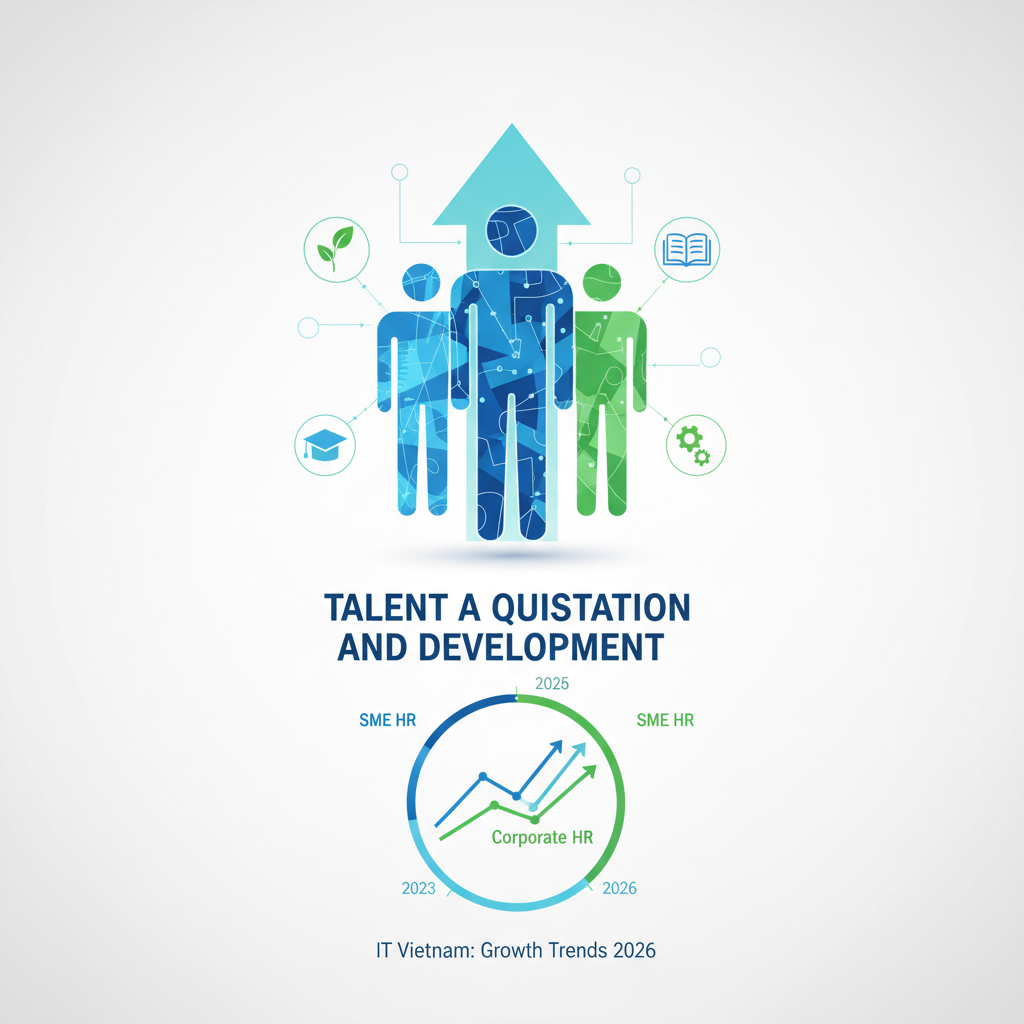
1. IT recruitment challenges and strategies for SMEs in Vietnam
For small tech firms and IT talent acquisition Vietnam SMEs, the HR Manager often juggles multiple roles, acting as a generalist. Their primary hurdle in recruitment is often fierce competition for skilled developers and engineers, coupled with limited employer brand recognition and smaller budgets compared to industry giants. SMEs face significant HR challenges Vietnam tech due to the high demand for specialized skills and candidates often favoring the stability and perks of larger companies. To overcome these, small tech firm recruitment strategies often lean into agility, culture, and unique value propositions. They might emphasize a flat hierarchy, opportunities for rapid career progression, direct impact on products, and a close-knit team environment. Leveraging professional networks, participating in local tech meetups, and offering flexible working arrangements are common tactics. Many also adopt a fast, streamlined interview process to secure candidates quickly before larger competitors can intervene. Focusing on potential over immediate perfect fit and investing in internal upskilling also becomes a viable HR Manager SME Vietnam strategy for onboarding IT professionals efficiently.
2. Large-scale talent acquisition and retention in Corporate IT
In contrast, large corporations operate with a more specialized HR Director Corporate IT Vietnam and dedicated talent acquisition teams. Their advantages include strong employer branding, substantial recruitment budgets, and sophisticated Applicant Tracking Systems (ATS). However, they face their own set of unique challenges. Attracting and integrating a high volume of diverse IT professionals across multiple departments or even global locations requires robust and standardized processes. Retaining top talent amidst internal bureaucracy and the allure of dynamic smaller firms is a continuous effort. Enterprise IT HR strategies focus heavily on comprehensive employer branding campaigns, often highlighting career paths, advanced technologies, and extensive benefits packages including health insurance, stock options, and global mobility opportunities. They invest in mass recruitment events, partnerships with universities, and a structured onboarding experience designed to integrate new hires into a complex organizational structure. For employee retention IT Vietnam, corporations often rely on performance management systems, regular training, and clear pathways for internal promotion, aiming to offer long-term stability and growth.
3. Employee development and training programs in different settings
The approach to fostering tech talent development Vietnam also varies greatly. In SMEs, employee development is frequently organic and often involves on-the-job learning, mentorship by senior colleagues, and access to online courses or small, specialized workshops as budget permits. The HR Manager SME Vietnam might identify a specific skill gap and source a targeted, cost-effective training solution. This approach often leads to highly adaptable employees who wear many hats, crucial for a growing company. The focus is on immediate application and direct impact.
Conversely, large enterprises typically boast extensive and structured employee development and training programs. These can range from internal corporate universities and academies offering proprietary courses, leadership development programs, and mentorship initiatives, to funding for industry certifications and higher education. The HR Director Corporate IT Vietnam often oversees substantial budgets allocated for continuous learning, leveraging e-learning platforms, virtual reality training, and international conferences to ensure their workforce remains at the forefront of technological advancements. Such programs not only enhance individual skills but also serve as a powerful tool for employee retention IT Vietnam, demonstrating a long-term commitment to their staff’s professional growth. The investment in these programs underscores the different philosophies regarding human capital – while SMEs prioritize agile, demand-driven skill acquisition, corporations aim for holistic, strategic workforce planning and deep talent pipelines. Understanding these fundamental differences is key to successful HR best practices Vietnam for IT professionals across the board.
The landscape of IT talent acquisition Vietnam is complex, shaped by the contrasting operational models and resources of SMEs and large enterprises. While both strive to attract and nurture the best IT professionals, their methodologies, challenges, and strengths differ considerably. The Differences between the SMEs’ HR Manager and the Corporates’ HR Director in IT field in Vietnam highlight a spectrum of HR strategies, from the agile, culture-driven tactics of small firms to the structured, brand-powered approaches of corporations. Ultimately, success for both hinges on a deep understanding of the local market dynamics and a strategic, adaptable approach to human resources.
Compensation, Benefits, and HR Systems
Effectively managing employee compensation, benefits packages, and leveraging HR technology are critical functions, yet their execution varies dramatically across different organizational scales. In Vietnam’s dynamic IT landscape, the Differences between the SMEs’ HR Manager and the Corporates’ HR Director in IT field in Vietnam are stark, particularly concerning human resources strategies, C&B, and tech adoption. While both aim to attract and retain top talent, their approaches are shaped by vastly different resources, strategic priorities, and operational capabilities.
1. Budget constraints and C&B in IT SMEs Vietnam
For IT Small and Medium-sized Enterprises (SMEs) in Vietnam, the HR Manager operates within significant financial limitations. This directly impacts their ability to offer competitive compensation and benefits (C&B) packages. Unlike their larger counterparts, SMEs’ HR strategies in Vietnam’s IT sector often require creative solutions to attract and retain skilled IT professionals. Their compensation packages are frequently more straightforward, comprising a base salary, essential social insurance, and perhaps a basic performance bonus. Non-monetary benefits, such as a flexible work environment, opportunities for rapid career growth, and a strong company culture, become crucial tools for employee retention IT Vietnam. The HR Manager must be adept at maximizing limited HR budget allocation SMEs, often relying on internal training and mentorship programs rather than extensive external professional development. Crafting attractive benefits trends Vietnam IT with a lean budget is a continuous challenge, demanding innovation and a deep understanding of what truly motivates their specific workforce.
2. Sophisticated compensation & benefits structures in Corporate IT
Conversely, Corporate HR Directors in Vietnam’s IT field command significantly larger budgets and resources, enabling them to design sophisticated compensation and benefits structures. Their C&B strategies are often multi-layered, incorporating competitive base salaries, performance-based bonuses, stock options, comprehensive health and wellness programs, provident funds, and extensive professional development opportunities. These corporations can benchmark against global standards and implement tailored IT sector Vietnam C&B packages designed to attract highly specialized talent. The Corporate HR Director’s role extends beyond mere administration to strategic talent management IT Vietnam, ensuring that C&B aligns with global corporate objectives and local market dynamics. They often manage complex salary grades, global mobility policies, and long-term incentive plans, all aimed at fostering high performance and long-term commitment. Their ability to offer a comprehensive “total rewards” package, combining financial, developmental, and experiential benefits, is a key differentiator in the competitive IT talent market.
3. Adoption and impact of HR tech solutions (HRIS, ATS)
The disparity in resources also profoundly affects the adoption and impact of HR technology solutions like HRIS (Human Resources Information Systems) and ATS (Applicant Tracking Systems). SME HR Managers often start with basic tools, perhaps even spreadsheets, for payroll and employee data management. Implementing an HRIS can be a significant investment, making HRIS implementation challenges a real concern. Their focus is typically on solutions that offer immediate operational efficiency for tasks like leave tracking and basic payroll. The adoption of HR tech solutions is usually phased, prioritizing core functionalities over advanced analytics or employee self-service portals due to cost and complexity. In contrast, Corporate HR Directors leverage enterprise-grade HR tech solutions as strategic assets. They invest in integrated HRIS platforms that span recruitment (ATS), payroll, performance management, learning and development, and advanced analytics. Corporate HR tech adoption is driven by the need for scalability, data-driven decision-making, and enhanced employee experience. These systems allow for sophisticated workforce planning, predictive analytics for talent management, and streamlined global HR operations. The impact is transformative, enabling data-informed strategic HR Corporate Vietnam initiatives, reducing administrative burden, and enhancing compliance, ultimately allowing the HR Director to focus on higher-level strategic contributions rather than day-to-day tactical tasks. This strategic use of technology underlines the vast differences in operational capabilities and strategic HR depth between the two roles in Vietnam’s bustling IT sector.
Challenges, Opportunities, and Career Trajectories
Navigating the dynamic landscape of Vietnam’s IT sector presents a unique set of demands and opportunities for HR professionals. This section explores the distinct obstacles, growth prospects, and potential career paths for HR professionals, specifically highlighting the Differences between the SMEs’ HR Manager and the Corporates’ HR Director in IT field in Vietnam‘s varied company sizes. From nimble startups to established multinational corporations, the strategic imperative of HR adapts, requiring varied skill sets and approaches to talent management.
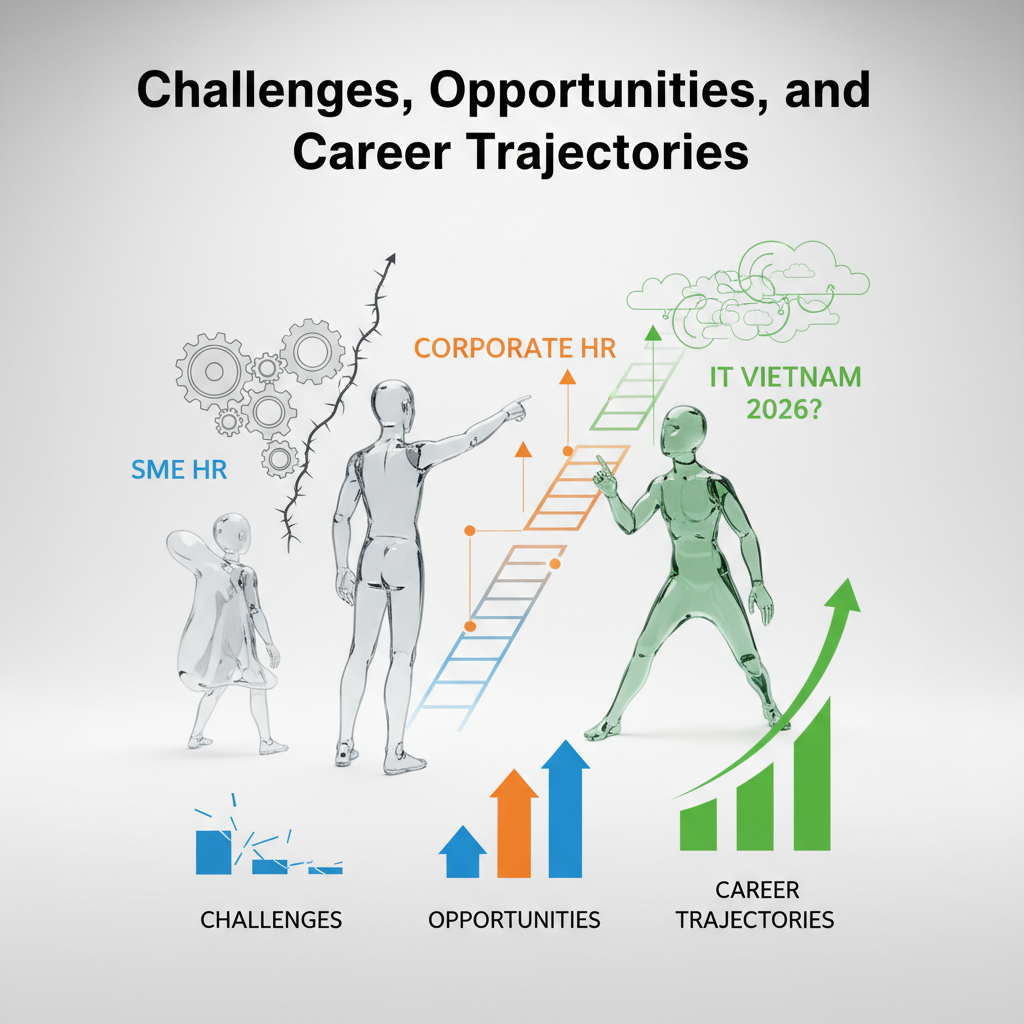
1. Unique HR challenges for IT SMEs in Vietnam
For IT Small and Medium-sized Enterprises (SMEs) in Vietnam, the HR Manager often wears multiple hats, acting as a generalist responsible for the entire employee lifecycle. Their primary challenge lies in effective **talent acquisition**, competing with larger corporations for top-tier tech talent, often with limited budgets and brand recognition. Developing robust **retention strategies** becomes crucial, often involving fostering a strong company culture, providing rapid growth opportunities, and offering flexible working arrangements. Managing **compensation & benefits** for a lean team requires creativity, often balancing competitive salaries with equity options or unique perks to attract and retain skilled developers and engineers.
Resource constraints mean limited investment in sophisticated **HR technology**. HR managers in SMEs frequently rely on manual processes or basic tools, making efficiency a constant pursuit. Ensuring **legal compliance** with Vietnamese labor laws can also be daunting without dedicated legal support. Moreover, the rapid scaling inherent in many IT startups means HR must be incredibly adaptable, quickly building policies and processes from the ground up. The HR Manager in an IT SME is not just an administrator; they are a crucial business partner, directly impacting the company’s ability to innovate and grow, often needing to be an expert in **organizational development** on a smaller scale.
2. Navigating corporate bureaucracy and scale for HR Directors
In contrast, HR Directors in large IT corporations, especially multinational entities, face a different magnitude of complexity. Their role is far more strategic, focusing on **strategic HR** planning, large-scale talent management, and aligning HR initiatives with global business objectives. They must navigate intricate corporate bureaucracies, often managing diverse teams across various locations and time zones. The Differences between the SMEs’ HR Manager and the Corporates’ HR Director in IT field in Vietnam are stark here; the corporate HR Director is less involved in day-to-day operational tasks and more on policy formulation, executive stakeholder management, and driving organizational change.
Key responsibilities include implementing sophisticated global **HR technology** platforms, leading significant **change management** initiatives during mergers, acquisitions, or organizational restructuring, and leveraging advanced **HR analytics** to inform data-driven decisions. They oversee complex **compensation & benefits** frameworks, ensuring equity and competitiveness across various employee tiers and geographic locations. Building a culture that fosters high performance while adhering to global standards and local nuances is paramount. Their challenges often revolve around managing large-scale employee relations and engagement programs, making a clear distinction from the multi-faceted, hands-on role in SMEs – and ensuring seamless integration of local HR practices within a global framework.
3. Career progression and future trends in Vietnam IT HR
Career trajectories for HR professionals in Vietnam’s IT sector are diverse and promising. An HR Manager in an SME might progress to a Senior HR Manager, then to an HR Business Partner role as the company scales, or even a Head of HR. For those in larger corporations, paths often lead from HR Business Partner to HR Director, and eventually to a Chief Human Resources Officer (CHRO) position, influencing global talent strategy. Continuous learning and adaptation are vital, especially given the rapid evolution of the tech industry.
Future trends in Vietnam IT HR emphasize the increasing adoption of **HR technology**, including AI and automation for tasks like recruitment and onboarding. Data-driven decision-making, informed by robust **HR analytics**, will become standard, shifting HR from an administrative function to a strategic powerhouse. There’s a growing focus on enhancing the overall **employee experience**, ensuring well-being, engagement, and productivity in a competitive market. Furthermore, initiatives around **diversity & inclusion** are gaining traction, recognizing their impact on innovation and talent attraction. As remote and hybrid work models become permanent fixtures, HR professionals will also need to master new forms of **organizational development** and virtual team management. Staying abreast of these changes, perhaps through resources like SHRM’s HR Technology Topics, is crucial for those aspiring to lead HR in Vietnam’s vibrant IT landscape.
Partner with Shelby Global
You are looking for reliable HR Sevice Suppliers? Contact Shelby Global Now! To connect with verified talents and upgrade your orginization.
—————————————
References
– The Information Technology Market in Vietnam: A Promising Land for Attracting Talent in 2023: https://www.talentnet.vn/en/news/the-information-technology-market-in-vietnam-a-promising-land-for-attracting-talent-in-2023
– VietnamWorks HR Insider Report: https://www.vietnamworks.com/hr-insider/insights/hr-report-q1-2023/
– IT workers in Vietnam highly in demand: https://vietnamnet.vn/en/it-workers-in-vietnam-highly-in-demand-2079013.html
– Vietnam Total Rewards Survey Results 2023: https://www.willistowerswatson.com/en-VN/Insights/2023/11/vietnam-total-rewards-survey-results-2023
– SHRM’s HR Technology Topics: https://www.shrm.org/resources-and-tools/hr-topics/technology