
Foundations of Vietnam’s Labor Law for Film
Vietnam’s vibrant film industry is rapidly gaining international recognition, attracting global productions and fostering local talent. As the industry expands, understanding the intricacies of Vietnamese labor law becomes paramount for producers, production companies, and HR professionals. Navigating the legal landscape ensures compliance, fosters fair working conditions, and mitigates potential disputes. This section introduces the core labor laws applicable to the film sector, providing a foundational understanding of the Legal HR terms & conditions for Films field in vietnam, which are essential for smooth and successful film production in the country.
1. Overview of the Vietnamese Labor Code 2019 (and updates)
The cornerstone of labor legislation in Vietnam is the Labor Code 2019, which came into effect on January 1, 2021, replacing the earlier 2012 version. This comprehensive legal framework aims to establish harmonious, stable, and progressive labor relations, safeguarding both employees’ rights and employers’ legitimate interests. For the film industry, understanding this code is non-negotiable, as it dictates crucial aspects such as employment contracts, working hours, wages, social insurance, occupational safety and health, and dispute resolution mechanisms.
Key updates in the 2019 code included changes to retirement ages, the types of labor contracts, regulations on sexual harassment, and strengthened protections for employees. While the Labor Code provides the overarching principles, specific regulations are often detailed in various decrees, circulars, and government resolutions. Therefore, staying abreast of these updates is crucial for HR compliance in film production, especially given the dynamic nature of project-based work, often involving diverse local and international talent. For a detailed guide on the Vietnamese Labor Code, including its implications, refer to comprehensive legal resources such as Tilleke & Gibbins’ insights on Vietnam’s new Labor Code.
2. Key Definitions: Employee vs. Contractor in Film Production
A critical distinction in Vietnamese labor law, especially pertinent to the film industry, is that between an ’employee’ and an ‘independent contractor.’ Misclassifying workers can lead to significant legal and financial repercussions for production companies, including back payments for social insurance, personal income tax liabilities, and penalties. The Labor Code 2019 primarily defines an ’employee’ based on the existence of an employment relationship, typically characterized by an employment contract, the employer’s right to direct and supervise the work, remuneration (wages), and the employee’s obligation to adhere to internal labor regulations.
Conversely, an ‘independent contractor’ (or freelancer) is generally engaged through a service contract, where they provide a specific deliverable or service without being subject to the daily supervision and direction typical of an employment relationship. They often control their own work methods, bear their own business risks, and are responsible for their own social insurance and personal income tax obligations. Given that many roles in film production—from cinematographers and editors to costume designers and graphic artists—are often project-based, distinguishing between a film crew member engaged as an employee versus a freelance film worker providing specialized services is vital for proper HR compliance and contractual arrangements.
3. General Principles of Employment Contracts in Vietnam
Under Vietnamese law, an employment relationship must typically be formalized through a written employment contract, with very limited exceptions for temporary work lasting less than three months (which can be oral, but with specific limitations). These contracts are fundamental for establishing the terms and conditions of employment, protecting both parties, and ensuring adherence to the Labor Code. There are three main types of employment contracts:
- Indefinite-term labor contracts: These contracts have no specific end date, indicating a long-term employment relationship.
- Fixed-term labor contracts: These contracts are for a duration of 12 to 36 months. A fixed-term contract can be renewed once; if the employee continues to work after the second fixed-term contract expires, it automatically converts to an indefinite-term contract.
- Seasonal labor contracts: These contracts are for specific tasks that are expected to be completed in less than 12 months.
Each employment contract must contain essential information, including the employer’s and employee’s details, job description, work location, contract term, wage, allowances, working hours, rest breaks, occupational safety provisions, and social insurance contributions. For film production, which often involves short-term, project-specific engagements, fixed-term and seasonal contracts are common. Careful drafting is required to ensure these contracts align with the project’s timeline and workforce needs, while strictly complying with the Labor Code to avoid unintended conversions to indefinite-term contracts, particularly for international film crew employment and managing short-term film contracts.
Crafting Film Production Employment Contracts
Delves into the specifics of drafting and managing employment contracts for various roles within a film production, ensuring legal compliance. The intricate world of film production demands meticulous attention to legal details, especially when it comes to employment contracts. In Vietnam, navigating the unique landscape of the film industry requires a deep understanding of local labor laws and industry-specific nuances. Proper contract drafting is not merely a formality; it’s the backbone of a legally compliant and smoothly running production, safeguarding the interests of both the production company and its diverse workforce. This section explores key considerations for establishing robust Legal HR terms & conditions for Films field in vietnam, from essential clauses to special provisions for creative talent.
1. Mandatory Clauses for Film Crew Contracts
For any film production operating in Vietnam, ensuring compliance with the Vietnam’s New Labour Code is paramount. Every employment contract for film crew members, from grips to gaffers, must contain several mandatory clauses. These typically include the full names and addresses of both parties, the job title and a clear description of duties, the contract duration, and the working location. Crucially, the compensation structure, including salary, allowances, and any applicable bonuses, must be explicitly stated. Details regarding working hours, overtime policies, and rest periods are also essential to adhere to Vietnamese labor law. Furthermore, clear provisions for termination, including notice periods and severance pay in accordance with legal requirements, are non-negotiable. Intellectual property (IP) assignment clauses are particularly critical in the film industry, ensuring that all work created by crew members during their employment becomes the property of the production company. Confidentiality agreements, especially regarding script details and production secrets, are also vital to protect sensitive information. Integrating these elements properly ensures comprehensive HR compliance for film production and robust crew contracts in Vietnam, mitigating potential disputes and legal challenges.
2. Fixed-term vs. Indefinite Contracts in Project-Based Work
The project-based nature of film production often necessitates the use of fixed-term contracts. Understanding the legal distinctions between fixed-term and indefinite contracts under Vietnamese law is crucial for production employment agreements. Fixed-term contracts are ideal for specific productions, defining the employment period from pre-production through post-production. According to Vietnamese labor regulations, fixed-term contracts can typically be renewed once, after which, if employment continues, they are generally converted into indefinite-term contracts. This conversion rule has significant implications for long-running series or companies that frequently employ the same personnel across multiple projects. Production companies must carefully manage these transitions to avoid unintended legal obligations associated with indefinite contracts. Indefinite-term contracts offer greater job security but also impose different employer obligations regarding termination and benefits. Strategic planning regarding contract types helps maintain flexibility while ensuring adherence to film industry contracts Vietnam, protecting the production from unforeseen liabilities. Consulting with entertainment law Vietnam experts is advisable to navigate these complexities effectively.
3. Special Provisions for Actors, Directors, and Creative Talent
Contracts for actors, directors, writers, and other creative talent require specialized provisions beyond those for general crew members. These individuals often bring unique intellectual property and public profiles, necessitating tailored legal frameworks. Key areas include comprehensive intellectual property film clauses that detail the scope of IP assignment, licensing, and moral rights – particularly significant for creators in Vietnam. Image rights and publicity clauses are critical for actors, specifying how their likeness can be used for promotional purposes and for how long. Compensation for creative talent can be multifaceted, involving upfront fees, deferred payments, and potential residuals or profit participation, which must be clearly outlined. Exclusivity clauses are common, preventing talent from working on competing projects during the production period. Credit clauses, detailing how and where talent will be credited, are also highly important. Talent agreements Vietnam must also address representation (agents/managers), force majeure events, and detailed provisions for reshoots or additional work. These specialized contracts, often falling under entertainment law Vietnam, ensure that the unique contributions and rights of high-value talent are legally recognized and protected, safeguarding the entire production’s creative and commercial interests.
Navigating Wages, Working Hours, and Benefits
The burgeoning film industry in Vietnam presents exciting opportunities, but successful production hinges on a meticulous understanding and adherence to the country’s labor laws. Navigating Legal HR terms & conditions for Films field in vietnam is crucial for ensuring fair treatment of local and international crew, mitigating legal risks, and fostering a positive working environment. This section delves into the essential regulations concerning compensation, working schedules, and employee benefits, providing a robust framework for producers and HR professionals operating within the Vietnamese film sector.
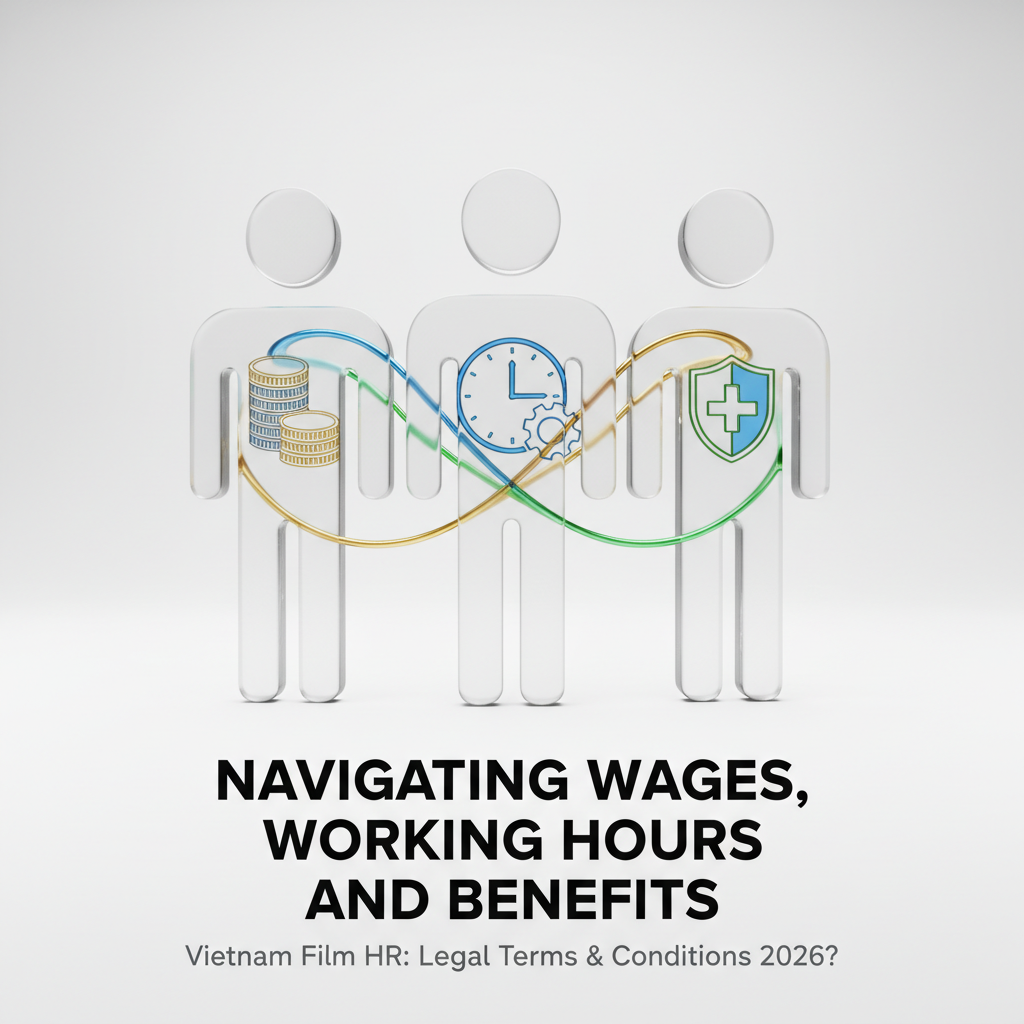
1. Minimum Wage and Overtime Regulations for Film Crew
Vietnam operates a regional minimum wage system, with different rates applying to four distinct regions. Ensuring compliance with these rates is the bedrock of ethical film production salaries. For crew members across various roles – from grips and lighting technicians to production assistants and even actors – their basic pay must meet or exceed the minimum wage applicable to the province where production is based. Understanding these regional distinctions is vital for accurate crew compensation.
Beyond the standard working hours, the film industry often necessitates demanding schedules, leading to significant overtime. Vietnamese labor law provides clear guidelines for overtime pay Vietnam. Employees working beyond normal hours are entitled to additional remuneration: at least 150% of their normal wage for working on regular days, 200% for working on weekly rest days, and 300% for working on public holidays or paid annual leave days. This ensures that the often-extended hours typical of film sets are appropriately compensated. Proper calculation and timely payment of these entitlements are critical aspects of labor law compliance and contribute significantly to crew morale and legal standing. You can find detailed information on the latest regional minimum wage updates affecting all sectors, including film, from official sources to ensure your budget allocations are precise and compliant.
2. Working Hours, Rest Periods, and Leave Entitlements
Vietnamese labor law stipulates a standard working week of no more than 48 hours, typically spread over an 8-hour workday. While the dynamic nature of film production can often push these boundaries, employers must ensure that maximum working hours, including overtime, do not exceed 12 hours a day and 400 hours a year (under certain conditions, otherwise generally 200 hours). Adhering to these limits for film crew working hours is paramount for worker well-being and legal conformity. Equally important are mandatory rest days: employees are generally entitled to at least 24 consecutive hours of rest per week. In special cases, this can be accumulated but must be taken within a month.
Furthermore, employees in Vietnam are entitled to various forms of leave. After 12 months of employment, workers are typically granted 12-16 days of paid annual leave Vietnam, depending on the nature of their work and their tenure. Vietnam also observes numerous public holidays film productions must account for, during which employees are entitled to paid time off or enhanced overtime rates if they work. Specific provisions also cover sick leave, maternity leave, and paternity leave, all of which must be managed according to stringent labor regulations. Comprehensive HR planning that incorporates these leave entitlements is essential for maintaining production schedules while upholding employee rights.
3. Mandatory Social Insurance and Health Benefits
A cornerstone of Vietnamese labor law is the mandatory contribution to social insurance schemes, which profoundly impacts employee benefits Vietnam. Employers and employees are required to contribute to Social Insurance, Health Insurance, and Unemployment Insurance. Social Insurance covers various benefits, including sickness, maternity, occupational accidents and diseases, retirement, and death gratuities. Health Insurance provides coverage for medical examinations and treatment, an invaluable benefit for a hardworking film crew. These contributions are a significant aspect of labor contributions and are vital for securing the long-term welfare of your workforce.
The rates for these contributions are statutory and typically involve a percentage of the employee’s monthly salary, with both employer and employee sharing the burden. For instance, the Social Insurance contribution is split, with the employer typically contributing a larger portion. Beyond these mandatory schemes, some productions may offer additional private health benefits or life insurance, enhancing their position as a responsible employer. Understanding these obligations is crucial for overall HR compliance film sector, ensuring that all crew members, whether local or foreign (with specific considerations for foreigners), are adequately protected. For more detailed insights into all mandatory contributions, including social insurance Vietnam film regulations and health insurance crew provisions, it’s advisable to consult with a local legal expert or refer to official government advisories. Implementing these provisions diligently is not just a legal obligation but also a testament to a production’s commitment to employee welfare.
By meticulously addressing these aspects of Legal HR terms & conditions for Films field in vietnam, film productions can establish a strong, compliant foundation, fostering an environment where creativity thrives alongside robust employee protection and fair labor practices. For further exploration of specific labor law aspects within the Vietnamese context, especially concerning comprehensive HR strategies for film production, please refer to our detailed resources on Legal HR terms & conditions for Films field in vietnam.
HR Compliance and Special Considerations for Film Projects
The burgeoning film industry in Vietnam, with its unique blend of local talent and international collaborations, presents a distinct set of HR challenges and compliance issues. The dynamic nature of film production, often involving diverse teams and tight schedules, necessitates a proactive and thorough understanding of local labor laws, immigration regulations, and intellectual property rights. Navigating these complexities is crucial for any production company aiming for smooth operations and legal adherence, making a deep dive into Legal HR terms & conditions for Films field in vietnam an absolute imperative. This section addresses key areas of HR compliance, ensuring that film projects can thrive within Vietnam’s regulatory framework while maintaining ethical standards and operational efficiency.
1. Work Permits and Visas for Foreign Film Crew
One of the primary HR considerations for international film projects in Vietnam revolves around the legal status of foreign crew members. Film productions frequently draw upon a global pool of directors, cinematographers, specialized technicians, and actors, all of whom require appropriate documentation to work legally in the country. Securing Vietnam film work permits and temporary resident cards or business visas is a critical, often time-consuming, process that demands meticulous planning and execution. The requirements for foreign talent visas can be stringent, often necessitating proof of qualification, professional experience, a clean criminal record, and a sponsoring Vietnamese entity or production company. The application process involves multiple government agencies, including the Ministry of Labour, Invalids and Social Affairs (MOLISA) and the Department of Immigration. Any oversight or delay in acquiring these documents can lead to significant production setbacks, fines, and even the deportation of personnel, underscoring the importance of expert guidance in navigating expat labor compliance Vietnam and ensuring all foreign film crew work permits are in order long before principal photography begins.
2. Child Labor Laws in Film and Safeguarding Minors
The inclusion of child actors in film projects, while enriching narratives, introduces a complex layer of HR compliance concerning child labor laws and the safeguarding of minors. Vietnam possesses robust legislation, including the Law on Children and provisions within the Labour Code, specifically designed to protect young individuals. For film productions, this translates into strict regulations regarding working hours, ensuring that children’s education is not compromised, and providing a safe on-set environment. Productions must adhere to limitations on daily and weekly working hours, guarantee adequate rest periods, and often arrange for on-set tutoring to maintain educational continuity. Furthermore, explicit and informed consent from parents or legal guardians is mandatory, often requiring detailed contracts outlining the child’s role, working conditions, and remuneration. Beyond legal compliance, ethical responsibilities dictate creating an age-appropriate, supportive, and safe atmosphere for child actors, including designated supervision to ensure their physical and psychological well-being. Understanding and meticulously implementing these child actor regulations Vietnam is paramount for any film involving minors.
3. Intellectual Property Rights and Confidentiality Agreements
In the highly creative and collaborative environment of film production, the protection of intellectual property (IP) and sensitive information is paramount. Intellectual property film Vietnam involves a wide array of elements, from scripts, screenplays, and musical scores to original footage, visual effects, and post-production edits. Establishing clear ownership and usage rights for these elements through comprehensive contracts with writers, directors, composers, and other creative contributors is critical to prevent future disputes, especially when considering international distribution or derivative works. Equally important are robust Non-Disclosure Agreements (NDAs) and confidentiality clauses. These confidentiality agreements production safeguard sensitive project details such as plotlines, character developments, production budgets, talent negotiations, and proprietary techniques from unauthorized disclosure. NDAs should be standard practice for all crew members, freelancers, vendors, and anyone with access to confidential information. Properly drafted talent agreements Vietnam, alongside strong IP and confidentiality frameworks, are essential for securing the integrity of the film project, protecting its commercial viability, and ensuring compliance within the Vietnamese film industry regulations.
In conclusion, navigating the HR landscape for film projects in Vietnam requires a comprehensive understanding of local labor laws, immigration policies, and intellectual property regulations. Proactive planning and expert advice are indispensable to mitigate risks, ensure legal compliance, and foster a smooth, successful production environment within the vibrant Vietnamese film industry.
Dispute Resolution and Termination in the Film Industry
Exploring the legal framework for resolving workplace disputes and the proper procedures for contract termination within Vietnam’s dynamic film production context is crucial for maintaining a stable and compliant working environment. The unique project-based nature of the film industry, coupled with the intricate provisions of Legal HR terms & conditions for Films field in vietnam, demands a thorough understanding of Vietnamese labor law. This guide provides essential insights into managing human resources effectively, addressing potential conflicts, and ensuring fair practices from pre-production through post-production.
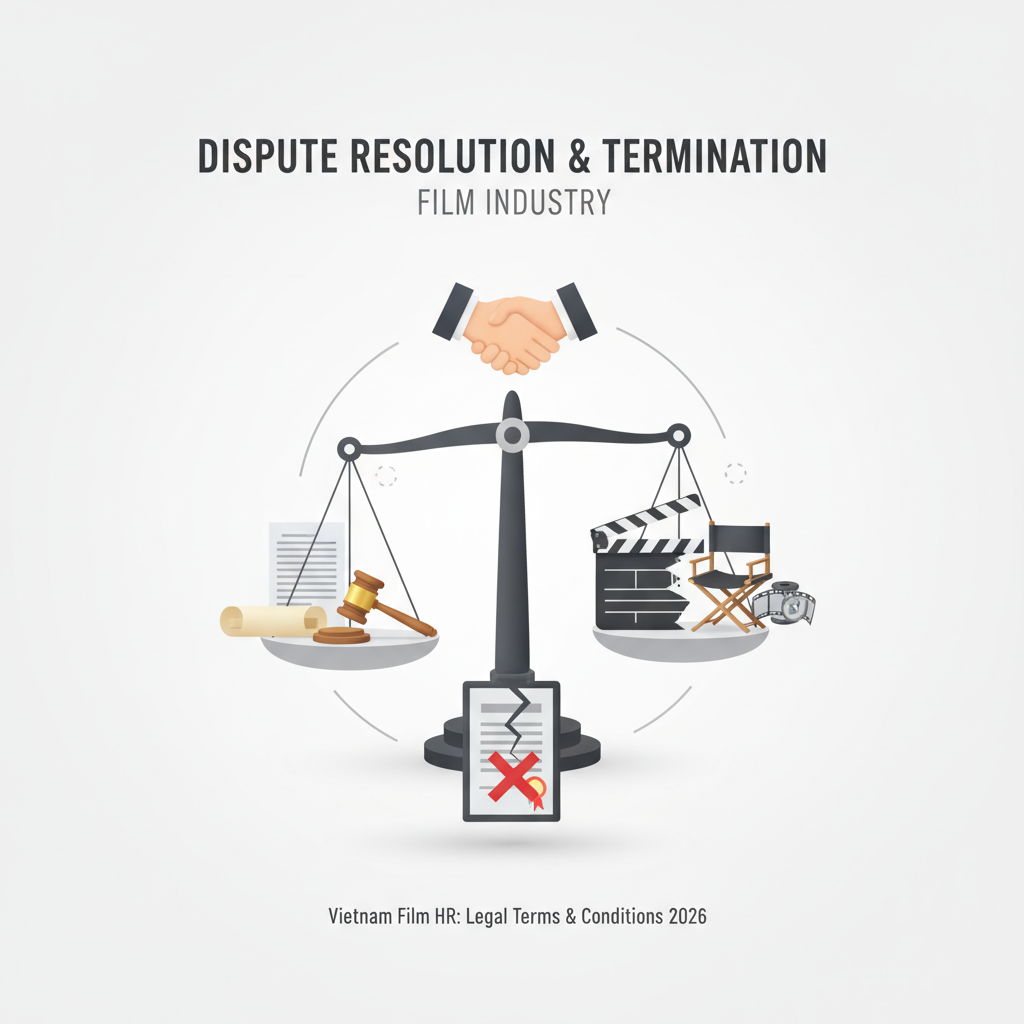
Navigating the legal landscape of employment in Vietnam’s burgeoning film sector requires diligence. From crafting robust film industry employment contracts Vietnam to handling sensitive issues like workplace disputes Vietnam film, adherence to regulations is paramount. Production companies must be well-versed in the processes for dispute resolution Vietnam film and the legally mandated steps for contract termination film production, ensuring transparency and compliance at every stage. This proactive approach not only mitigates risks but also fosters a professional reputation in the global filmmaking arena.
-
Mediation and Arbitration for Labor Disputes
Effective labor mediation Vietnam and arbitration are cornerstones of resolving conflicts in the Vietnamese workplace, including the fast-paced film industry. When disagreements arise between employers (production companies) and employees (cast, crew, staff), the Vietnamese Labor Code encourages amicable resolution through conciliation. Initial attempts at resolution typically involve internal company processes or labor conciliation councils, composed of representatives from both parties and the local labor authority. If conciliation fails, parties may escalate the matter to arbitration film industry. Labor arbitrators, appointed by the government, provide a binding resolution after reviewing evidence and hearing arguments from both sides. These methods offer a more streamlined, cost-effective, and confidential alternative to traditional litigation, crucial for maintaining production schedules and crew morale. Understanding these mechanisms is vital for any production entity operating under Vietnam film labor law to swiftly address issues such as wage disputes, working conditions, or contractual disagreements. For a comprehensive overview of the legal framework, consult resources like Resolving Labor Disputes in Vietnam, which outlines the relevant decrees and procedures.
-
Legal Grounds for Contract Termination in Film Projects
The termination of film industry employment contracts Vietnam must strictly adhere to the provisions of the Vietnamese Labor Code. Legal grounds for termination are meticulously defined to protect both employers and employees. Termination can occur by mutual agreement, which is often the most straightforward approach, particularly upon the completion of a specific film project. However, unilateral termination, whether initiated by the employer or employee, requires specific legal justification and adherence to prescribed notice periods. Employers may terminate a contract on grounds such as an employee’s breach of contract (e.g., severe misconduct, repeated non-performance, or gross negligence impacting production), force majeure events that render project continuation impossible, or restructuring leading to redundancy. For film projects, unique scenarios may include a project being cancelled, postponed indefinitely, or undergoing significant changes that eliminate certain roles. Conversely, employees have the right to terminate their contracts under specific conditions, such as not being provided with the agreed work, unsafe working conditions, or non-payment of wages. Proper documentation, clear communication, and strict adherence to notice requirements are paramount to avoid legal challenges and ensure HR compliance film Vietnam.
-
Severance Pay and Post-Employment Obligations
Upon termination of an employment contract, Vietnamese law often mandates the provision of severance pay Vietnam law. The entitlement and calculation of severance pay depend on the grounds for termination and the employee’s length of service. Generally, employees are entitled to severance pay if their contract is terminated due to redundancy, job loss due to company restructuring, or if the contract expires and is not renewed (under specific conditions), provided they have worked for the employer for a minimum of 12 months. This is calculated based on half a month’s salary for each year of service. However, severance pay is typically not required for terminations due to an employee’s serious misconduct or unilateral termination by the employee for non-valid reasons. Beyond financial compensation, post-employment obligations film projects entail various responsibilities. These often include the return of company property (e.g., equipment, scripts, dailies, proprietary data), adherence to non-disclosure agreements (NDAs) regarding sensitive production information, and, in some cases, non-compete clauses, although the enforceability of the latter is often heavily scrutinized under Vietnamese law. Establishing clear exit procedures and checklists is essential to manage these obligations effectively and prevent future workplace disputes Vietnam film, ensuring a smooth transition for both parties and safeguarding intellectual property.
In conclusion, robust legal HR practices are indispensable for the sustainable growth and operational success of the film industry in Vietnam. By understanding and diligently applying the frameworks for dispute resolution, contract termination, and post-employment obligations, production companies can navigate the complexities of labor law, foster positive working relationships, and contribute to a thriving and compliant cinematic landscape.
Partner with Shelby Global
You are looking for reliable HR Sevice Suppliers? Contact Shelby Global Now! To connect with verified talents and upgrade your orginization.
—————————————
References
– Tilleke & Gibbins’ insights on Vietnam’s new Labor Code: https://www.tilleke.com/insights/vietnams-new-labor-code/
– Vietnam’s New Labour Code: Key Changes and Implications: https://www.legalbusinessonline.com/news/vietnam%E2%80%99s-new-labour-code/110967
– Vietnam’s New Minimum Wage Rates 2024: https://www.vietnam-briefing.com/news/vietnams-new-minimum-wage-rates-2024-region-i-ii-iii-and-iv.html
– Vietnam’s Law on Children 2016: Key Provisions: https://www.lexology.com/library/detail.aspx?g=202d0889-183e-4621-bc75-bb1b69733a87
– Resolving Labor Disputes in Vietnam: https://www.lexology.com/library/detail.aspx?g=e6e0018b-5942-4217-9150-ff99538c8230