
Core Labor Laws & Compliance in Vietnam’s F&B Sector
Navigating the complex landscape of Vietnam’s labor laws is crucial for any food and beverage (F&B) business seeking sustainable growth and operational integrity. This section delves into the foundational labor regulations that directly impact human resources within the F&B industry, ensuring that businesses operate efficiently and within strict legal boundaries. Understanding these Legal HR terms & conditions for Food & Beverage field in vietnam is paramount for effective F&B employment contracts, robust HR compliance Vietnam, and fair employee rights Vietnam.
1. Overview of the Vietnam Labor Code (2019 Amendments)
The cornerstone of Vietnam labor regulations is the Labor Code, significantly updated in 2019, which came into effect on January 1, 2021. This comprehensive legislation governs all aspects of employment relationships, from recruitment to termination, and sets the framework for F&B employment law. Key amendments brought more flexibility to labor contracts, reinforced protections against discrimination, and refined regulations concerning internal labor rules. For F&B businesses, understanding these updates is vital for drafting compliant employment contracts, managing probationary periods, and ensuring proper termination procedures. The Code outlines various types of contracts, including definite-term and indefinite-term, which have specific implications for staffing compliance F&B operations. Adherence to the Labor Code Vietnam F&B requirements is not merely a legal obligation but also a strategic move to foster a stable and productive workforce, reducing risks of labor disputes and enhancing employer reputation in the competitive F&B sector. Staying updated with these provisions is essential for maintaining HR compliance Vietnam and protecting both employer and employee interests.
2. Mandatory Social, Health, and Unemployment Insurance for F&B Staff
One of the most significant aspects of employee benefits Vietnam, and a mandatory obligation for F&B businesses, is contributing to social insurance, health insurance, and unemployment insurance funds. These contributions are critical for ensuring the welfare and security of F&B staff. Social insurance covers sickness, maternity, occupational diseases, work accidents, retirement, and death benefits. Health insurance provides access to medical services, while unemployment insurance offers support during periods of job loss. Employers and employees are required to make monthly contributions based on the employee’s salary. The specific rates and contribution bases are stipulated by law and can vary over time. For F&B establishments, ensuring accurate and timely payment of these contributions is a non-negotiable part of payroll regulations Vietnam. Non-compliance can lead to substantial fines, retroactive payments, and even criminal charges in severe cases. Furthermore, providing these mandatory insurances enhances employee morale and retention, crucial for an industry with high turnover rates. Businesses must meticulously manage their payroll to ensure these contributions are correctly calculated and submitted, demonstrating a commitment to employee well-being and legal conformity. For detailed insights into social insurance specifics, employers can refer to authoritative guides on the subject, such as the comprehensive information available on Social Insurance in Vietnam.
3. Regulations on Work Hours, Overtime, and Public Holiday Compensation
Given the operational nature of the F&B industry, which often involves shift work, weekends, and public holidays, regulations concerning work hours, overtime, and compensation are particularly pertinent. The Vietnam Labor Code sets a standard maximum work hour limit, typically 8 hours a day or 48 hours a week, though specific provisions allow for reduced hours in certain hazardous environments. For F&B, employers must meticulously track work hours to ensure compliance. Overtime work is permitted but subject to strict limitations and higher compensation rates. Employees working overtime must be paid at least 150% of their normal wage on normal days, 200% on weekly rest days, and 300% on public holidays or paid leave days, excluding the normal daily wage. Public holidays, as declared by the government, also require special attention. Employees working on these days are entitled to additional compensation. These regulations are designed to protect employees from exploitation and ensure fair remuneration for their efforts. Accurate record-keeping of attendance and working hours is not just good practice but a legal necessity for F&B businesses to avoid disputes and penalties. Adhering to these provisions is vital for maintaining workplace health & safety F&B standards and demonstrating robust HR compliance Vietnam, fostering a transparent and equitable working environment for all staff members.
Employment Contracts & Onboarding Specifics for F&B
Delve into the requirements for drafting legally compliant employment contracts and the specific onboarding processes for F&B employees, including nuances for part-time and seasonal staff. Understanding the “Legal HR terms & conditions for Food & Beverage field in Vietnam” is crucial for seamless operations and compliance.
1. Types of Employment Contracts: Indefinite, Definite, and Seasonal
In Vietnam’s dynamic F&B sector, understanding various employment contracts is paramount for legal compliance and operational flexibility. The Vietnamese Labor Code distinguishes primarily between indefinite-term, definite-term, and seasonal (or specific job) contracts.
- Indefinite-term contracts are ongoing agreements without a specified end date, typical for core, permanent staff like head chefs or managers. They offer job security and foster long-term commitment.
- Definite-term contracts have a clearly defined end date (12-36 months), commonly used for mid-level kitchen staff or servers. Under Vietnamese law, an employee can sign a maximum of two successive definite-term contracts for the same job before the third must become indefinite, unless specific exceptions apply.
- Seasonal contracts (or contracts for specific jobs) are for tasks less than 12 months, highly relevant for F&B due to peak periods (e.g., holidays, events). These provide flexibility for extra waitstaff or temporary kitchen assistants. However, roles must genuinely fit “seasonal” or “specific job” criteria to avoid misclassification. Proper documentation is essential.
Navigating these contract types, especially for part-time and seasonal employees, requires diligent adherence to the Legal HR terms & conditions for Food & Beverage field in Vietnam.
2. Probationary Period Guidelines and Best Practices for F&B Roles
Probationary periods are vital for both employers and employees in the F&B industry to assess suitability. Under Vietnamese law, maximum probationary periods vary by job type:
- Up to 180 days for professional/technical qualifications (e.g., head chef).
- Up to 60 days for college/university qualifications (e.g., restaurant supervisor).
- Up to 30 days for secondary vocational qualifications (e.g., line cook).
- Up to 6 working days for other roles (e.g., dishwasher, basic waitstaff).
During probation, employees are entitled to at least 85% of the official salary. Terms must be clearly stipulated in a written agreement.
Best Practices for F&B Roles:
- Clear Expectations: Define specific, measurable performance metrics (e.g., order accuracy for a server, prep speed for kitchen staff).
- Regular Feedback: Provide consistent, constructive feedback throughout the period.
- Training & Support: Offer adequate training on F&B operations, hygiene, and service standards.
- Documentation: Maintain meticulous records of reviews and incidents.
- Legal Compliance: Ensure strict adherence to maximum durations and minimum salary, as per the Vietnamese Labor Code.
A well-managed probationary period minimizes turnover and effectively integrates new hires into the fast-paced F&B environment.
3. Essential Clauses for F&B Employment Agreements (Hygiene, Service Standards, Tips)
Beyond standard clauses, F&B agreements require specific provisions to address unique operational and regulatory demands.
- Hygiene and Food Safety Standards: Contracts must explicitly detail responsibilities for food hygiene and safety, including proper food handling, storage, personal hygiene (gloves, hairnets), and reporting health issues. Non-compliance should be a serious breach. Reference relevant national food safety regulations, e.g., from Vietnam’s Ministry of Health.
- Service Standards and Customer Experience: Agreements should outline expected service levels, communication protocols, professional demeanor, and problem-solving with guests. This covers uniform policies, greeting standards, and handling complaints professionally, vital for brand consistency. Include clauses protecting company reputation.
- Tips, Service Charges, and Gratuities Policy: Transparent handling of gratuities is crucial. Vietnamese law allows employers to establish policies, which must be clear and communicated. The contract should specify:
- Service charge collection and distribution.
- Policy on personal tips.
- Any permitted deductions (must comply with labor regulations).
- Frequency and method of distribution.
Consult the latest Vietnamese government regulations on wage and gratuity distribution for compliance. For further details on these crucial aspects of Vietnamese labor law, refer to official sources such as the Vietnam Labor Code 2019.
These specific clauses clarify expectations and provide a legal framework for managing performance and ensuring operational excellence within the demanding F&B environment.
Wages, Benefits, and Employee Rights in Vietnamese F&B
Navigating the intricate landscape of employment regulations is crucial for any business operating in Vietnam, especially within the dynamic Food & Beverage (F&B) sector. Understanding the legal framework surrounding minimum wages, employee benefits, and various rights is not merely a matter of compliance but a cornerstone of fostering a fair, productive, and sustainable workforce. This section explores the essential legal HR terms & conditions for Food & Beverage field in Vietnam, ensuring fair compensation and treatment, and helping F&B establishments maintain robust HR compliance in Vietnam. Adhering to these regulations is vital for attracting and retaining talent in Vietnam’s competitive food service industry while upholding employee workplace rights in Vietnam.
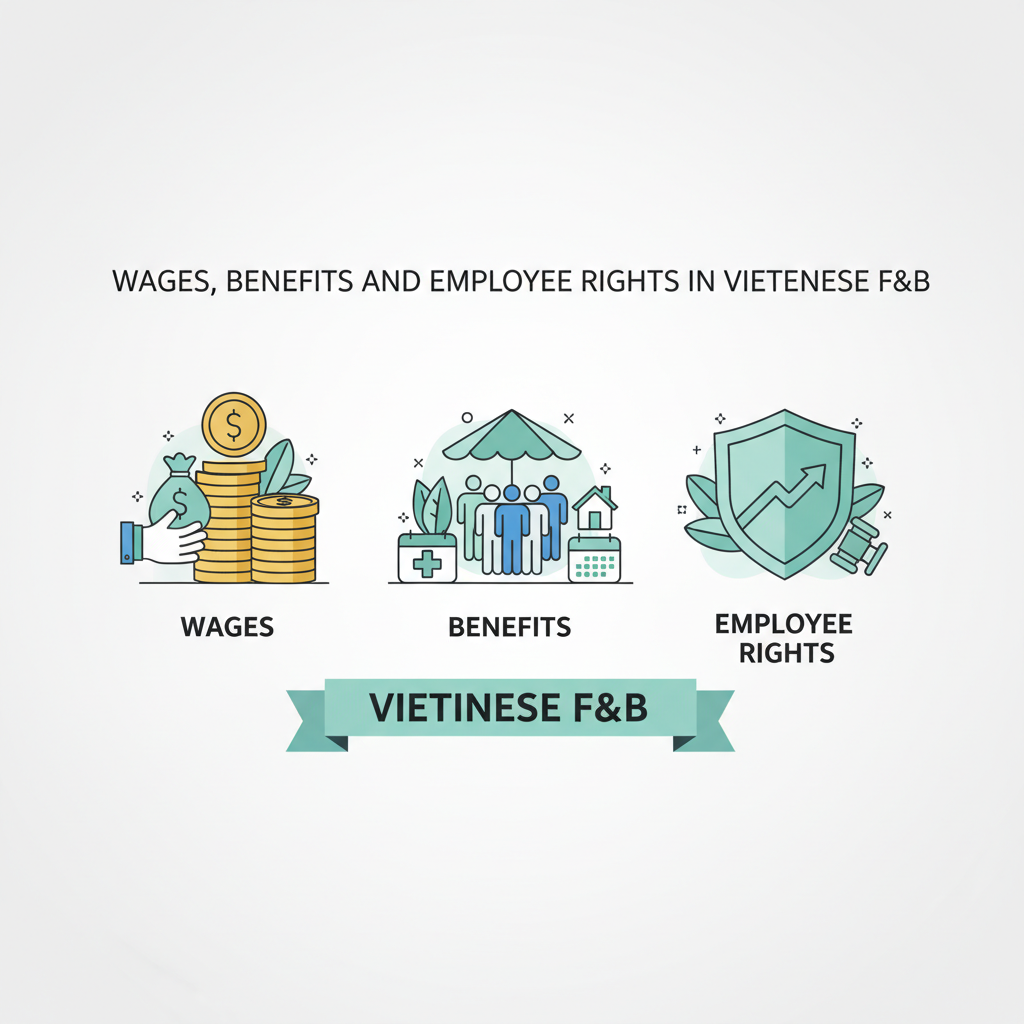
1. Minimum Wage Requirements and Regional Variations Across Vietnam
The Vietnamese government sets minimum wage requirements, which are crucial for ensuring a basic standard of living for employees. These Vietnamese F&B wages are not uniform nationwide; instead, they are categorized into four distinct regions (Region I, II, III, and IV), reflecting varying socio-economic conditions and living costs. Region I typically encompasses major cities like Hanoi and Ho Chi Minh City, having the highest minimum wage, while Region IV covers areas with lower economic development. Businesses in the F&B sector must meticulously identify their operational region to apply the correct minimum wage rate for their staff. These rates are subject to periodic review and adjustment, usually on an annual basis, to account for inflation and economic growth. Staying informed about the latest decrees from the Ministry of Labour, Invalids and Social Affairs (MOLISA) is paramount for ensuring compliance with Vietnam labor law and avoiding penalties related to F&B employment regulations.
2. Statutory Benefits: Annual Leave, Sick Leave, Maternity/Paternity Leave
Beyond the minimum wage, the Vietnamese Labour Code mandates a comprehensive suite of statutory employee benefits designed to protect the well-being of the workforce. For employees working a full year, the standard annual leave entitlement is 12 working days. This increases by one day for every five years of continuous employment with the same employer. Sick leave provisions require employees to provide medical certificates for paid absence, with specific durations and benefit levels linked to social insurance contributions. Maternity leave is a significant benefit, typically granting female employees six months of paid leave, which can commence before and extend after childbirth. Paternity leave, though shorter, also allows new fathers time off to support their families. Employers in the F&B sector must be diligent in managing these benefits, including accurate record-keeping and ensuring timely payment of social insurance contributions to facilitate access to these entitlements for their staff.
3. Employee Rights: Workplace Safety, Discrimination Protections, and Grievance Procedures
Protecting employee rights extends to fostering a safe and equitable working environment. Employers in Vietnamese F&B have a legal obligation to provide a safe and healthy workplace, adhering to Occupational Safety and Health (OSH) standards. This includes providing necessary safety equipment, training, and maintaining hygienic conditions, which are particularly critical in a food service setting. Furthermore, Vietnam labor law prohibits discrimination based on gender, race, religion, origin, or other protected characteristics in all aspects of employment, from hiring to promotion and termination. F&B establishments must implement clear non-discrimination policies and ensure fair treatment for all employees. Equally important are established grievance procedures, which provide employees with a formal channel to report complaints, resolve disputes, or address concerns without fear of retaliation. Clear communication of these procedures and fair handling of grievances are essential for maintaining a harmonious workplace and upholding the integrity of food service labor laws and employee workplace rights in Vietnam.
Termination, Discipline, and Dispute Resolution in F&B
Navigating the complex landscape of employee termination, disciplinary actions, and labor dispute resolution in Vietnam’s dynamic food and beverage (F&B) sector requires a thorough understanding of local legal HR terms & conditions for Food & Beverage field in Vietnam. Adherence to the Vietnamese Labor Code is paramount to ensure fair, lawful, and efficient human resource management, safeguarding both employer interests and employee rights. This section outlines the critical procedures and mechanisms for managing personnel challenges within F&B operations, focusing on compliance and best practices.
1. Legal Grounds for Termination and Required Notice Periods
In Vietnam, the termination of employment contracts must strictly comply with the provisions of the Labor Code. Employers in the F&B industry must have valid legal grounds to dismiss an employee, which can include mutual agreement, unilateral termination by either party, expiry of a fixed-term contract, or specific circumstances like force majeure or business restructuring. Unilateral termination by an employer is permitted only under specific conditions, such as an employee repeatedly failing to complete work assignments despite warnings, prolonged illness, or the company undergoing a merger, division, or economic downsizing. Crucially, proper documentation and evidence are required to support such grounds.
Notice periods are also a critical component of lawful termination. For indefinite-term contracts, a minimum of 45 days’ notice is generally required. For definite-term contracts ranging from 12 to 36 months, the notice period is typically 30 days. Shorter definite-term contracts (under 12 months) usually require 3 working days’ notice. Employers must also be aware of specific scenarios that prohibit termination, such as an employee being on sick leave, maternity leave, or taking annual leave. Failure to observe these requirements can render a termination unlawful, leading to significant penalties, including reinstatement, back pay, and compensation. Understanding these Vietnamese labor law intricacies is vital for F&B establishments to maintain HR compliance.
2. Disciplinary Procedures and Sanctions (Warnings, Suspensions, Dismissals)
Maintaining discipline within an F&B environment, where service quality and punctuality are key, often requires structured disciplinary action. The Vietnamese Labor Code specifies a clear framework for imposing disciplinary sanctions. Employers cannot simply dismiss an employee without following due process. Disciplinary procedures typically involve:
- Investigation: Gathering evidence of the alleged violation.
- Notice of Meeting: Notifying the employee and relevant representatives (e.g., trade union) of a disciplinary meeting, providing sufficient time for preparation.
- Disciplinary Meeting: Conducting a meeting where the employee has the right to explain and defend themselves. Minutes must be recorded.
- Decision: Issuing a written disciplinary decision based on the evidence and discussions.
The types of permissible sanctions range from reprimand (a formal written warning), temporary suspension from work without pay (for a maximum of 15 days, or 90 days in special cases), to dismissal. Dismissal is reserved for severe offenses such as theft, embezzlement, disclosing trade secrets, or repeated serious violations despite prior reprimands. Any disciplinary action must be proportionate to the offense and implemented within specific time limits from the date of discovery of the violation. Strict adherence to these steps is crucial to prevent claims of unfair dismissal or arbitrary disciplinary measures, which could lead to labor disputes.
3. Labor Dispute Resolution Mechanisms: Conciliation, Arbitration, and Court Proceedings
Despite best efforts in HR management, labor disputes can arise in the fast-paced F&B industry. Vietnam’s legal system provides a multi-tiered approach to resolving these disputes, emphasizing amicable settlement before litigation. The primary mechanisms include:
- Workplace Conciliation: This is often the mandatory first step for collective labor disputes and highly encouraged for individual disputes. A labor conciliator, typically from the local labor department, facilitates negotiations between the employer and employee(s) to reach a mutually acceptable agreement. Conciliation is designed to be swift and cost-effective, aiming to preserve the employment relationship where possible.
- Labor Arbitration Council: If conciliation fails, parties may refer the dispute to a Labor Arbitration Council. While not always mandatory, this step provides a more formal, quasi-judicial review. The council hears both sides, reviews evidence, and issues a decision. Parties generally have the option to accept or reject the arbitration decision, with rejection usually leading to court proceedings.
- Court Proceedings: As a last resort, if disputes remain unresolved through conciliation or arbitration, either party can file a lawsuit with the People’s Court. Labor courts will adjudicate the dispute based on legal provisions, evidence presented, and testimonies. Court proceedings are typically more time-consuming and expensive but provide a legally binding resolution.
F&B businesses should prioritize establishing clear internal grievance procedures to resolve issues early. Proactive communication, fair investigation, and transparent decision-making can significantly reduce the likelihood of disputes escalating to external bodies, ensuring smoother operations and a more stable workforce.
Specific HR Challenges & Best Practices for F&B in Vietnam
Vietnam’s vibrant Food & Beverage (F&B) sector is a cornerstone of its economy, attracting significant investment and fostering a dynamic culinary scene. However, this rapid growth also presents unique and complex Human Resources (HR) challenges. F&B businesses, from burgeoning cafes to international hotel chains, must expertly navigate a distinctive landscape of Legal HR terms & conditions for Food & Beverage field in Vietnam, cultural nuances, and demanding operational environments. Ensuring robust HR compliance and cultivating a positive, productive working environment is not just an advantage, but a critical necessity for sustained success and growth. This section explores the specific HR hurdles faced by the F&B sector in Vietnam and offers actionable best practices to overcome them, focusing on managing foreign talent, upholding stringent health and safety standards, and investing in continuous professional development.

1. Managing Foreign Workers in F&B: Work Permits, Visas, and Legal Compliance
The F&B industry in Vietnam frequently leverages a diverse international workforce, particularly skilled foreign chefs, managers, and specialized service staff who bring global expertise and standards. While invaluable, the employment of foreign nationals introduces significant HR complexities. Employers must meticulously adhere to Vietnamese labor law concerning foreign worker regulations, which are among the stricter frameworks in the region. Key challenges include understanding and navigating the intricate processes for obtaining work permits, temporary residence cards, and appropriate business visas. These requirements vary significantly based on the employee’s nationality, specific job role, and intended duration of stay, often demanding rigorous documentation such as academic qualifications, health checks, and criminal record clearances from their home countries.
Best practices for managing foreign workers necessitate a proactive and detail-oriented approach. F&B businesses should initiate the work permit and visa application processes well in advance of a foreign employee’s planned start date, often requiring consultation with experienced legal experts or HR advisory firms specializing in Vietnamese immigration and HR compliance F&B Vietnam. It is paramount to ensure that all employment contracts comply with local regulations, including stipulated salary benchmarks, benefits packages, and clear termination clauses. Regular audits of employee documentation and visa statuses are essential to prevent penalties for non-compliance, which can include substantial fines, operational disruptions, and even deportation. Providing comprehensive orientation and ongoing support to foreign employees regarding local customs, tax obligations, and social insurance contributions greatly facilitates their integration, contributing to higher job satisfaction and retention rates for this crucial talent pool.
2. Health & Safety Regulations for Food Handling Staff and Premises
In the F&B industry, health and safety are non-negotiable and paramount for both consumers and employees. Vietnam enforces rigorous food safety regulations designed to prevent contamination and ensure hygienic practices throughout the entire food supply chain—from procurement and storage to preparation and serving. F&B establishments face the continuous challenge of implementing and scrupulously monitoring these standards. This includes strict adherence to protocols for preventing cross-contamination, maintaining optimal temperature controls for ingredients and prepared foods, and ensuring impeccable cleanliness of premises, equipment, and utensils. Beyond foodborne illness prevention, occupational health and safety (occupational safety F&B) for staff is a critical concern, especially for those working with hot equipment, sharp tools, or in high-pressure, fast-paced kitchen environments. Common workplace hazards include burns, cuts, slips, and ergonomic strains.
To effectively navigate these challenges, F&B businesses must implement robust health and safety protocols. This involves mandatory and regular food hygiene certifications for all food handling staff, coupled with comprehensive training on HACCP (Hazard Analysis and Critical Control Points) principles and the proper use of personal protective equipment (PPE). Regular internal and external audits of kitchens, dining areas, and storage facilities are crucial for identifying and mitigating potential risks before they escalate. Clear emergency procedures, easily accessible first-aid facilities, and transparent reporting mechanisms for incidents or near-misses must be established. Cultivating a strong safety culture where employees are educated, empowered to report hazards, and committed to adhering to best practices is fundamental for ensuring both regulatory compliance and operational excellence, thereby protecting both staff and customers.
3. Training Requirements and Professional Development (e.g., Food Hygiene Certifications)
The F&B sector in Vietnam often grapples with a relatively high staff turnover rate, which makes continuous training and professional development a persistent HR challenge. Maintaining consistently high service quality, culinary standards, and operational efficiency relies heavily on a well-trained, skilled, and motivated workforce. There is a perpetual need to upskill existing staff and rapidly onboard new hires, equipping them with specific culinary techniques, service etiquette, and, critically, comprehensive food safety protocols. The requirement for specific industry certifications, such as food hygiene certifications issued by authorized Vietnamese bodies, is not merely a best practice but a legal mandate for many roles involved in food preparation and service.
Best practices for training and professional development in F&B involve a multi-faceted and strategic approach. Beyond the legally required certifications, businesses should invest in comprehensive onboarding programs that thoroughly cover company policies, service standards, and initial safety training. Continuous learning can be fostered through regular workshops focused on enhancing culinary skills, improving customer service excellence, and fostering stronger team collaboration. Implementing a clear career progression framework, offering opportunities for cross-training across different roles, and providing incentives for skill acquisition can significantly contribute to reducing turnover and enhancing overall employee engagement. Leveraging digital learning platforms can also provide flexible and scalable training solutions, ensuring that staff are consistently updated on the latest industry trends and evolving regulatory changes. Investing proactively in staff development not only ensures strict HR compliance F&B Vietnam but also cultivates a loyal, highly skilled, and productive team, which is indispensable for the long-term success of any F&B enterprise in Vietnam’s competitive market.
Partner with Shelby Global
You are looking for reliable HR Sevice Suppliers? Contact Shelby Global Now! To connect with verified talents and upgrade your orginization.
—————————————
References
– :
– Vietnam Labor Code 2019: https://thuvienphapluat.vn/van-ban/Lao-dong-Tien-luong/Bo-luat-lao-dong-2019-333578.aspx
– Vietnam’s Regional Minimum Wage Rates 2023 – Vietnam Briefing: https://www.vietnam-briefing.com/news/vietnams-regional-minimum-wage-rates-2023.html
– Baker McKenzie’s Guide to Vietnam Labor Law on Lexology: https://www.lexology.com/library/detail.aspx?g=76b4d24f-c0c5-4d08-8e8e-d971578e3547
– Vietnam’s Labour Code: An Overview: https://www.vietnam-briefing.com/news/vietnams-labour-code.html