Understanding the Singapore Production Landscape & Managerial Needs
Singapore, a global economic powerhouse, continues to solidify its position as a leading advanced manufacturing hub in Asia. This dynamic environment necessitates a strategic approach to talent acquisition, particularly for critical roles such as production managers. The sector is characterized by rapid technological adoption, intricate supply chains, and a constant drive for efficiency and innovation. For companies looking to thrive, understanding the unique demands of the Singapore production landscape is paramount. This insight not only informs strategic planning but also guides the development of a robust test structure to assess Manager Level CVs in production field in singapore, ensuring that only the most capable leaders are brought on board to navigate its complexities and capitalize on its opportunities.

1. Key Challenges & Opportunities in Singapore’s Manufacturing Sector
Singapore’s manufacturing sector operates within a highly competitive global context, presenting both significant challenges and compelling opportunities. Challenges primarily stem from high operating costs, a tight labor market, and increasing geopolitical uncertainties that impact global supply chain resilience. Companies must contend with rising material costs, skilled workforce development needs, and the imperative to maintain competitiveness against lower-cost regions. However, Singapore’s strategic response to these challenges creates immense opportunities. The government’s unwavering commitment to advanced manufacturing through initiatives like the Industry 4.0 transformation and significant investments in R&D has positioned the nation at the forefront of innovation. The pivot towards high-value manufacturing segments such as precision engineering, aerospace, biomedical sciences, and electronics, coupled with a strong emphasis on digital transformation, offers a fertile ground for growth. Production managers are therefore expected to not only optimize existing processes but also spearhead innovative solutions, leverage automation, and integrate new technologies to ensure operational excellence and foster sustainable growth in this demanding environment. For more insights into Singapore’s manufacturing performance, refer to the official EDB Manufacturing Overview.
2. Essential Leadership Competencies for Production Managers
Beyond technical proficiency, the modern production manager in Singapore requires a robust set of leadership competencies. Strategic thinking is crucial for aligning production goals with broader business objectives, while exceptional problem-solving skills are indispensable for tackling complex operational hurdles and unforeseen disruptions. Adaptability is key, enabling managers to swiftly respond to market shifts, technological advancements, and evolving regulatory landscapes. Furthermore, effective communication and strong team leadership are vital for fostering a collaborative work environment, driving workforce development, and motivating diverse teams towards common goals. Production managers must also champion lean manufacturing principles and continuous improvement methodologies to enhance efficiency and reduce waste. The ability to make data-driven decisions, interpret complex analytics, and lead change management initiatives is increasingly non-negotiable. Identifying these critical leadership qualities requires more than a cursory glance at a CV; it demands a sophisticated test structure to assess Manager Level CVs in production field in singapore that delves into practical experience, situational judgment, and demonstrated leadership impact to bridge skill gaps and ensure successful talent acquisition.
3. The Evolving Role of Technology in Production Management
The manufacturing sector’s rapid embrace of Industry 4.0 technologies has profoundly reshaped the role of a production manager. Concepts like the ‘smart factory,’ powered by the Internet of Things (IoT), Artificial Intelligence (AI), automation, and predictive analytics, are no longer futuristic ideals but operational realities. Today’s production managers must be technologically astute, capable of understanding and integrating these advanced tools into daily operations. This involves leveraging automation for enhanced production efficiency, utilizing AI for predictive maintenance and quality control, and interpreting vast amounts of data from interconnected systems to drive informed decision-making. Their responsibilities extend to overseeing the implementation of robotics, managing cyber-physical systems, and ensuring the smooth flow of data across the entire production ecosystem. Consequently, a successful production manager must act as a digital transformation agent, inspiring their teams to adopt new technologies and processes. The ability to evaluate and deploy emerging technologies effectively is a differentiator. Any comprehensive test structure to assess Manager Level CVs in production field in singapore must, therefore, thoroughly assess a candidate’s technological literacy, their experience with digital tools, and their vision for future technological adoption in a fast-paced manufacturing environment.
In conclusion, Singapore’s production landscape demands a new breed of managers: adaptable, technologically proficient, and strong leaders capable of driving innovation amidst complex challenges. Identifying these critical talents requires a strategic and rigorous approach to assessment, ensuring that candidates possess not only the requisite technical skills but also the strategic foresight and leadership acumen necessary to excel in this competitive and evolving sector. A well-defined evaluation process is vital for sustained success.
Deconstructing the Ideal Manager Level Production CV
In Singapore’s dynamic and highly competitive manufacturing landscape, a Production Manager’s CV must transcend a mere chronological listing of job titles. To truly stand out, it needs to be a compelling narrative of quantifiable achievements, leadership impact, and strategic foresight. Employers are increasingly looking for more than just experience; they seek demonstrable skills and a clear track record of driving results. Crafting a CV that effectively communicates this requires a strategic approach, essentially acting as a Test structure to assess Manager Level CVs in production field in singapore, ensuring it highlights true managerial capability and potential for operational excellence.
1. Quantifying Achievements: Metrics & Business Impact
The hallmark of an exceptional Production Manager CV, especially in Singapore, is its emphasis on measurable outcomes. Generic responsibilities mean little without the context of impact. Instead of stating “Managed production line,” articulate “Spearheaded initiatives that increased production line efficiency by 15% through Lean Manufacturing Principles, reducing per-unit cost by 8% over 18 months.” Every significant achievement should be backed by specific metrics – percentages, monetary values, timeframes, or ratios. Think about key performance indicators (KPIs) such as cycle time reduction, yield improvement, waste reduction, on-time delivery rates, and safety incident reduction. These figures provide irrefutable evidence of your contribution to the bottom line, demonstrating your ability to drive operational excellence and contribute directly to the company’s strategic planning production goals. Highlighting success in areas like supply chain optimization or process re-engineering using real numbers showcases a results-driven mindset that is highly valued.
2. Highlighting Industry-Specific Certifications & Training
In Singapore’s drive towards advanced manufacturing and Industry 4.0, continuous learning and specialized certifications are not just desirable but often essential. A strong CV will prominently feature industry-specific qualifications that validate expertise beyond on-the-job experience. Consider certifications like Lean Six Sigma (Green Belt or Black Belt), APICS CSCP (Certified Supply Chain Professional) or CPIM (Certified in Production and Inventory Management), PMP (Project Management Professional), or specific advanced manufacturing skills training. These credentials signal a commitment to professional development and mastery of best practices in areas critical to modern production environments. They assure potential employers that you possess the theoretical knowledge and practical frameworks to implement cutting-edge strategies and adapt to evolving challenges, from digital transformation to sustainable practices. Including a link to authoritative industry insights, such as the World Economic Forum’s insights on the Future of Manufacturing, further contextualizes your alignment with global trends.
3. Showcasing Leadership, Team Management, & Mentorship Experience
A Production Manager is fundamentally a leader of people and processes. Your CV must effectively communicate not just that you led a team, but how you led them to success. Detail instances where you fostered a high-performance culture, resolved team conflicts, implemented successful talent development programs, or mentored junior staff to achieve their potential. Highlight your ability to manage cross-functional teams, collaborate with engineering, quality, and logistics departments, and drive collective success. Use action verbs that convey leadership such as “mentored,” “coached,” “developed,” “inspired,” and “empowered.” For example, instead of “Managed a team of 30 operators,” write “Led and mentored a team of 30 production operators, improving team productivity by 20% and reducing staff turnover by 10% through targeted training and empowerment initiatives.” This demonstrates your capacity for strategic planning production and your understanding that people are the cornerstone of operational excellence, contributing significantly to your CV impact statements.
Ultimately, a manager-level Production Manager CV for the Singapore market is a strategic document. It’s not just about listing what you’ve done, but proving the measurable value you’ve delivered and showcasing the leadership qualities that make you an invaluable asset. By focusing on quantifiable achievements, relevant certifications, and impactful leadership, your CV will serve as a robust Test structure to assess Manager Level CVs in production field in singapore, clearly demonstrating your ability to drive operational excellence and lead with vision in a competitive environment.
The Initial Screening Test Structure: Beyond Keywords
The initial phase of CV assessment for managerial roles in the production field in Singapore requires a sophisticated approach that transcends mere keyword matching. To effectively identify true potential and efficiently filter out unsuitable candidates, recruitment processes must incorporate a robust test structure to assess Manager Level CVs in production field in singapore. This involves a multi-layered strategy designed to uncover leadership capabilities, strategic thinking, and a proven track record relevant to the dynamic production environment in Singapore, rather than just checking for buzzwords.

1. Developing a Weighted Scoring System for CVs
Moving beyond a simple keyword count, a weighted scoring system offers a more nuanced and objective CV assessment in Singapore. For managerial roles in production, specific criteria hold significantly more weight than others. For instance, direct experience in managing large-scale production operations, P&L responsibility, process improvement initiatives (e.g., Lean, Six Sigma), and proven success in optimizing supply chain logistics within the manufacturing sector should be assigned higher scores. Less critical, though still relevant, aspects like specific software proficiency (unless it’s niche and mandatory) or general academic achievements might receive lower weighting. This system ensures that candidates demonstrating a strong alignment with the core demands of a production manager hiring role are prioritized. Each criterion, from leadership tenure and team size managed to budget oversight and successful project completion, is quantitatively assessed against predefined benchmarks. This approach significantly streamlines the initial screening by highlighting candidates whose profiles genuinely resonate with the strategic objectives of the role, rather than those who simply know how to optimize their CV for basic applicant tracking systems.
2. Identifying Red Flags and Disqualifiers Early
Efficient initial screening isn’t just about finding the best; it’s also about quickly identifying those who are clearly not a fit. For managerial CV screening in the production sector, certain “red flags” can indicate unsuitability or potential issues. These might include frequent job hopping without clear career progression, significant gaps in employment that are unexplained, a lack of quantifiable achievements despite extensive experience, or a CV that is poorly structured and contains numerous errors, suggesting a lack of attention to detail – a critical trait for a production manager. Disqualifiers could be a complete absence of experience in managing teams, no demonstrated leadership in process improvement, or a lack of exposure to relevant industry regulations or safety standards pertinent to Singapore’s production landscape. By setting clear parameters for these red flags and disqualifiers, recruiters can rapidly filter out a substantial portion of the applicant pool, focusing their precious time on more promising candidates. This proactive identification of non-starters is crucial for maintaining an efficient and targeted recruitment pipeline, preventing valuable resources from being spent on unsuitable applicants.
3. Leveraging AI Tools for Pre-Screening Efficiency
The sheer volume of applications for manager-level roles necessitates the adoption of advanced tools. Leveraging AI tools for pre-screening efficiency has become indispensable for modern recruitment. These AI recruitment tools can go far beyond keyword matching, analyzing CVs for patterns, identifying relevant skills, and even assessing cultural fit based on linguistic analysis and expressed values. These tools can process hundreds of CVs in minutes, applying the weighted scoring system and flagging potential red flags with a high degree of accuracy. For production management roles, AI can be trained to look for specific project management methodologies (e.g., Agile, Waterfall in a manufacturing context), certifications (e.g., PMP, SCPro), and even industry-specific terminology that indicates a deeper understanding of the sector. While AI assists in creating a highly refined shortlist, it’s crucial to remember that human oversight remains vital to ensure fairness, interpret nuanced aspects, and prevent bias. The integration of AI for talent identification in Singapore provides a powerful synergy, significantly enhancing the speed and quality of the initial screening process, allowing human recruiters to engage with candidates who truly possess the potential to excel in a demanding production environment.
Competency-Based Assessment Modules for CVs
Evaluating a Production Manager’s CV goes beyond merely scanning job titles and employment dates; it demands a structured, evidence-based approach to identify specific competencies critical for success in dynamic manufacturing environments, particularly within Singapore’s advanced industrial landscape. This section outlines a robust Test structure to assess Manager Level CVs in production field in singapore, focusing on key attributes that predict high performance and strategic leadership. By employing structured frameworks and analytical rigor, recruiters can effectively discern candidates who possess not just experience, but also the demonstrable skills to drive operational excellence and innovation.
1. Assessing Problem-Solving & Decision-Making Through Project Examples
A Production Manager’s ability to navigate complex challenges and make timely, effective decisions is paramount. When reviewing CVs, look for specific project examples that highlight instances of problem identification, analysis, solution development, and implementation. Candidates should articulate these experiences using a modified STAR (Situation, Task, Action, Result) method, even if not explicitly stated. For instance, did they address a recurring production bottleneck, a critical supply chain disruption, or a significant quality control issue?
Key indicators to scrutinize:
- Quantifiable Results: Look for metrics such as “reduced downtime by X%,” “improved yield by Y%,” “mitigated Z supply chain risks,” or “saved A dollars in operational costs.”
- Methodology: Does the CV describe the analytical tools or methodologies used to diagnose the problem (e.g., root cause analysis, statistical process control, fault tree analysis)?
- Innovation & Adaptability: Did the candidate propose novel solutions or demonstrate flexibility in adapting existing processes to new challenges?
- Context of Complexity: Consider the scale and complexity of the problems tackled. Solving an issue on a multi-million-dollar production line in a high-tech facility in Singapore speaks volumes about their decision-making under pressure.
Successful candidates will not just list responsibilities but detail how they tackled problems, showcasing their strategic thinking and resilience. This evidence provides invaluable insight into their practical problem-solving capabilities, a core competency for any production leadership role.
2. Evaluating Operational Excellence & Process Improvement Initiatives
Operational excellence is the bedrock of efficient production. A strong CV for a Production Manager in Singapore should provide concrete evidence of involvement in, and leadership of, process improvement initiatives. This goes beyond maintaining the status quo; it’s about continuously seeking ways to enhance efficiency, quality, and cost-effectiveness.
Look for evidence of:
- Lean Manufacturing & Six Sigma: Mentions of certifications (Green Belt, Black Belt), projects led, or active participation in implementing Lean manufacturing principles (e.g., Kaizen events, 5S, Value Stream Mapping) or Six Sigma methodologies. These signal a structured approach to waste reduction and process optimization.
- Key Performance Indicator (KPI) Improvement: Did the candidate lead initiatives that significantly improved OEE (Overall Equipment Effectiveness), reduced cycle times, minimized scrap rates, or enhanced first-pass yield? Quantify these improvements whenever possible.
- Technology Adoption: Experience with implementing automation, Manufacturing Execution Systems (MES), ERP systems, or predictive maintenance solutions often indicates a forward-thinking approach to operational efficiency.
- Continuous Improvement Culture: Did the candidate foster a culture of continuous improvement within their teams, perhaps through training initiatives or suggestion schemes?
A deep dive into these areas reveals a candidate’s practical experience in driving sustainable improvements and their understanding of process optimization. This is crucial for maintaining competitiveness in Singapore’s highly advanced manufacturing sector.
3. Gauging Communication & Stakeholder Management Skills
Production Managers operate at the nexus of multiple departments – engineering, quality, supply chain, sales, and even executive leadership. Effective communication and astute stakeholder management are therefore non-negotiable. A CV, though primarily a written document, can offer clues to these vital soft skills.
Indicators to assess:
- Cross-Functional Collaboration: Look for projects that required coordination with diverse teams. Did they lead inter-departmental task forces? Were they responsible for integrating new product introductions with R&D and marketing?
- Vendor & Supplier Management: Successful negotiation with suppliers, conflict resolution with vendors, or initiatives to improve supplier performance demonstrate strong external communication and relationship-building abilities.
- Reporting & Presentation: Descriptions of reporting key performance metrics to senior management, presenting project updates, or training team members suggest clarity in communication and the ability to tailor messages to different audiences.
- Team Leadership & Mentorship: While often seen as a separate competency, leading and mentoring teams inherently requires strong communication – delegating tasks, providing feedback, motivating, and resolving internal conflicts.
The capacity to articulate complex technical information clearly, influence various parties, and build consensus is paramount. A comprehensive Test structure to assess Manager Level CVs in production field in singapore will scrutinize how candidates describe these collaborative achievements, offering insights into their ability to thrive in a multifaceted operational environment. For further insights into optimizing your recruitment process for managerial roles, explore our resources on effective CV assessment.
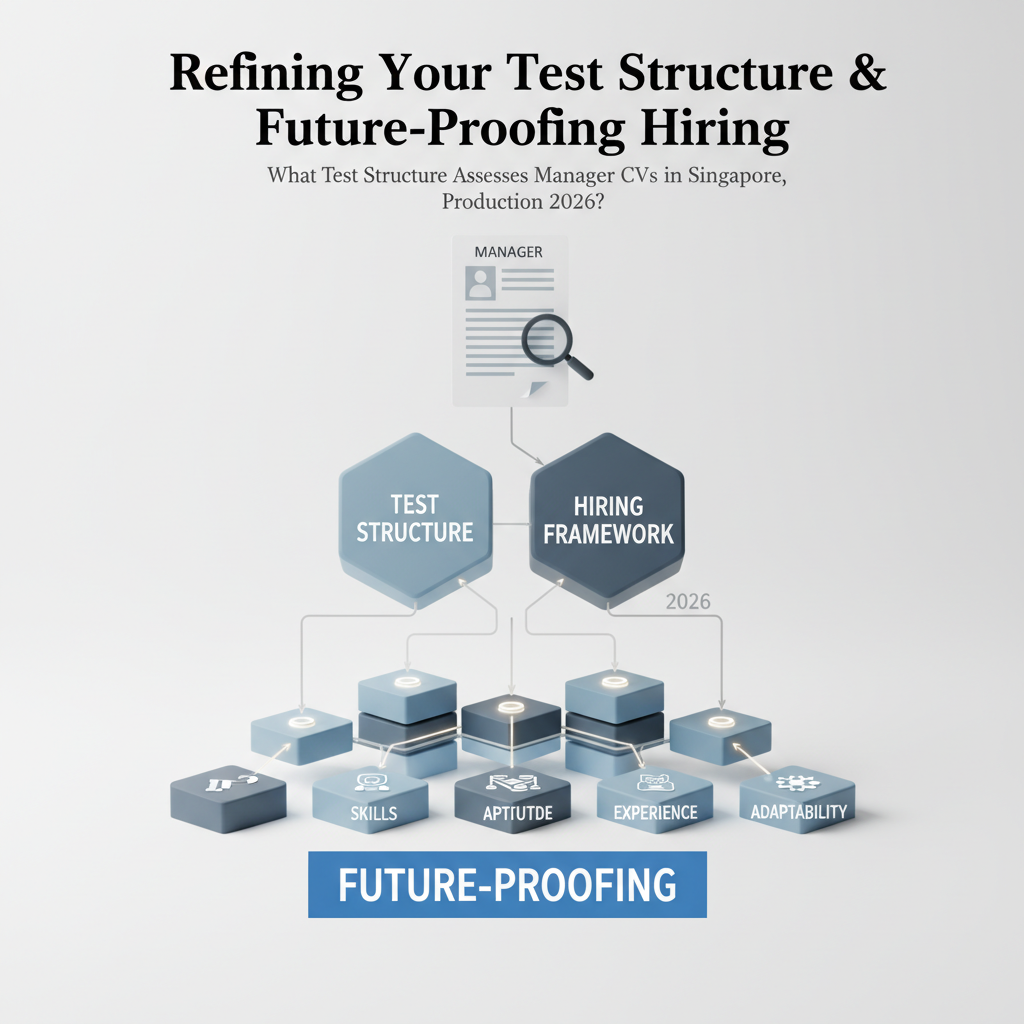
Refining Your Test Structure & Future-Proofing Hiring
In today’s dynamic industrial landscape, particularly within Singapore’s competitive production sector, the ability to recruit and retain top-tier managerial talent is paramount. A well-designed Test structure to assess Manager Level CVs in production field in Singapore is not a static tool but a living framework that requires continuous refinement. This section explores strategies for ongoing improvement of your CV assessment process and how to adapt proactively to future industry trends, thereby ensuring long-term effectiveness in recruitment and securing your organization’s competitive edge.
The goal is to move beyond superficial CV screening, delving deeper into a candidate’s potential, cultural alignment, and future readiness. By integrating sophisticated methodologies and forward-thinking analysis, companies can achieve superior production manager hiring Singapore results, bolstering their operational efficiency and innovation capabilities.
1. Feedback Loops: Improving the Assessment Framework
The journey to an optimized CV assessment framework begins and ends with robust feedback loops. It’s insufficient to simply hire; understanding the post-hire performance of managers is crucial for refining your initial screening criteria. Implement a systematic approach to gather data on the performance of newly hired Production Managers, comparing their on-the-job success against their initial CV assessments and interview scores. This quantitative analysis allows you to identify which aspects of your Test structure to assess Manager Level CVs in production field in Singapore are most predictive of success and which might need adjustment.
Key Performance Indicators (KPIs) such as project completion rates, team productivity, safety record improvements, and adherence to budget are invaluable metrics. By correlating these with specific qualifications, experiences, and soft skills identified during the initial CV assessment process, organizations can make data-driven improvements. Regular review sessions involving hiring managers, HR professionals, and even high-performing employees can provide qualitative insights, discussing discrepancies and successes. This iterative process is the cornerstone of effective recruitment process optimization, ensuring that your framework continuously evolves to meet the specific demands of your production environment.
2. Integrating Cultural Fit and Values Alignment
Beyond technical prowess and relevant experience, a candidate’s cultural fit and alignment with organizational values are increasingly recognized as critical factors for long-term success, especially for leadership roles in Singapore’s diverse and dynamic industrial landscape. A manager who aligns with the company culture is more likely to be engaged, motivate their team effectively, and contribute positively to the overall work environment. This aspect significantly contributes to future-proof talent acquisition by reducing turnover and fostering a harmonious workplace.
To integrate cultural fit into your Test structure to assess Manager Level CVs in production field in Singapore, look for subtle cues in their CV. This might include involvement in team-based projects, volunteering, leadership roles in non-work contexts, or even personal statements that articulate their values. During subsequent interviews, delve deeper into their experiences, asking behavioral questions that reveal how they’ve handled ethical dilemmas, collaborated with diverse teams, or adapted to changing organizational priorities. Tools like personality assessments or situational judgment tests can complement CV screening by providing a more objective measure of a candidate’s alignment with your company’s ethos. Prioritizing cultural fit assessment ensures that your new production manager not only performs well but also thrives within your unique organizational ecosystem.
3. Anticipating Future Skills for Production Leadership in Singapore
The production sector is undergoing rapid transformation, driven by Industry 4.0, automation, AI, and sustainability mandates. For Production Managers in Singapore, this means an evolving skill set beyond traditional operational expertise. To future-proof your hiring, your Test structure to assess Manager Level CVs in production field in Singapore must actively anticipate and assess for these emerging competencies. Key skills now include digital literacy, data analytics for process optimization, change management capabilities to navigate technological adoption, and a strong understanding of sustainable manufacturing practices.
When reviewing CVs, look for evidence of continuous learning, participation in digital transformation projects, experience with lean manufacturing or Six Sigma methodologies, and any certifications in advanced technologies. Assess potential for adaptability and a growth mindset – crucial traits for leaders in a rapidly changing environment. Organizations must perform regular skills gap analysis Singapore manufacturing trends reveal, adapting their assessment criteria accordingly. Understanding the global outlook on future employment skills, such as those highlighted by the World Economic Forum’s Future of Jobs Report, can provide invaluable benchmarks for what constitutes effective leadership competencies assessment in the years to come. By proactively embedding these future-oriented considerations, your recruitment process will secure leaders capable of navigating and driving innovation in tomorrow’s production landscape.
Partner with Shelby Global
You are looking for reliable HR Sevice Suppliers? Contact Shelby Global Now! To connect with verified talents and upgrade your orginization.
—————————————
References
– :
– World Economic Forum’s insights on the Future of Manufacturing: https://www.weforum.org/agenda/2023/12/future-of-manufacturing-2024-report-trends-technology/
– Leveraging AI tools for pre-screening efficiency: https://www.shrm.org/resources-and-tools/hr-topics/technology/artificial-intelligence-in-hr/
– Lean manufacturing principles: https://asq.org/quality-resources/lean
– World Economic Forum’s Future of Jobs Report: https://www.weforum.org/publications/the-future-of-jobs-report-2023/