
Introduction to Vietnam’s Film Industry Landscape
Vietnam’s film industry is experiencing a dynamic transformation, shifting from a nascent market to a burgeoning hub of cinematic creativity and commercial activity. This growth trajectory is not only captivating audiences but also opening up a spectrum of career opportunities for aspiring and seasoned professionals alike. Understanding the current state and future potential of this industry is crucial for anyone looking to navigate its complexities, especially when considering salary range report of jobs in Films field in vietnam and career pathways. The industry’s expansion is driven by a combination of factors, including a young, entertainment-hungry population, increasing disposable incomes, government support, and technological advancements, all contributing to a vibrant and competitive landscape.

1. Recent Growth and Market Trends
The Vietnamese film market has demonstrated remarkable resilience and growth, particularly in the post-pandemic era. Box office revenues have shown a steady incline, with local productions frequently outperforming international blockbusters, a testament to the rising quality and appeal of Vietnamese cinema. This trend is further fueled by a strong nationalist sentiment and a desire for stories that resonate with local culture and experiences. The proliferation of multiplex cinemas across major cities and even provincial areas has also significantly expanded accessibility for audiences. Furthermore, the digital revolution has introduced new distribution channels, with streaming platforms gaining considerable traction, offering alternative avenues for content consumption and revenue generation. The rise of these platforms also creates a demand for new types of content and production expertise, influencing the overall industry landscape in Vietnam and subsequently, the job market. This dynamic environment suggests a positive outlook for professionals, where a detailed salary range report of jobs in Films field in vietnam would highlight increasing remuneration potentials across various roles.
2. Key Players and Production Hubs
The Vietnamese film industry is characterized by a mix of established players and emerging independent studios. Major domestic production and distribution companies like Galaxy Studio, BHD, and CJ HK Entertainment (a joint venture with South Korea’s CJ E&M) dominate the market, often investing in high-budget local films and co-productions. These entities are pivotal in shaping audience preferences and setting industry standards. Alongside these giants, a vibrant ecosystem of smaller independent production houses is flourishing, pushing creative boundaries and often focusing on niche genres or auteur-driven projects. Ho Chi Minh City remains the undisputed heart of the film industry, housing the majority of production facilities, talent agencies, and post-production studios. Hanoi also serves as a significant hub, particularly for documentary filmmaking, state-funded projects, and cultural preservation initiatives, offering distinct career paths. The concentration of these key players and resources in these hubs means that aspiring professionals often gravitate towards these cities for better access to opportunities and career progression. Understanding these geographical and corporate landscapes is essential for effective career planning within the film sector.
3. Challenges and Opportunities for Professionals
While the Vietnamese film industry is on an upward trajectory, it faces several challenges that impact professionals. Issues such as limited budgets for independent projects, piracy, and a sometimes-stringent censorship framework can hinder creative freedom and financial returns. Furthermore, there’s a recognized skill gap in certain specialized areas, including visual effects (VFX), advanced sound design, and international-standard scriptwriting and producing. However, these challenges simultaneously present significant opportunities. The demand for skilled professionals who can navigate these hurdles and bring international best practices to the local market is high. There’s a growing need for talent in areas like digital content creation, streaming platform management, and cross-cultural co-productions. Government initiatives aimed at promoting Vietnamese culture through cinema, coupled with increasing international interest in collaborating on projects, further broaden the scope for local talent. For professionals, this means investing in continuous learning and adapting to new technologies and global standards can lead to substantial career advancement and more competitive compensation. A comprehensive salary range report of jobs in Films field in vietnam would clearly illustrate how specialized skills and experience in these high-demand areas can command premium salaries, making the sector an attractive prospect for ambitious individuals.
Understanding Film Job Roles and Their Salary Tiers
The Vietnamese film industry is experiencing a dynamic period of growth, fueled by local talent and increasing international interest. This surge presents exciting career opportunities across various departments, making it crucial for aspiring and established professionals alike to understand the diverse salary range report of jobs in Films field in vietnam. From storytelling to technical demands, each role comes with unique responsibilities and corresponding remuneration. This breakdown explores common job roles, categorizing them by typical salary expectations and required skills, offering insights into Vietnamese film industry salaries, film production jobs Vietnam, media career path Vietnam, and cinema job roles Vietnam.
The local cinematic landscape is evolving, embracing international standards and digital innovation. This expansion means a greater demand for skilled professionals. Understanding typical salary tiers is vital for career planning and negotiation within this exciting, yet competitive, sector.
-
Entry-Level Positions: Production Assistants, Interns
Entry-level roles offer invaluable hands-on experience and a steep learning curve. Production Assistants (PAs) and Interns are crucial for smooth operations, handling administrative tasks, logistics, and on-set support. Internships, often minimally compensated, provide observation opportunities across different filmmaking facets.
These roles demand high energy, adaptability, a strong work ethic, and communication skills. The initial salary range report of jobs in Films field in vietnam for these positions typically ranges from 4,000,000 VND to 8,000,000 VND per month. Despite modest compensation, they offer unparalleled networking and a direct path to understanding industry workings. Many successful filmmakers began in these foundational roles.
-
Mid-Level Roles: Camera Operators, Editors, Assistant Directors
As professionals gain experience and hone specialized skills, they transition into mid-level roles with greater responsibility and specific expertise, crucial for executing creative vision and managing complex logistics.
-
Camera Operators: Operate cameras, frame shots, and ensure visual quality under the Director of Photography. Requires a keen eye and technical proficiency. Salaries typically fall between 10,000,000 VND and 25,000,000 VND per month, depending on portfolio and project scale.
-
Editors: Assemble raw footage into a coherent, engaging final product. Requires a strong sense of storytelling, mastery of editing software (e.g., Adobe Premiere Pro), and meticulous attention to detail. Compensation ranges from 12,000,000 VND to 30,000,000 VND per month, influenced by experience and project complexity.
-
Assistant Directors (ADs): Manage daily on-set logistics, schedules, and discipline. The 1st AD translates the director’s vision into a workable plan. Requires exceptional organizational skills, leadership, and ability to work under pressure. ADs can expect salaries from 15,000,000 VND to 35,000,000 VND per month, with higher rates for extensive feature film experience.
These mid-level positions reflect a significant step up in skill demand and accountability, offering competitive Vietnamese film industry salaries for proficient professionals.
-
Senior and Specialized Roles: Directors, Producers, Cinematographers
At the pinnacle of the film hierarchy are senior and specialized roles commanding significant creative and managerial authority. These individuals, with extensive experience and proven artistic vision, contribute significantly to Vietnam’s burgeoning digital economy and creative sectors growth.
-
Directors: The creative visionary, guiding artistic and dramatic aspects, interpreting the screenplay, and managing performances. Requires exceptional leadership, storytelling, and deep understanding of filmmaking. Salaries are highly variable, often project-based, ranging from 30,000,000 VND to over 100,000,000 VND per project or per month, with top-tier directors earning significantly more.
-
Producers: The logistical and financial architects, initiating, coordinating, and managing film creation from funding to distribution. Requires strong business acumen, networking, and problem-solving. Salaries are highly project-dependent, often with profit-sharing, ranging from 35,000,000 VND to well over 150,000,000 VND per project for significant productions.
-
Cinematographers (DPs): Responsible for artistic and technical imaging decisions. Works with the director to establish visual style, overseeing camera and lighting. Demands understanding of composition, lighting, and technology with artistic sensibility. Experienced DPs command salaries from 25,000,000 VND to 80,000,000 VND per month or per project.
These roles represent the pinnacle of a media career path Vietnam, requiring years of dedication, continuous skill development, and a proven ability to deliver high-quality cinematic works. Compensation reflects immense responsibility and creative input.
The Vietnamese film industry offers a vibrant landscape for creative professionals. While entry-level positions provide a crucial foundation, dedication and networking lead to lucrative mid-level and specialized senior roles. As the industry flourishes, understanding these job roles and their corresponding salary range report of jobs in Films field in vietnam is key to navigating a successful career in Vietnamese cinema.
Factors Influencing Salary in Vietnam’s Film Sector
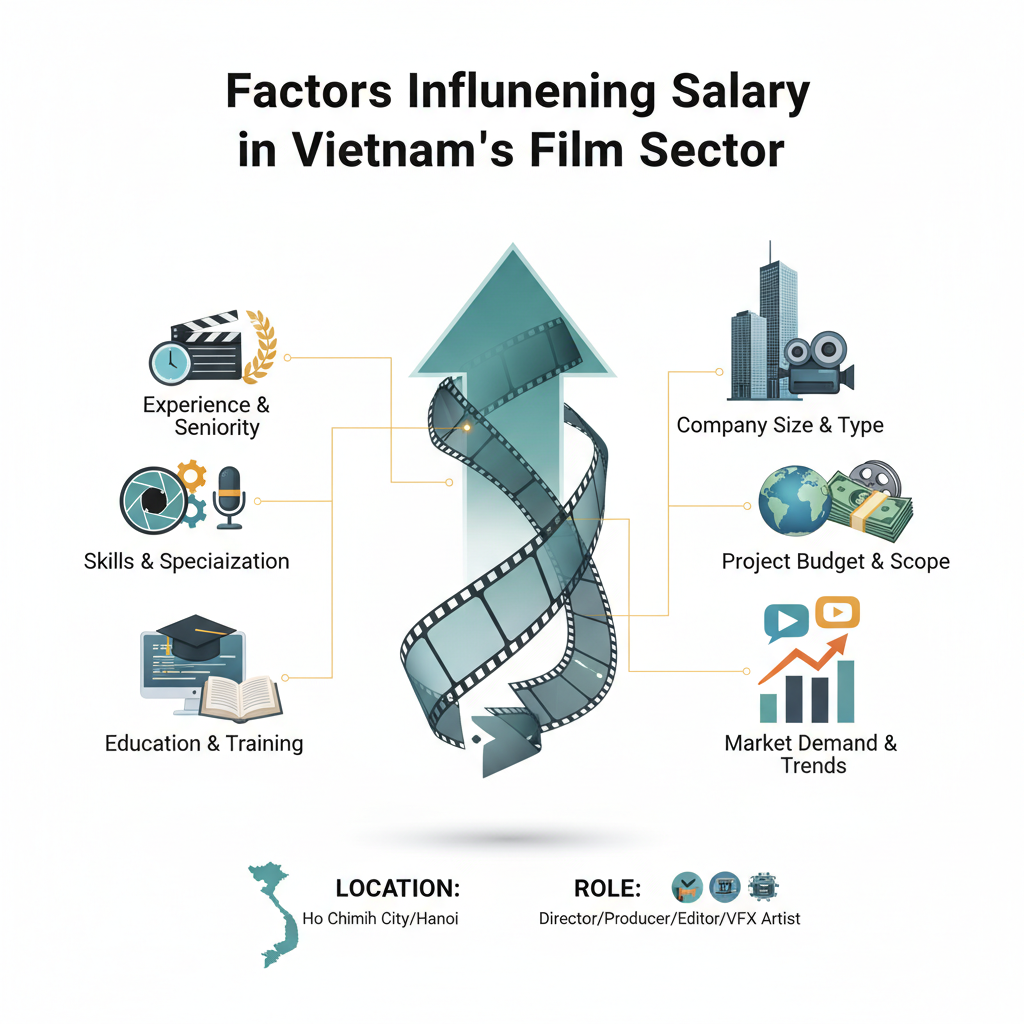
The vibrant and rapidly expanding film industry in Vietnam presents a dynamic landscape for professionals, but understanding the salary range report of jobs in Films field in vietnam requires a nuanced analysis of several critical elements. From burgeoning independent productions to large-scale international collaborations, the earning potential within the sector, including for various film production jobs Vietnam, is shaped by a confluence of factors. This section will delve into the key determinants that dictate an individual’s income, offering insights for those looking to build a career or gauge their earning potential within Vietnam’s burgeoning creative industry income Vietnam.
1. Experience Level and Portfolio Strength
Undoubtedly, experience remains the paramount factor influencing salary levels across all roles in the Vietnamese film industry, from aspiring assistants to seasoned directors and cinematographers. Entry-level positions typically command more modest incomes, reflecting the need for on-the-job training and skill development. As professionals accumulate years of experience, their market value significantly increases. A strong, diverse portfolio showcasing successful projects and a range of acquired skills is crucial. For instance, a talented editor with five years of experience working on award-winning shorts will command a higher rate than someone with similar experience but a less impressive body of work. Specialised skills, such as expertise in visual effects (VFX), advanced colour grading, or drone operation, also elevate earning potential due to their niche demand. Freelance professionals, in particular, heavily rely on their portfolio and reputation to secure higher-paying gigs, with proven track records leading to more consistent and lucrative opportunities within the industry.
2. Project Type: Commercials vs. Feature Films vs. TV Series
The nature of the production itself plays a significant role in determining the pay scale for media professional earnings Vietnam. Commercials, often characterised by their fast-paced production cycles and higher budgets per minute of content, frequently offer the highest daily or project-based rates for crew members and talent. This is due to the demanding schedules, high client expectations, and the direct link to marketing returns for brands. Feature films, while prestigious and often requiring longer commitments, tend to have varying budget scales. Large-budget international or domestic blockbusters can offer competitive salaries and longer contracts, while independent or art-house films might operate on tighter budgets, leading to lower, albeit still respectable, compensation. TV series production, especially for major broadcasters or streaming platforms, can offer stable, long-term employment with consistent salaries, though daily rates might be slightly lower than high-end commercials. The scale, duration, and funding source of the project dictate the overall film crew rates Ho Chi Minh and nationwide.
3. Geographical Location: Ho Chi Minh City vs. Hanoi vs. Other Cities
Location is a critical determinant of salary in Vietnam’s film sector. Ho Chi Minh City (HCMC) stands as the undisputed hub of the nation’s film and advertising industries. With the highest concentration of production houses, advertising agencies, post-production studios, and talent agencies, HCMC offers the most opportunities and, consequently, the highest average salaries. The sheer volume of projects, including many international collaborations, drives up demand for skilled professionals. Hanoi, while a significant cultural and political center, has a smaller, though growing, film market, which generally translates to slightly lower pay scales compared to HCMC. Other cities, such as Da Nang or Can Tho, possess emerging creative scenes but offer considerably fewer film production opportunities and therefore lower earning potentials. Professionals often migrate to HCMC to access better projects and higher incomes, highlighting the centralisation of the industry’s economic power.
Detailed Salary Range Report for Key Film Positions (2026 Projections)
Description: Providing specific estimated salary ranges for prominent film jobs across various departments, with a focus on 2026 projections based on current trends.
The Vietnamese film industry is experiencing a dynamic period of growth, fueled by increasing local demand, international collaborations, and advancements in production capabilities. This expansion naturally translates into a heightened demand for skilled professionals across various departments, subsequently influencing compensation structures. Understanding the potential salary range report of jobs in Films field in Vietnam is crucial for both aspiring talent and established industry veterans. This report provides 2026 salary projections for key film positions, offering insights into expected compensation based on current market trends, economic indicators, and the growing complexity of film productions in Vietnam. These figures are estimates and can vary significantly based on experience, project scale, company reputation, and negotiation skills.
1. Director & Assistant Director Salary Insights
The visionaries and orchestrators of any film project, Directors and Assistant Directors command substantial compensation, reflecting their critical roles in bringing a narrative to life. Their salaries are often project-based, with significant variations influenced by the film’s budget, genre, the director’s track record, and the project’s commercial potential.
- Director: By 2026, a Director in Vietnam can expect a project fee ranging from 70,000,000 VND to 250,000,000 VND for a mid-budget feature film. Highly acclaimed directors working on major commercial or international co-productions may command upwards of 500,000,000 VND to 1,000,000,000+ VND per project, often including performance bonuses or profit shares. For more consistent, long-form work like TV series or high-profile commercial campaigns, monthly retainers could range from 30,000,000 VND to 80,000,000 VND.
- Assistant Director (AD): Essential for on-set logistics, scheduling, and maintaining production flow, an AD’s compensation reflects their organizational prowess. In 2026, an experienced First Assistant Director could project to earn between 20,000,000 VND and 45,000,000 VND per project for a feature film, or 18,000,000 VND to 35,000,000 VND per month for extended productions. Junior ADs or Second ADs would typically fall into the 10,000,000 VND to 20,000,000 VND range per project/month.
2. Producer & Production Manager Compensation
Producers and Production Managers are the backbone of any film, handling everything from financing and legalities to logistics and resource allocation. Their compensation often reflects the immense responsibility and the success of the project they manage.
- Producer: The salary for a Producer in Vietnam is highly variable, often tied to the project’s budget and sometimes including backend participation. For a standalone feature film in 2026, a Producer might expect a fee of 80,000,000 VND to 300,000,000 VND. For executive producers on major studio films or high-grossing commercial projects, this can easily escalate into the billions with profit shares. For those managing a production house or multiple smaller projects, a monthly salary could be in the range of 40,000,000 VND to 100,000,000 VND, depending on the scale of operations and the robust economic growth driving the creative sector in Vietnam.
- Production Manager (PM): Responsible for keeping the production on schedule and within budget, PMs are critical. By 2026, an experienced Production Manager could anticipate earning between 25,000,000 VND and 60,000,000 VND per project for features, or a monthly salary of 22,000,000 VND to 45,000,000 VND for ongoing work in commercial or television production.
3. Camera, Sound & Editing Crew Wages
The technical and post-production crews are the artisans who craft the visual and auditory experience of a film. Their specialized skills are increasingly valued as production quality standards rise.
- Director of Photography (DP)/Cinematographer: Tasked with the film’s visual style, a DP’s expertise is highly sought after. In 2026, a skilled DP in Vietnam can expect project fees between 30,000,000 VND and 80,000,000 VND for feature films. For commercial shoots or television series, monthly rates might range from 25,000,000 VND to 50,000,000 VND.
- Camera Operator: Working under the DP, Camera Operators ensure shots are executed precisely. Their projected wages for 2026 could be between 15,000,000 VND and 30,000,000 VND per project or month, depending on experience and the complexity of the equipment.
- Sound Mixer/Recordist: Crucial for capturing clean, high-quality audio on set, a Sound Mixer’s skill is paramount. By 2026, their compensation could range from 15,000,000 VND to 30,000,000 VND per project for features, or a similar monthly rate for episodic content and commercials.
- Editor: The Editor shapes the narrative and rhythm of the film in post-production. An experienced Editor can expect project-based fees of 20,000,000 VND to 50,000,000 VND for a feature film in 2026. For regular commercial or TV work, monthly salaries could fall between 18,000,000 VND and 35,000,000 VND.
The Vietnamese film industry continues to mature, and with it, the demand for specialized talent will only grow. These 2026 salary projections offer a glimpse into the evolving compensation landscape. Professionals with niche skills, a strong portfolio, and a willingness to adapt to new technologies will be particularly well-positioned to command the higher end of these estimated salary ranges. Continued professional development and networking remain key to thriving in this exciting sector.
Career Growth and Future Outlook for Film Professionals in Vietnam
The Vietnamese film industry is experiencing a dynamic transformation, moving beyond its foundational stages to embrace a future brimming with potential. This evolution translates directly into diverse pathways for career advancement and a promising trajectory for professionals working in film. As the sector matures, driven by technological innovations, increasing local and international investment, and a burgeoning audience, we anticipate significant shifts in skill demands and, critically, an upward trend in future salary ranges. Understanding these evolving dynamics is crucial for anyone looking to build a sustainable and lucrative career in the vibrant film industry Vietnam, positioning themselves for higher-paying film production jobs.

1. Upskilling and Specialization for Higher Pay
In a rapidly evolving landscape, the value of continuous learning cannot be overstated for film professionals in Vietnam. Specialized skills are increasingly sought after, commanding higher remuneration as studios and production houses compete for top talent. Areas such as advanced visual effects (VFX), 3D animation, immersive sound design, color grading, and virtual production are no longer niche but becoming integral to contemporary filmmaking. Professionals who invest in mastering these skills through workshops, certifications, and advanced degrees will find themselves in a premium pay bracket. For instance, a skilled VFX artist capable of working on international-standard projects can expect significantly higher compensation than a generalist editor. Similarly, expertise in emerging technologies like AI-driven production tools or interactive storytelling for new media platforms presents unique opportunities for career advancement film. The demand for highly specialized technicians and creative minds, particularly those proficient in industry-standard software and hardware, is set to intensify, driving salaries upwards for those who can deliver cutting-edge results in the vietnamese film market.
2. Impact of International Co-productions on Local Salaries
The increasing number of international co-productions in Vietnam is a game-changer for local talent, directly influencing salary benchmarks. These collaborations bring not only substantial foreign investment and advanced technologies but also introduce global production standards and practices. Local professionals involved in these projects often gain invaluable experience working alongside international crews, adopting new methodologies, and expanding their professional networks. Crucially, these projects typically operate with larger budgets, allowing for higher pay rates for local film production jobs, bringing them closer to international standards. This exposure elevates the skill sets of Vietnamese crews and artists, making them more competitive and desirable for future projects, both local and international. Professionals with strong communication skills, particularly in English, who can seamlessly integrate into diverse cultural and operational environments, are especially valuable. The ripple effect of these co-productions is expected to raise the overall salary range report of jobs in Films field in Vietnam, as local productions strive to retain top talent by offering more competitive compensation.
3. Forecasting Future Salary Trends (2026 and Beyond)
Looking ahead to 2026 and beyond, several factors point towards a robust future for salaries in the Vietnamese film industry. Continued economic growth, coupled with increased government support for cultural industries, will likely boost investment in local film production. The rise of streaming platforms (both international and local) is creating a consistent demand for high-quality content, translating into more job opportunities and competitive salaries across the entire production pipeline. Technological advancements will continue to open new avenues, particularly in post-production, animation, and game development (which often shares talent pools with film), where specialized roles will command premium rates. The maturing vietnamese film market, with its growing audience and critical acclaim for local films, will further solidify its economic viability. While entry-level salaries may see steady but moderate increases, the most significant growth in compensation will be observed for professionals with niche skills, extensive experience, and a proven track record of working on successful, high-budget projects, especially those with an international scope. A comprehensive salary range report of jobs in Films field in Vietnam will increasingly reflect this demand for specialized expertise and international exposure, making strategic career planning and continuous skill development paramount for long-term success and higher earning potential.
Partner with Shelby Global
You are looking for reliable HR Sevice Suppliers? Contact Shelby Global Now! To connect with verified talents and upgrade your orginization.
—————————————
References
– Vietnam’s Film Industry on the Rise: Challenges and Opportunities: https://www.vietnam-briefing.com/news/vietnams-film-industry-on-the-rise-challenges-and-opportunities.html/
– Southeast Asia’s digital economy: A new generation: https://www2.deloitte.com/sg/en/pages/consumer/articles/sea-digital-economy-report-2022.html
– :
– World Bank: Vietnam Overview: https://www.worldbank.org/en/country/vietnam/overview
– Vietnam’s film industry on the rise – VnExpress International: https://e.vnexpress.net/news/culture/vietnam-s-film-industry-on-the-rise-4648705.html