
Understanding the Foundations: SME vs. Corporate HR
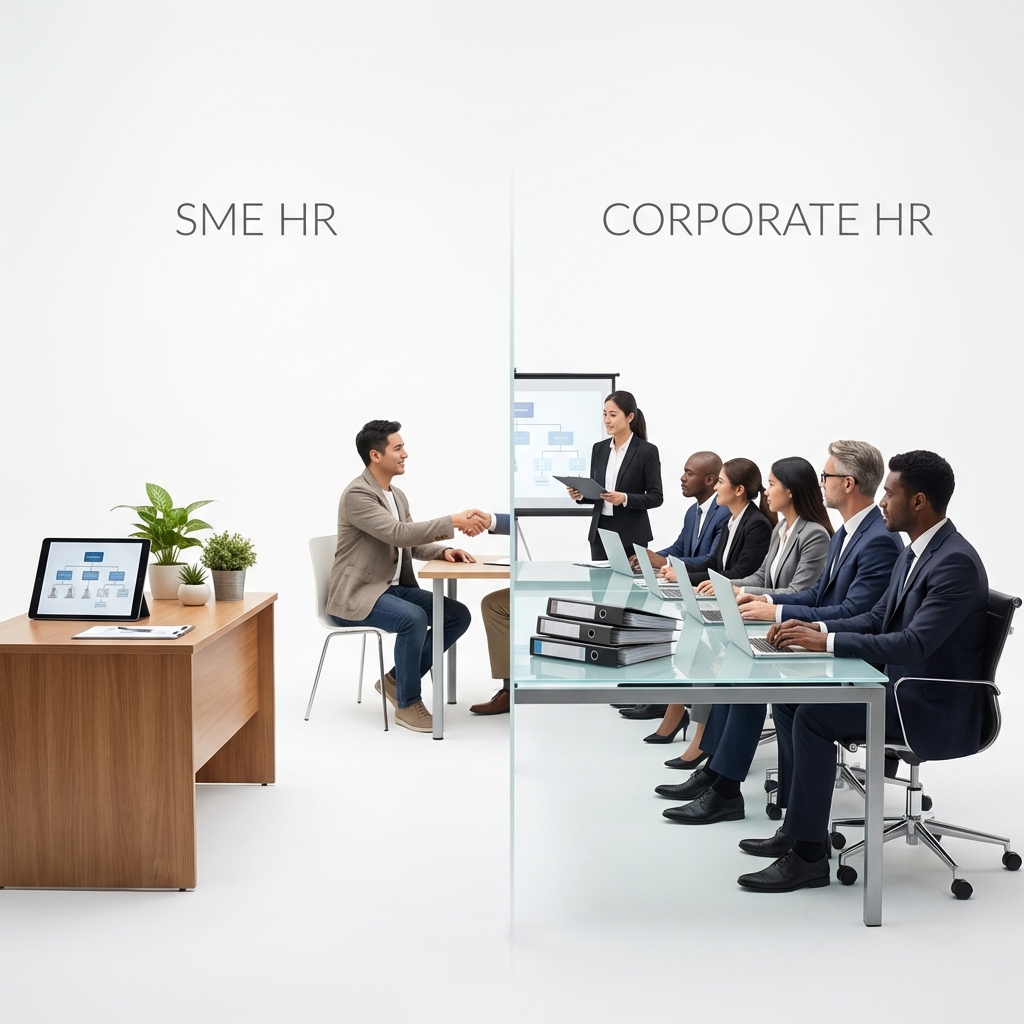
The landscape of Human Resources (HR) management in Malaysia’s vibrant production sector is remarkably diverse, primarily shaped by the size and operational scale of the companies involved. This section introduces the fundamental characteristics of HR structures within Small and Medium Enterprises (SMEs) and large Corporates, specifically within Malaysia’s production sector. It highlights initial distinguishing factors that set them apart, laying the groundwork for understanding the nuanced Differences between the SMEs’ HR Structure and the Corporates’ HR Structure in production field in malaysia.
1. Defining HR Structure in Malaysian SMEs (Production)
In the context of Malaysian SMEs within the production field, the HR structure is typically lean, agile, and often highly integrated with other operational functions. HR responsibilities are frequently handled by a multi-hatted individual, such as the owner, a general manager, or a dedicated HR executive who manages everything from recruitment and payroll to employee relations and basic training. Specialization is rare, and processes are often less formalized, relying heavily on direct communication and ad-hoc decision-making. For these enterprises, the primary focus of HR is often on compliance with local labor laws (e.g., Employment Act 1955, EPF, SOCSO) and ensuring the workforce is sufficient for daily production demands. Training programs, if any, are usually on-the-job and focused on immediate operational needs. The informal nature can foster a strong sense of community and direct access to leadership, but it can also lead to inconsistencies in policy application and limited strategic HR planning. This distinct approach underscores the unique challenges and characteristics faced by SMEs in Malaysia.
2. Defining HR Structure in Malaysian Corporates (Production)
Conversely, large Corporates in Malaysia’s production sector boast highly structured and specialized HR departments. These organizations typically feature dedicated teams for various HR functions, including talent acquisition, compensation and benefits, learning and development, HR business partnering, industrial relations, and HR information systems (HRIS). Processes are meticulously formalized, often governed by extensive policies and procedures that ensure consistency and compliance across multiple production sites, or even international operations. Strategic HR planning is integral, with HR departments actively contributing to business objectives such as workforce planning, talent pipeline development, and fostering a strong corporate culture. Comprehensive benefits packages, structured career development paths, and advanced HR technologies are common. The sheer scale necessitates robust HR systems to manage a large, diverse workforce, ensure advanced safety protocols, and navigate complex industrial relations, marking a clear distinction in the HR structure and its operational impact.
3. Core Differentiating Factors: Scale, Resources, and Scope
The primary Differences between the SMEs’ HR Structure and the Corporates’ HR Structure in production field in malaysia can be distilled into three core factors: scale, resources, and scope.
- Scale: SMEs operate with smaller workforces, often at a single or a few localized production facilities. This allows for more direct, informal HR interactions. Corporates, managing thousands of employees across numerous domestic and sometimes international production plants, require formalized, scalable HR systems and robust communication channels. The scale impacts everything from recruitment volume to the complexity of industrial relations.
- Resources: Corporates generally possess significantly larger budgets for HR. This translates into dedicated HR staff, investment in sophisticated HRIS, extensive training programs, and competitive compensation and benefits. SMEs often operate with limited budgets, relying on cost-effective solutions, basic HR software (if any), and leveraging external consultants for specialized needs rather than maintaining in-house expertise.
- Scope: The scope of HR’s influence and strategic involvement also varies dramatically. In SMEs, HR is often transactional, focused on administrative tasks and immediate compliance. While essential, it rarely participates in high-level strategic business planning. In contrast, corporate HR is typically strategic, acting as a business partner involved in shaping organizational strategy, talent management, and fostering a culture that drives long-term success. This includes complex talent acquisition strategies for specialized production roles, advanced performance management, and comprehensive succession planning, all aimed at supporting the enterprise’s broader objectives.
Understanding these foundational differences is crucial for anyone navigating the Malaysian production sector, whether as an HR professional, an entrepreneur, or a policymaker. These distinctions dictate the challenges faced, the solutions implemented, and ultimately, the impact of HR on the overall business performance.
Talent Acquisition & Development Strategies
Examining the Malaysian production sector reveals distinct approaches to attracting, hiring, and nurturing talent between Small and Medium-sized Enterprises (SMEs) and large Corporates. The differences between the SMEs’ HR structure and the Corporates’ HR structure in the production field in Malaysia significantly shape their talent management strategies, influencing everything from budget allocation to long-term development plans. Understanding these nuances is crucial for both job seekers and policymakers aiming to strengthen Malaysia’s industrial workforce.
1. Recruitment Channels and Branding Power
The initial phase of talent acquisition – attracting candidates – highlights a stark contrast. Corporates in the Malaysian production sector typically leverage their strong brand recognition and larger recruitment budgets to cast a wide net. They often utilise premium job portals, professional networking sites like LinkedIn, extensive university outreach programs, and even engage executive search firms for specialized roles. Their established global or national reputation serves as a powerful employer brand, making them attractive to a broader pool of candidates seeking stability, structured career paths, and competitive remuneration packages. For instance, the latest Hays Malaysia Salary Guide 2024 often reflects the competitive salaries and benefits offered by larger entities, further solidifying their appeal.
Conversely, Malaysian production SMEs often operate with tighter budgets and less developed employer branding. Their recruitment efforts tend to be more localized and rely heavily on informal channels such as word-of-mouth referrals, local community networks, and more cost-effective regional job boards. While they may not offer the same level of brand prestige or salary, SMEs often attract talent through promises of a close-knit culture, direct impact, and opportunities for broader role exposure. The challenge for SMEs lies in building a compelling value proposition that stands out amidst the branding power of larger players, often necessitating creative strategies to highlight their unique workplace culture and growth potential.
2. Onboarding, Training, and Skill Development Programs
Once talent is acquired, the approach to onboarding and development also diverges significantly. Corporates typically implement comprehensive, multi-stage onboarding programs that can last several weeks or even months, designed to integrate new hires into large, complex organizational structures and foster a deep understanding of corporate culture and processes. Their training and skill development budgets are substantial, allowing for investment in state-of-the-art e-learning platforms, external professional certifications, leadership development programs, and rotational assignments. This systematic approach ensures employees gain specialized skills, align with strategic objectives, and are prepared for future leadership roles, forming a robust talent pipeline.
In contrast, SMEs often adopt a more agile and less formal approach to onboarding and training. New hires typically undergo a rapid, hands-on orientation, often involving direct mentorship from experienced colleagues or the owner themselves. Formal training budgets are usually limited, leading SMEs to rely heavily on on-the-job training (OJT) and internal knowledge transfer. Where external training is sought, it’s often through government-backed initiatives like those offered by HRD Corp (Human Resources Development Corporation) in Malaysia, which provides grants for upskilling and reskilling. While less structured, this environment can foster multi-skilling, as employees in SMEs often take on a wider range of responsibilities, developing a broader skill set out of necessity. This direct, practical learning can lead to rapid skill acquisition, albeit in a less formalized framework.
3. Performance Management and Career Progression Paths
The final phase – managing performance and charting career progression – again reveals fundamental differences. Corporates in the Malaysian production sector typically employ sophisticated performance management systems, including key performance indicators (KPIs), regular performance reviews, 360-degree feedback mechanisms, and structured annual appraisal cycles. These systems are often directly linked to salary increments, bonuses, and formal promotion pathways, providing clear, transparent career progression within a defined organizational hierarchy. Succession planning is a critical component, identifying and preparing high-potential employees for future leadership roles, ensuring continuity and stability.
SMEs, on the other hand, often adopt more informal and flexible performance management practices. Feedback is frequently direct, continuous, and less structured, often coming from immediate supervisors or the company owner. While less formalized, this direct interaction can lead to a more personalized development experience. Career progression paths in SMEs are generally less rigid; advancements might not follow a strict ladder but rather emerge organically as the company grows or new roles are created. Employees might find themselves taking on significantly expanded responsibilities or even new departments, offering unique entrepreneurial opportunities and rapid growth in influence. Recognition and rewards, while potentially less standardized, can often feel more personal and immediate, reflecting the close-knit nature of the SME environment. These intrinsic rewards, coupled with opportunities for significant impact, are often key motivators in the SME landscape, complementing the formal structures found in larger corporations.
Compensation, Benefits & Regulatory Compliance
The operational landscape within Malaysia’s production industry presents a stark contrast in how Human Resources departments in Small and Medium-sized Enterprises (SMEs) versus Corporates manage compensation, employee benefits, and adherence to intricate labor laws. These disparities are crucial in understanding the broader differences between the SMEs’ HR structure and the Corporates’ HR structure in the production field in Malaysia, influencing everything from talent attraction to operational risk.
1. Salary Structures, Incentives, and Total Rewards
In the Malaysian production industry, the approach to salary structures and incentives varies significantly. SMEs often operate with more flexible, less formalized salary structures. Compensation may be heavily influenced by direct negotiations, individual performance rather than rigid pay grades, and market rates specific to their immediate locality or niche. Incentive programs, if present, are typically simpler, such as annual bonuses tied directly to company profitability or individual output targets, with less emphasis on sophisticated total rewards packages. Their capacity to offer extensive long-term incentives or complex share option schemes is generally limited by budgetary constraints and organizational scale.
Conversely, Corporates in the production sector boast highly structured salary grades, often benchmarked against regional and international industry standards. Their compensation philosophy usually incorporates a more sophisticated total rewards approach, encompassing not just base salary but also performance-based bonuses, commissions, long-term incentives, and sometimes equity participation. These structures are meticulously designed to attract top talent, promote internal equity, and drive strategic business objectives. Furthermore, Corporates often invest in robust job evaluation systems and regular market salary surveys to ensure their compensation remains competitive and aligned with their strategic goals, a level of sophistication rarely seen in SMEs due to resource limitations.
2. Employee Benefits Packages: Health, Wellness, and Perks
Employee benefits are another key area illustrating the differences between the SMEs’ HR structure and the Corporates’ HR structure in the production field in Malaysia. SMEs typically provide statutory benefits as mandated by Malaysian law, including contributions to the Employees Provident Fund (EPF), Social Security Organization (SOCSO), and Employment Insurance System (EIS). Beyond these, non-statutory benefits might be basic, such as limited medical outpatient coverage or a minimal annual leave entitlement, largely constrained by cost. Wellness programs, comprehensive health insurance, or extensive perks are often beyond their immediate financial reach, though some may offer basic group personal accident insurance.
Corporates, with their larger financial muscle, tend to offer much more comprehensive benefits packages. These often include extensive group medical insurance (covering hospitalization, specialists, and dental/vision care), enhanced leave policies (e.g., paternity leave beyond statutory requirements, compassionate leave), and well-being programs (e.g., gym memberships, health screenings, employee assistance programs). Many also offer additional perks like subsidized meals, transportation allowances, professional development budgets, and robust retirement planning support. These enhanced benefits are critical tools for talent attraction and retention, providing a significant competitive edge over SMEs in a tight labor market.
3. Navigating Malaysian Labor Laws and HR Compliance
Adherence to Malaysian labor laws and regulatory compliance presents one of the most significant operational challenges, especially when considering the differences between the SMEs’ HR structure and the Corporates’ HR structure in the production field in Malaysia. SMEs often rely on generalist HR personnel, if they have a dedicated HR department at all, or outsource critical compliance functions. Their understanding and implementation of complex regulations like the Employment Act 1955, Occupational Safety and Health Act (OSHA) 1994, and various foreign worker policies can sometimes be less robust. This reliance can lead to inadvertent non-compliance, exposing them to fines, legal disputes, and reputational damage.
Corporates, on the other hand, typically possess dedicated legal and compliance teams within HR, or access to specialized external legal counsel. They invest heavily in understanding and proactively managing HR compliance risks. This includes rigorous adherence to Malaysian labor laws, meticulous record-keeping, regular audits, and comprehensive training for managers on employment best practices. Furthermore, Corporates are often at the forefront of implementing new regulations, ensuring their policies on industrial relations, grievance handling, and workplace safety are not just compliant but often exceed minimum statutory requirements. This proactive approach minimizes legal exposure and fosters a more stable and ethical work environment, which is paramount in the high-risk production sector. The extensive resources and expertise available to corporates allow for a more sophisticated and proactive approach to regulatory adherence, a stark contrast to the often reactive, resource-constrained approach of many SMEs in the Malaysian production industry.
HR Technology Adoption & Digital Transformation
In the dynamic landscape of Malaysia’s production sector, the journey towards digital transformation within Human Resources (HR) departments varies significantly between Small and Medium-sized Enterprises (SMEs) and large Corporates. Understanding the fundamental Differences between the SMEs’ HR Structure and the Corporates’ HR Structure in production field in malaysia is crucial for appreciating their distinct approaches to HR technology adoption. While both strive for enhanced efficiency and strategic decision-making, the scale of investment, complexity of systems, and the underlying strategic objectives often dictate a divergent path. Corporates, with their extensive resources and multi-layered operations, typically lead the charge in implementing sophisticated HR solutions, whereas SMEs often adopt a more phased, cost-conscious, and modular approach. This section will delve into these varying degrees of leveraging Human Resources Information Systems (HRIS), automation, and digital tools to enhance HR functions.
-
HRIS Implementation and Accessibility
The implementation and accessibility of Human Resources Information Systems (HRIS) represent a primary distinguishing factor. For many SMEs in Malaysia’s production sector, HRIS adoption often begins with basic, cloud-based solutions designed to manage core functions efficiently without significant upfront capital expenditure. These systems are typically chosen for their user-friendliness, scalability, and affordability, allowing SMEs to digitize essential records, track employee data, and centralize basic HR information. Accessibility in this context often means straightforward web or mobile interfaces, enabling HR personnel, and sometimes employees, to access information and perform simple tasks. However, the depth of functionality might be limited, often focusing on compliance and administrative convenience rather than advanced strategic insights.
In stark contrast, large Corporates in Malaysia often invest in comprehensive, enterprise-level HRIS platforms that integrate a vast array of functionalities across different departments and global operations. Solutions from providers like SAP SuccessFactors, Oracle HCM Cloud, or Workday are common, offering modules for talent management, performance appraisal, recruitment, learning & development, and workforce analytics, alongside core HR functions. The accessibility of these systems is typically multi-tiered, with self-service portals for employees and managers, detailed dashboards for HR specialists, and advanced reporting tools for leadership. These sophisticated HRIS are not just record-keeping systems; they are strategic tools designed to support complex organizational structures, ensure regulatory compliance across multiple jurisdictions, and provide a single source of truth for all HR-related data. The depth of integration with other enterprise systems, such as ERP and financial software, further amplifies their strategic value.
-
Automation of HR Processes (Payroll, Leave, Attendance)
Automation within HR processes like payroll, leave management, and attendance tracking is another area where the disparity between SMEs and Corporates becomes evident. SMEs typically prioritize automating the most time-consuming and compliance-critical tasks. Payroll processing, often prone to manual errors, is a prime candidate for automation, reducing administrative burden and ensuring timely, accurate salary disbursements. Similarly, automated leave management systems streamline requests, approvals, and balance tracking, while digital attendance systems (e.g., biometric, mobile-based) replace manual logbooks. The goal here is predominantly operational efficiency, freeing up HR staff from repetitive tasks to focus on more value-added activities, albeit on a smaller scale. These automation efforts are often implemented through standalone modules or integrated basic HRIS.
Corporates, on the other hand, embrace extensive and deeply integrated automation across virtually all HR processes. Their payroll systems are highly sophisticated, handling complex tax structures, varied compensation plans, and multi-country payroll requirements, often with real-time analytics. Leave and attendance management are integrated with workforce scheduling, project management tools, and performance systems, providing a holistic view of employee availability and productivity. Furthermore, automation extends beyond administrative tasks to areas like recruitment (applicant tracking systems, AI-powered screening), onboarding workflows, performance management cycles, and even learning path assignments. This comprehensive automation aims not just for efficiency but also for scalability, consistency, enhanced employee experience, and robust compliance across a large and often geographically dispersed workforce. According to a report by Deloitte, organizations that effectively leverage HR automation can significantly improve operational efficiency and decision-making, highlighting a global trend that large Malaysian Corporates are actively embracing. Deloitte’s insights on HR technology and automation trends underscore the transformative potential when applied strategically.
-
Data Analytics and Strategic HR Decision-Making
The ability to leverage data analytics for strategic HR decision-making marks perhaps the most significant divergence. For many SMEs, HR data analytics is often rudimentary. Decision-making is frequently based on basic reports derived from HRIS, focusing on headcount, turnover rates, and simple cost analysis. While valuable, these insights are typically reactive and support operational adjustments rather than proactive strategic planning. The focus is more on maintaining a healthy workforce and ensuring compliance, with limited resources allocated to advanced data interpretation or predictive modeling. The sheer volume of data might not justify complex analytical tools, or the expertise to utilize them might be lacking.
Conversely, Corporates have invested heavily in robust data analytics capabilities. Their integrated HRIS platforms feed into sophisticated business intelligence tools, enabling deep dives into workforce demographics, talent pipelines, performance trends, engagement scores, and predictive attrition models. HR becomes a truly strategic partner, utilizing data to inform workforce planning, identify skill gaps, optimize talent acquisition strategies, measure the ROI of HR programs, and forecast future HR needs. This allows for proactive decision-making, helping organizations anticipate market shifts, build resilient workforces, and optimize human capital for competitive advantage. The ability to correlate HR data with business performance metrics provides Corporates with unparalleled insights, transforming HR from an administrative function into a data-driven strategic powerhouse. The depth of analytics allows them to identify key drivers of employee satisfaction and productivity, optimizing their human capital investments effectively.
In conclusion, while both SMEs and Corporates in Malaysia’s production sector acknowledge the indispensable role of HR technology, their adoption journeys are shaped by resources, scale, and strategic objectives. From foundational HRIS implementations and targeted automation in SMEs to integrated enterprise systems, comprehensive automation, and advanced data analytics in Corporates, the digital transformation of HR is progressing at different paces, reflecting the unique challenges and opportunities each organizational type faces. This evolving landscape underscores the increasing importance for all businesses to strategically adopt HR technologies to remain competitive and foster a productive workforce in the digital age.
Strategic HR Impact & Future Trends in Production
The stark differences between the SMEs’ HR Structure and the Corporates’ HR Structure in production field in Malaysia extend far beyond operational minutiae, profoundly influencing organizational agility, business growth, and long-term resilience. While SMEs often exhibit lean, adaptable HR functions, larger corporations benefit from specialized, strategic HR departments. Understanding these diverging impacts is crucial for navigating Malaysia’s dynamic industrial landscape and anticipating future HR trends.
1.
Impact on Organizational Agility and Business Growth
The structural disparities in HR directly correlate with an organization’s capacity for agility and sustained growth. In Malaysian production SMEs, the often-centralized, multi-functional HR role, frequently handled by a business owner or general manager, can foster rapid decision-making and a close-knit employee culture. This personal touch can be a significant asset in fostering loyalty and responsiveness in smaller teams. However, the lack of dedicated HR specialization can also hinder the implementation of robust talent development programs, sophisticated compensation structures, or proactive workforce planning essential for scalable growth. Agility in SMEs is often reactive, driven by immediate needs rather than comprehensive strategic foresight.
Conversely, corporate production environments in Malaysia leverage highly specialized HR departments. These structures, often segmented into talent acquisition, compensation & benefits, learning & development, and HR business partnering, enable a more systematic approach to workforce management. This specialization facilitates strategic workforce planning, ensuring the right talent is in place for future expansion, technological adoption, and market shifts. While potentially slower in day-to-day decision-making due to bureaucratic layers, corporate HR frameworks are designed for planned, sustainable growth and resilience against larger-scale disruptions, offering a more robust foundation for long-term strategic objectives.
2.
Challenges and Opportunities for SME HR in Production
HR in Malaysian production SMEs faces a unique set of challenges. Resource constraints are paramount, often limiting investment in HR technology, professional development for HR personnel (who may wear multiple hats), and comprehensive employee benefits. Attracting and retaining skilled production talent is particularly difficult when competing with the structured career paths and greater resources offered by corporations. Compliance with evolving labor laws, managing industrial relations, and implementing effective performance management systems often fall to individuals with limited HR-specific training, increasing operational risk.
Despite these hurdles, opportunities abound. The close-knit nature of SME teams allows for more direct communication and a greater potential for customized employee engagement initiatives. SME HR can leverage their proximity to the workforce to build strong internal cultures, fostering a sense of ownership and adaptability. Furthermore, the ability to make rapid changes allows SMEs to experiment with innovative HR practices on a smaller scale, potentially leading to quick wins in productivity or employee satisfaction. The challenge lies in professionalizing these efforts without losing the inherent advantages of a smaller, more flexible structure.
3.
The Evolving Role of Strategic HR in Corporate Production
For corporate production in Malaysia, the role of HR is rapidly evolving from an administrative function to a strategic business partner. The increasing complexity of global supply chains, the imperative for digital transformation, and the war for skilled talent demand a more data-driven, analytical approach to HR. Strategic HR in these environments focuses on strategic workforce planning, anticipating future skill gaps, and developing robust talent pipelines. This includes leveraging HR analytics to predict attrition, optimize recruitment strategies, and measure the ROI of learning and development programs.
Future trends indicate a greater emphasis on employee experience, well-being, and diversity, equity, and inclusion (DEI) initiatives to enhance employer branding and attract a new generation of workers. HR will play a critical role in fostering a culture of continuous learning and reskilling, essential for adopting Industry 4.0 technologies and maintaining competitiveness. The integration of AI and automation into HR processes will also free up HR professionals to focus more on strategic initiatives, talent development, and organizational design, solidifying their position at the executive table.
In conclusion, while SMEs in Malaysian production demonstrate agility through lean HR, their growth can be constrained by a lack of specialization. Corporations, with their specialized HR structures, are better equipped for long-term strategic growth and resilience, though they must guard against bureaucratic inertia. The future for both environments lies in a more data-driven, strategic approach to human capital, with HR becoming a central driver of innovation, sustainability, and competitive advantage in Malaysia’s evolving industrial landscape.
Partner with Shelby Global
You are looking for reliable HR Sevice Suppliers? Contact Shelby Global Now! To connect with verified talents and upgrade your orginization.
—————————————
References
– SME Corp. Malaysia – About SME Definition: https://www.smecorp.gov.my/index.php?mod=content&menu=845&page=1
– Hays Malaysia Salary Guide 2024: Hiring Outlook and Salary Trends in Malaysia: https://www.hays.com.my/en/news/press-releases/hays-malaysia-salary-guide-2024-hiring-outlook-and-salary-trends-in-malaysia
– Malaysian Labor Laws: https://www.mohr.gov.my/index.php/en/labour-laws-2
– Deloitte’s insights on HR technology and automation trends: https://www2.deloitte.com/us/en/pages/human-capital/articles/hr-technology-automation-trends.html
– Strategic Workforce Planning: https://www.shrm.org/resources-and-tools/hr-topics/talent-acquisition/pages/strategic-workforce-planning.aspx