
Role Definition & Organizational Context
The fast-paced and competitive landscape of Singapore’s Fast-Moving Consumer Goods (FMCG) sector presents a unique set of challenges and opportunities for Human Resources professionals. The fundamental Differences between the SMEs’ HR Manager and the Corporates’ HR Director in FMCG companies in singapore are profound, shaped by the scale, resources, and strategic imperatives of their respective organizations. While both roles are critical to an organization’s success, their day-to-day responsibilities, strategic impact, and operational focus diverge significantly, reflecting the distinct organizational contexts in which they operate. Understanding these distinctions is crucial for anyone navigating or aspiring to a career in HR within this dynamic industry.

1. Understanding SME HR Manager’s Core Responsibilities
In Small and Medium-sized Enterprises (SMEs) within Singapore’s FMCG sector, the HR Manager often embodies the quintessential HR generalist roles. This individual is typically a jack-of-all-trades, managing the entire employee lifecycle with limited support staff. Their mandate is heavily skewed towards operational HR management, covering everything from recruitment to offboarding. Key responsibilities include hands-on recruitment in Singapore SMEs, where they might personally sift through applications, conduct interviews, and manage the onboarding process for new hires. They are the primary point of contact for employee relations in small businesses, addressing grievances, mediating conflicts, and fostering a positive workplace culture.
Furthermore, the SME HR Manager is deeply involved in critical administrative tasks such as payroll administration FMCG, ensuring timely and accurate compensation, and meticulously managing employee benefits. A significant portion of their effort is dedicated to ensuring compliance with Singapore labour laws, a complex and ever-evolving area that demands constant attention, especially in the tightly regulated FMCG environment. Operating with lean HR teams, these managers must exhibit immense resourcefulness and efficiency. Their capacity for agile HR decision-making directly influences the business’s ability to adapt to market changes. The direct business impact of HR in an SME is immediate and visible, with HR strategies often closely integrated with daily operational needs rather than long-term strategic planning.
2. The Strategic Mandate of a Corporate HR Director
Conversely, the HR Director in a large corporate FMCG structure in Singapore operates on a vastly different plane. This role demands robust Strategic HR leadership, focusing on overarching organizational goals rather than daily administrative tasks. While still ensuring foundational HR functions are performed, the Corporate HR Director’s time is dedicated to shaping the company’s long-term talent agenda. They lead teams of specialized HR professionals focusing on areas like talent acquisition in large corporations, organizational development, compensation & benefits, and learning & development.
A significant part of their role involves developing organizational development strategies that align with global business objectives, driving initiatives like change management HR to support mergers, acquisitions, or digital transformations. They are instrumental in formulating global HR frameworks and ensuring local implementation aligns with international standards while adhering to Singaporean nuances. The HR Director is responsible for sophisticated HR policy formulation, creating frameworks that govern thousands of employees across diverse business units. They also champion HR technology adoption to enhance efficiency and data analytics capabilities for strategic insights. Furthermore, workforce planning and analytics become critical tools for predicting future talent needs and developing robust succession plans, positioning HR as a true strategic partner to the C-suite.
3. Impact of Company Size and Structure on HR Functions
The inherent differences in company size and structure fundamentally redefine the scope and nature of HR functions. In SMEs, the HR Manager is a hands-on operator, directly implementing policies and handling day-to-day employee needs. This necessitates a broad skill set, quick responsiveness, and a deep understanding of immediate operational challenges. Their influence is often felt through direct interactions and problem-solving, with a strong focus on maintaining a stable and productive workforce under resource constraints.
For large corporations, the HR Director transitions from operational execution to strategic orchestration. They influence through policy, strategy, and organizational design, leveraging data and specialized teams to drive long-term value. Their decisions impact a vast employee base and often have global implications, requiring a sophisticated understanding of complex organizational dynamics, market trends, and stakeholder management. The fundamental differences between the SMEs’ HR Manager and the Corporates’ HR Director in FMCG companies in singapore, therefore, are not merely a matter of title but reflect distinct approaches to talent management, strategic influence, and operational engagement, each vital for the respective organization’s success in Singapore’s competitive FMCG landscape.
Scope of Work and Key Responsibilities
Understanding the distinct roles of an HR Manager in a Small and Medium-sized Enterprise (SME) versus an HR Director in a large Corporate within Singapore’s fast-moving consumer goods (FMCG) sector reveals significant operational and strategic divergences. These differences between the SMEs’ HR Manager and the Corporates’ HR Director in FMCG companies in singapore are shaped by organizational scale, resource availability, and the complexity of their respective workforces and business objectives. From hands-on operational tasks to high-level strategic planning, their responsibilities delineate contrasting approaches to human resource management.
-
Operational vs. Strategic Focus: Day-to-Day Tasks
For an SME HR Manager in Singapore’s FMCG landscape, the role is predominantly operational and hands-on. Their day-to-day tasks often encompass a broad spectrum of immediate needs: managing payroll administration Singapore, handling employee relations SME queries directly, ensuring local HR compliance Singapore, and facilitating basic HR administrative duties. This includes processing leave applications, onboarding new hires, and addressing immediate employee concerns. They are typically responsible for maintaining a harmonious work environment and ensuring adherence to local labor laws, often acting as the sole HR point of contact for all staff. Their focus is reactive, addressing current needs and supporting the immediate operational goals of the business, such as maintaining smooth production lines or retail operations.
Conversely, a Corporate HR Director in a multinational FMCG firm operates with a distinct strategic focus. Their purview extends beyond daily transactional activities to encompass high-level HR strategy corporate vs SME. They are tasked with developing global HR policies tailored for Singapore, driving organizational development initiatives, and implementing robust performance management systems across various business units. This involves engaging with senior leadership to align HR strategies with long-term business goals, such as market expansion or product innovation. The corporate director leverages HR analytics to inform data-driven decisions, focusing on proactive measures that enhance overall organizational effectiveness and sustainability within a complex, often global, operational framework. Their role is less about direct employee interaction and more about establishing frameworks and leadership that empower HR teams and drive strategic outcomes.
-
Talent Management & Acquisition Strategies in FMCG
In SMEs within the Singaporean FMCG sector, talent management and acquisition strategies are often practical and resource-constrained. The SME HR Manager typically handles direct recruitment for all roles, from shop floor staff to junior management, often relying on personal networks or local job boards. Onboarding is usually a more personalized, less formalized process. Training and development are often ad-hoc, focusing on immediate skill gaps rather than long-term career progression. Retention strategies might involve direct communication, competitive local salaries, and fostering a close-knit company culture. The immediate challenge is securing competent staff quickly to meet operational demands, making talent acquisition FMCG Singapore a constant, direct concern, often reacting to immediate hiring needs rather than long-term workforce planning FMCG.
For a Corporate HR Director, talent management is a sophisticated, integrated process. They are responsible for designing comprehensive talent acquisition strategies, including employer branding Singapore initiatives to attract top-tier talent. Their remit includes developing robust succession planning corporate HR frameworks to ensure leadership continuity, implementing advanced learning & development initiatives, and fostering a strong corporate culture across multiple geographies. They oversee large-scale recruitment drives, often utilizing advanced HR technology adoption for applicant tracking and candidate experience. Their focus extends to identifying high-potential employees, creating structured career paths, and deploying sophisticated workforce planning tools to anticipate future talent needs and mitigate FMCG HR challenges Singapore. This strategic approach ensures a steady pipeline of skilled professionals, aligned with the company’s global objectives and long-term competitive advantage.
-
Compensation & Benefits: Policy vs. Implementation
The SME HR Manager’s role in compensation and benefits (C&B) is primarily one of implementation and administration. They ensure that payroll is processed accurately and on time, manage employee benefits enrollment (e.g., medical insurance, provident fund contributions like CPF), and ensure adherence to Singapore’s Employment Act and other local labor compliance standards. Their involvement in compensation benefits design is usually limited to proposing minor adjustments based on local market rates or internal equity. Budget constraints often mean simpler benefits packages, and the focus is on practical, affordable solutions that meet legal minimums and retain staff without significantly impacting the bottom line. Decisions are often made in direct consultation with the business owner or general manager, ensuring immediate financial viability.
In contrast, the Corporate HR Director is the architect of the compensation & benefits framework. They are responsible for sophisticated compensation benefits design, conducting extensive market benchmarking, and developing total rewards philosophies that attract and retain top global talent. This includes designing variable pay schemes, long-term incentive plans, and comprehensive benefits packages that align with global HR policies and local market competitiveness. They oversee global C&B programs, ensuring equity, compliance, and strategic alignment across various regions and business units. Furthermore, they link C&B structures to performance management systems, ensuring that reward strategies motivate high performance and support organizational goals. The Corporate HR Director’s role is analytical, strategic, and often involves significant budget influence, shaping the overall employee value proposition and ensuring the organization remains an employer of choice in a competitive FMCG talent market.
Strategic Impact and Decision-Making
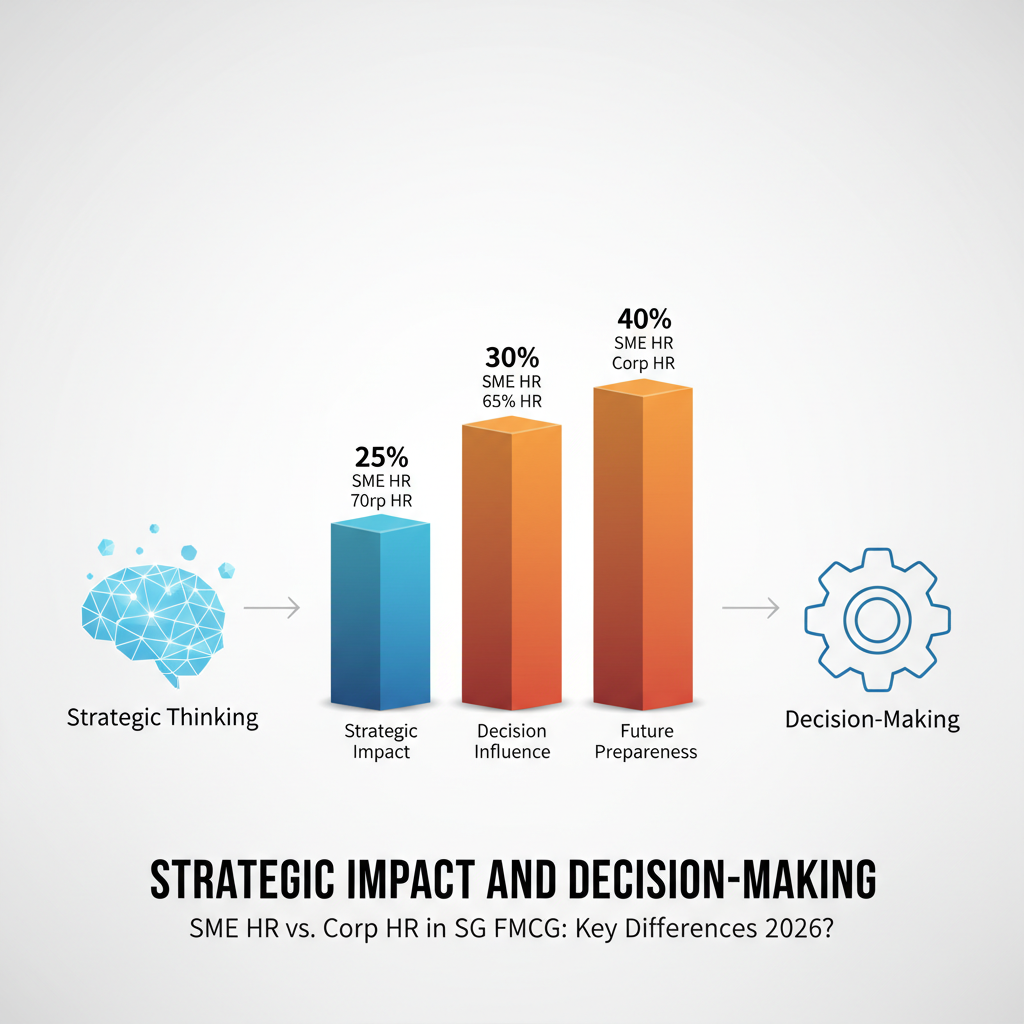
Understanding the distinct strategic contributions and decision-making influence of HR professionals is crucial when examining the landscape of FMCG companies in Singapore. This section explores how an HR Manager in a Small and Medium-sized Enterprise (SME) and an HR Director in a large Corporate entity each contribute to the overall business strategy, highlighting their unique levels of influence and power within their respective organizations. The differences between the SMEs’ HR Manager and the Corporates’ HR Director in FMCG companies in Singapore are particularly pronounced in their strategic reach and operational depth, reflecting the scale and complexity of their environments.
1. Influencing Business Strategy in SMEs
In the agile world of Singaporean FMCG SMEs, the HR Manager often plays a profoundly hands-on and direct role in shaping business strategy. Unlike their corporate counterparts, SME HR Managers are typically embedded deeply within daily operations, often functioning as a key advisor to the CEO or business owner. Their influence stems from their intimate understanding of the workforce, company culture, and immediate operational challenges. Decision-making is often collaborative, quick, and highly responsive to market changes or internal needs. For instance, an SME HR Manager might directly influence product launch strategies by advising on talent availability for a new line, or by developing rapid recruitment plans to scale up production. They are vital in talent retention, ensuring that the small, often specialized team remains motivated and engaged, directly impacting the SME’s capacity for innovation and growth. Their strategic impact is less about long-term, global frameworks and more about ensuring the immediate health and future viability of the business through effective, localized human capital management. The scope of their decisions often spans everything from compensation structures to employee development, directly impacting the bottom line and operational efficiency.
2. Driving Corporate HR Initiatives and Global Alignment
Conversely, the HR Director in a large FMCG corporate in Singapore operates within a multi-layered, often global, organizational structure. Their strategic impact is characterized by driving large-scale HR initiatives that align with overarching corporate objectives and global standards. Their decision-making power is significant but often channeled through established frameworks, policies, and cross-functional teams. This role involves developing sophisticated talent management frameworks, implementing global HR technologies, driving diversity and inclusion initiatives across multiple regions, and leading complex succession planning efforts. For example, a Corporate HR Director might spearhead a regional talent mobility program or design a new performance management system that integrates with global KPIs. Their focus is on scalability, consistency, and ensuring that HR strategies support the company’s long-term competitive advantage in a complex international market. They engage in extensive stakeholder management, collaborating with regional HR leads, legal teams, and senior business executives to ensure HR programs are effective, compliant, and culturally sensitive across diverse geographical footprints. Their ability to contribute to strategic workforce planning is paramount, influencing business expansion, market entry, and global talent pipelines.
3. Data-Driven HR: Analytics and Reporting
The application of data and analytics presents another key area of distinction. While both roles increasingly rely on data, the depth, complexity, and strategic implications vary significantly. The SME HR Manager often utilizes basic HR metrics – such as headcount, basic turnover rates, and payroll costs – to make immediate operational decisions and justify investments. Reporting is typically informal, presented directly to the CEO or leadership team, focusing on tangible, short-term outcomes that directly impact profitability or productivity. Their data insights might lead to quick adjustments in recruitment strategies or training programs. In contrast, the Corporate HR Director leverages advanced HR analytics, integrating data from various HRIS (Human Resources Information Systems) and external benchmarks. They delve into predictive analytics to forecast talent needs, assess the ROI of HR programs, analyze employee engagement trends across regions, and identify key drivers of attrition or performance. Their reporting is highly formalized, integrated into C-suite business reviews, and informs high-level strategic discussions on organizational design, market positioning, and long-term talent investments. The sophistication of their tools and the breadth of data available enable more nuanced and impactful strategic decision-making, highlighting how the differences between the SMEs’ HR Manager and the Corporates’ HR Director in FMCG companies in Singapore extend to their analytical capabilities and strategic foresight. Both roles are critical in their respective contexts, but their engagement with data reflects the scale and strategic horizons of their organizations.
Resources, Budgets, and Stakeholder Management
When examining the operational realities for an HR professional, the stark differences between the SMEs’ HR Manager and the Corporates’ HR Director in FMCG companies in Singapore become particularly evident in the domains of resources, budgets, and stakeholder management. These areas profoundly shape their strategic influence and daily execution within the dynamic FMCG HR challenges of the Singapore HR landscape.
1. Resource Constraints and Creative Solutions in SMEs
For an HR Manager in a Singaporean SME within the FMCG sector, the phrase “resource allocation” often signifies doing more with less. Limited HR resource allocation is a defining characteristic, encompassing everything from human capital (often a lean HR team, sometimes a one-person department) to technological infrastructure and external vendor support. The SME HR budget is typically modest, requiring the HR Manager to be exceptionally resourceful and agile. They might lack sophisticated HR technology investment for recruitment, performance management, or payroll, relying instead on manual processes, readily available software, or cost-effective cloud solutions.
Their role often demands creative solutions for talent acquisition resources, focusing on networking, employee referrals, and leveraging government grants or training subsidies available in Singapore. For compensation & benefits budget, the HR Manager must craft competitive yet sustainable packages, often without the luxury of extensive market data or dedicated C&B specialists. Managing HR compliance Singapore regulations also becomes a significant task, often without dedicated legal support, pushing the HR Manager to stay abreast of all updates personally. This necessitates strong problem-solving skills and a deep understanding of local regulations, often forcing them to become generalists who can wear multiple hats effectively. The emphasis is on efficiency, cost-effectiveness, and direct impact on business operations. This extensive HR manager scope demands adaptability and strategic foresight even with limited means.
2. Managing Large Budgets and HR Technologies in Corporates
In stark contrast, a Corporate HR Director in a large FMCG firm in Singapore operates within a framework of more substantial resources and a more expansive corporate HR budget. Their role involves strategic oversight and responsibility for significant budget control HR across multiple departments or even regional operations. They are instrumental in driving substantial HR technology investment, often implementing integrated HRIS (Human Resource Information Systems), AI-powered recruitment platforms, sophisticated learning management systems, and advanced analytics tools. This allows for data-driven decision-making and streamlined processes across large employee populations.
The Director’s focus is less on day-to-day tactical execution and more on strategic HR strategy Singapore formulation and ensuring its alignment with global business objectives. They manage dedicated teams for functions like talent acquisition, compensation and benefits, learning and development, and HR operations. While the HR director responsibilities include ensuring compliance, they typically have legal teams and specialized consultants to support this. Their work often involves negotiating contracts with major external HR partnerships for services such as executive search, global mobility, or specialized training programs. The scale of their operations necessitates robust financial planning and a deep understanding of return on investment (ROI) for various HR initiatives, making effective financial stewardship a core competency.
3. Internal vs. External Stakeholder Engagement
Stakeholder management HR is a critical function for both roles, but its complexity and scope vary significantly. For the SME HR Manager, internal stakeholder communication is often direct, frequent, and highly personal. They interact regularly with the founder/CEO, department heads, and all employees, often playing a hands-on role in resolving individual employee concerns. Their immediate focus is on fostering a cohesive work environment, ensuring employee satisfaction, and supporting operational managers directly. External engagement might be limited to government agencies, recruitment agencies, and local training providers. The success of the HR manager scope in this context heavily relies on building trust and rapport within a close-knit organizational culture.
Conversely, the Corporate HR Director navigates a much more intricate web of stakeholders. Their leadership stakeholder engagement includes not only the executive leadership team (CEO, CFO, regional heads) and global HR counterparts but also potentially union representatives, investor relations, and a diverse range of external HR partnerships including global consultants, technology vendors, and international recruitment firms. The communication is often more formal, structured, and focused on strategic outcomes, policy implementation, and large-scale organizational change initiatives. They must influence decision-making at a high level, negotiate complex agreements, and manage expectations across a broad spectrum of interests, often involving international nuances. Furthermore, they play a crucial role in shaping the corporate brand as an employer, working closely with marketing and communications teams. As highlighted by Deloitte’s Global Human Capital Trends reports on effective HR resource management and technology adoption, leveraging advanced tools and strategic partnerships is key for large organizations. The need for strong negotiation, persuasion, and political acumen is paramount, as they often balance local market needs with global directives.
Career Trajectory and Professional Development
The dynamic Singaporean FMCG landscape offers varied and exciting career trajectories for Human Resources professionals, necessitating distinct skill sets and growth mindsets depending on the organizational context. From nimble startups to multinational giants, HR roles are pivotal in attracting, developing, and retaining top talent. This section outlines potential career paths, growth opportunities, and essential skill development relevant to each HR role, with a particular focus on the differences between the SMEs’ HR Manager and the Corporates’ HR Director in FMCG companies in Singapore.

While both roles are fundamentally about people, their scope, strategic impact, and day-to-day responsibilities diverge significantly. An SME HR Manager often operates as a generalist, a jack-of-all-trades handling everything from recruitment and payroll to employee relations and compliance, often with limited resources and a direct impact on a smaller workforce. Conversely, a Corporate HR Director in a large FMCG firm leads specialized teams, shapes global talent strategies, and acts as a key business partner, influencing organizational development and cultural transformation across a complex, multi-layered structure.
-
Skill Sets for Success: Adapting to Role Demands
The core competencies required for success vary dramatically between these two HR leadership positions. An SME HR Manager in the Singapore FMCG sector must possess strong operational HR skills, including robust knowledge of local labour laws (e.g., Employment Act, CPF regulations), efficient payroll processing, end-to-end recruitment cycle management, and proactive employee relations. Adaptability, resilience, and a hands-on approach are critical, often requiring the HR Manager to pivot quickly between strategic and administrative tasks. Resourcefulness is key, as budget constraints often necessitate creative solutions for talent attraction and development.
In contrast, a Corporate HR Director in a large FMCG enterprise requires a more strategic and leadership-focused skill set. This includes advanced talent management expertise, organizational development (OD) capabilities, complex compensation & benefits design, HR analytics for data-driven decision-making, and change management leadership. They must excel at stakeholder management, influencing senior business leaders, and aligning global HR initiatives with local market needs. A deep understanding of the FMCG supply chain, market dynamics, and consumer behavior is also vital to effectively partner with business units. Their role is less about day-to-day HR operations and more about shaping the future workforce and organizational culture, demanding sophisticated leadership, foresight, and strong communication skills to articulate complex HR strategies.
-
Learning & Development Opportunities
Professional development pathways also differ significantly. For an SME HR Manager, growth often comes through hands-on experience across diverse HR functions, participation in local HR networks, and targeted short courses. Certifications like the IHRP Certified Professional (Institute for Human Resource Professionals) are highly valued in Singapore, providing foundational and advanced knowledge. Opportunities might include workshops on specific legal compliance updates, digital HR tools for efficiency, or enhancing employee engagement strategies. Self-directed learning through industry publications, online courses, and networking events are crucial for staying current in a fast-paced environment.
Corporate HR Directors, on the other hand, often benefit from structured development programs, executive education, and specialized certifications in areas like strategic HR business partnering, HR analytics, or leadership coaching. Large FMCG companies typically invest significantly in their HR leadership, offering access to international conferences, internal mobility programs across different markets or functions, and mentorship from senior global HR leaders. Developing future-ready HR skills, such as artificial intelligence in HR and advanced data interpretation, becomes a priority, often facilitated by internal HR academies or partnerships with leading business schools. These opportunities are designed to cultivate a global perspective and equip leaders to navigate complex organizational challenges and drive significant business impact.
-
Career Progression Paths within SME HR
A career starting as an HR Manager in an SME offers a rich foundation for growth, fostering a comprehensive understanding of HR operations and employee lifecycles. Progression within the SME sector might see an individual move from HR Executive to HR Manager, and potentially to a Senior HR Manager or Head of HR role, taking on broader strategic responsibilities as the company scales. This path often means developing a deeper generalist expertise, becoming a trusted advisor to the business owner, and shaping the entire people agenda.
For those aspiring to a Corporate HR Director role, the transition from an SME HR Manager requires deliberate upskilling and strategic career planning. It often involves specializing in a particular HR domain (e.g., Talent Acquisition, Compensation & Benefits, Organizational Development) or pursuing a Human Resources Business Partner (HRBP) role within a larger corporation to gain exposure to more complex organizational structures and strategic decision-making processes. The holistic experience gained in an SME, particularly the agility and problem-solving skills, can be a valuable asset. However, bridging the gap to a corporate director role demands demonstrating strategic foresight, leadership capabilities, and the ability to influence at an executive level, often requiring further education or specialized certifications beyond operational HR.
Partner with Shelby Global
You are looking for reliable HR Sevice Suppliers? Contact Shelby Global Now! To connect with verified talents and upgrade your orginization.
—————————————
References
– compliance with Singapore labour laws: https://www.mom.gov.sg/employment-practices/employment-act
– Singapore’s Employment Act: https://www.mom.gov.sg/employment-practices/employment-act
– The Strategic Role of Human Resources – SHRM: https://www.shrm.org/resources-and-tools/hr-topics/human-resource-management/pages/strategic-role-of-hr.aspx
– Deloitte’s Global Human Capital Trends reports: https://www2.deloitte.com/us/en/insights/topics/talent/global-human-capital-trends.html
– PwC Global Human Capital Trends Report: https://www.pwc.com/gx/en/issues/human-capital-trends.html