
Defining the Roles: Scope and Strategic Influence
In the dynamic and highly regulated medical field in Singapore, the landscape of Human Resources (HR) leadership varies significantly depending on the organizational structure. Small and Medium-sized Enterprises (SMEs) and large corporate healthcare entities, though both crucial to the nation’s health infrastructure, necessitate different HR approaches. This section meticulously compares the fundamental breadth of responsibilities and the level of strategic impact each HR role holds within their distinct organizational structures, highlighting the differences between the SMEs’ HR Manager and the Corporates’ HR Director in medicine field in Singapore. Understanding these distinctions is critical for aspiring HR professionals and organizational leaders alike.
While both roles are pivotal in managing human capital, their daily functions, decision-making authority, and long-term contributions diverge significantly. The SME HR Manager often juggles a multitude of hands-on tasks, whereas the Corporate HR Director operates at a higher, more strategic echelon, shaping overarching HR policies and long-term organizational trajectories. This inherent contrast is shaped by organizational size, resource availability, and the complexity of the workforce.

1. Breadth of Responsibilities: Operational vs. Strategic
The primary distinction in the differences between the SMEs’ HR Manager and the Corporates’ HR Director in medicine field in Singapore lies in their scope of responsibilities. An HR Manager in an SME medical practice or clinic typically encompasses a wide array of operational duties. This often includes full-cycle recruitment, onboarding, payroll processing, benefits administration, employee relations, and ensuring compliance with local labor laws and healthcare-specific regulations. Their role is highly reactive, responding to immediate staff needs and issues, often without the luxury of a dedicated HR team. They are the ‘doers,’ directly involved in the day-to-day HR functions that keep the practice running smoothly.
Conversely, the HR Director in a large corporate hospital group or pharmaceutical company operates with a predominantly strategic mandate. They oversee various specialized HR departments (e.g., talent acquisition, compensation & benefits, organizational development, learning & development). Their focus is on developing and implementing HR strategies aligned with the corporation’s long-term business objectives. This involves workforce planning, succession planning for critical medical roles, designing comprehensive talent management frameworks, and developing high-level policies that impact thousands of employees. They lead, delegate, and innovate, aiming to build a resilient and high-performing workforce capable of meeting future healthcare demands.
2. Impact on Organizational Growth & Culture
The impact on organizational growth and culture also starkly illustrates the differences between the SMEs’ HR Manager and the Corporates’ HR Director in medicine field in Singapore. For an SME HR Manager, their influence on growth is often indirect, stemming from their ability to attract and retain quality staff, maintain a positive work environment, and ensure regulatory compliance, which collectively contribute to operational stability. They play a crucial role in shaping the immediate workplace culture through direct interactions, conflict resolution, and fostering a close-knit team atmosphere. Their success ensures the continuity and quality of patient care, allowing the small practice to thrive organically.
In contrast, a Corporate HR Director wields significant strategic influence over the organization’s long-term growth and overarching culture. They are instrumental in shaping talent pipelines for expansion, leading change management initiatives during mergers or acquisitions, and driving organizational effectiveness through strategic HR interventions. Their decisions on talent development programs, leadership training, and performance management systems directly influence the organization’s capacity for innovation and scalability. Furthermore, they are key architects of the corporate culture, embedding values and ethical standards across a large, diverse workforce, often guided by national healthcare manpower strategies to ensure Singapore’s medical sector remains robust and future-ready. Their initiatives ensure the company attracts, retains, and develops the necessary expertise to remain competitive and meet the evolving healthcare needs of the population.
3. Resource Allocation & Budgetary Control
The disparity in resource allocation and budgetary control further underscores the differences between the SMEs’ HR Manager and the Corporates’ HR Director in medicine field in Singapore. An SME HR Manager typically operates with a modest budget, where every expenditure is closely scrutinized. Their focus is on efficient, cost-effective solutions for essential HR functions. This might involve choosing basic, affordable HR software, negotiating competitive rates for recruitment agencies, and providing fundamental training programs necessary for compliance or immediate skill gaps. Budgetary control for them is about making the most of limited resources, often requiring them to be resourceful and creative in their approach to HR challenges.
Conversely, the Corporate HR Director manages a substantial budget, often encompassing millions of dollars. This allows for significant investment in advanced HR technologies, comprehensive employee wellness programs, large-scale leadership development initiatives, and strategic talent acquisition campaigns targeting niche medical specialists globally. They are involved in high-level financial planning, justifying HR investments based on their strategic return on investment (ROI) and alignment with corporate objectives. Their budgetary control extends to influencing significant capital allocation for HR infrastructure, benefits packages, and long-term human capital development strategies, reflecting the scale and complexity of a large healthcare corporation’s needs.
Daily Operations and Core Responsibilities Compared
Navigating the complex world of human resources reveals distinct operational philosophies and core responsibilities when comparing an HR Manager in a Small and Medium-sized Enterprise (SME) to an HR Director in a corporate medical setting, especially in a dynamic market like Singapore. While both roles are pivotal to an organization’s success, their day-to-day tasks and strategic impact are shaped by the scale, industry, and regulatory environment of their respective workplaces. Understanding the Differences between the SMEs’ HR Manager and the Corporates’ HR Director in medicine field in singapore highlights the specialized demands placed on HR professionals in these varying contexts.
1. Talent Acquisition & Retention Strategies
For an HR Manager in an SME, talent acquisition often means being a jack-of-all-trades. This individual typically handles the entire recruitment lifecycle single-handedly or with minimal support, from drafting job descriptions and sourcing candidates on various platforms to conducting interviews and extending offers. The focus is usually on filling immediate vacancies with generalist profiles, often competing against larger entities with more attractive packages. Retention strategies are often informal, relying on a strong company culture, direct employee engagement, and opportunities for cross-functional growth within a smaller team. The budget for sophisticated applicant tracking systems or extensive employer branding initiatives is usually limited for an HR Manager Singapore SME.
Conversely, an HR Director in a corporate medical setting operates on a far grander, more strategic scale. This role involves overseeing a dedicated team of talent acquisition specialists and recruiters, focusing on strategic workforce planning that anticipates future needs for highly specialized medical professionals – from doctors and surgeons to nurses, allied health professionals, and administrative staff across multiple facilities. Retention involves developing comprehensive career development frameworks, succession planning, and highly competitive benefits packages tailored to the unique demands of the healthcare sector. The HR Director medical corporation leverages advanced HR analytics, sophisticated HRIS, and robust employer branding campaigns to attract and retain top-tier talent in a highly competitive and often global market, ensuring a continuous pipeline for critical roles.
2. Compensation & Benefits Management
The HR Manager in an SME typically manages compensation and benefits with a direct, hands-on approach. This often involves directly overseeing payroll processing, administering basic statutory benefits like CPF contributions, annual leave, and sick leave, and ensuring compliance with minimum wage requirements. Compensation packages are often more standardized, and benchmarking might be based on informal industry checks or publicly available data due to budget constraints. The HR Manager’s primary goal is often cost-efficiency and ensuring fair, transparent basic provisions for the small team, directly communicating any changes or updates to employees.
In contrast, the HR Director in a corporate medical setting is responsible for designing and implementing complex, multi-layered compensation and benefits strategies that are critical for attracting and retaining highly skilled medical professionals. This involves extensive market research, salary benchmarking across various medical specializations, and crafting intricate packages that may include performance-based incentives, malpractice insurance, continuous medical education allowances, and specialized health and wellness programs. The HR Director medical corporation must navigate union agreements, ensure pay equity across diverse roles and seniority levels, and comply with sector-specific financial regulations while aligning C&B strategies with the organization’s broader financial health and strategic objectives.
3. Employee Relations & Compliance
For an HR Manager in an SME, employee relations are often managed personally and directly. This individual acts as the primary point of contact for all employee grievances, disputes, and concerns, often mediating conflicts and providing direct pastoral care. Policies tend to be less formalized but more adaptable, focusing on maintaining a harmonious and productive small team environment. Ensuring compliance with fundamental labor laws, such as the Singapore Employment Act, is a core responsibility, but the HR Manager typically handles these aspects without a dedicated legal team, relying on personal understanding and external consultations when necessary. The human touch and accessibility are key to an HR Manager Singapore SME.
The HR Director in a corporate medical setting, however, operates within a highly regulated and often unionized environment. Their role involves developing robust employee relations frameworks, detailed grievance procedures, and comprehensive codes of conduct specific to healthcare ethics and professional standards. This individual oversees internal investigations, disciplinary actions, and terminations, often in collaboration with legal counsel and specialized employee relations teams. Beyond general labor laws, the HR Director must ensure stringent compliance with healthcare-specific regulations, patient privacy laws (like PDPA in Singapore), and ethical guidelines governing medical practice. The Ministry of Manpower’s Employment Act and other related regulations are foundational, but the complexity of a medical corporation demands an unparalleled level of regulatory adherence and risk management in all HR functions, particularly regarding the welfare and conduct of healthcare professionals.
In conclusion, while both roles are vital HR functions, the Differences between the SMEs’ HR Manager and the Corporates’ HR Director in medicine field in singapore are profound. The SME HR Manager is a hands-on generalist, focused on operational efficiency and direct employee support, whereas the Corporate Medical HR Director is a strategic leader, overseeing specialized teams, navigating complex regulatory landscapes, and driving HR initiatives that align with the intricate demands of a large-scale healthcare enterprise.
Navigating Unique Challenges in Singapore’s Medical Sector
Singapore’s medical industry, renowned for high standards, presents a complex HR landscape. Stringent regulations, talent shortages, and rapid technological shifts pose unique hurdles. These challenges manifest differently for an SMEs’ HR Manager and the Corporates’ HR Director in the medicine field in Singapore. Understanding these nuances is critical for effective talent management.
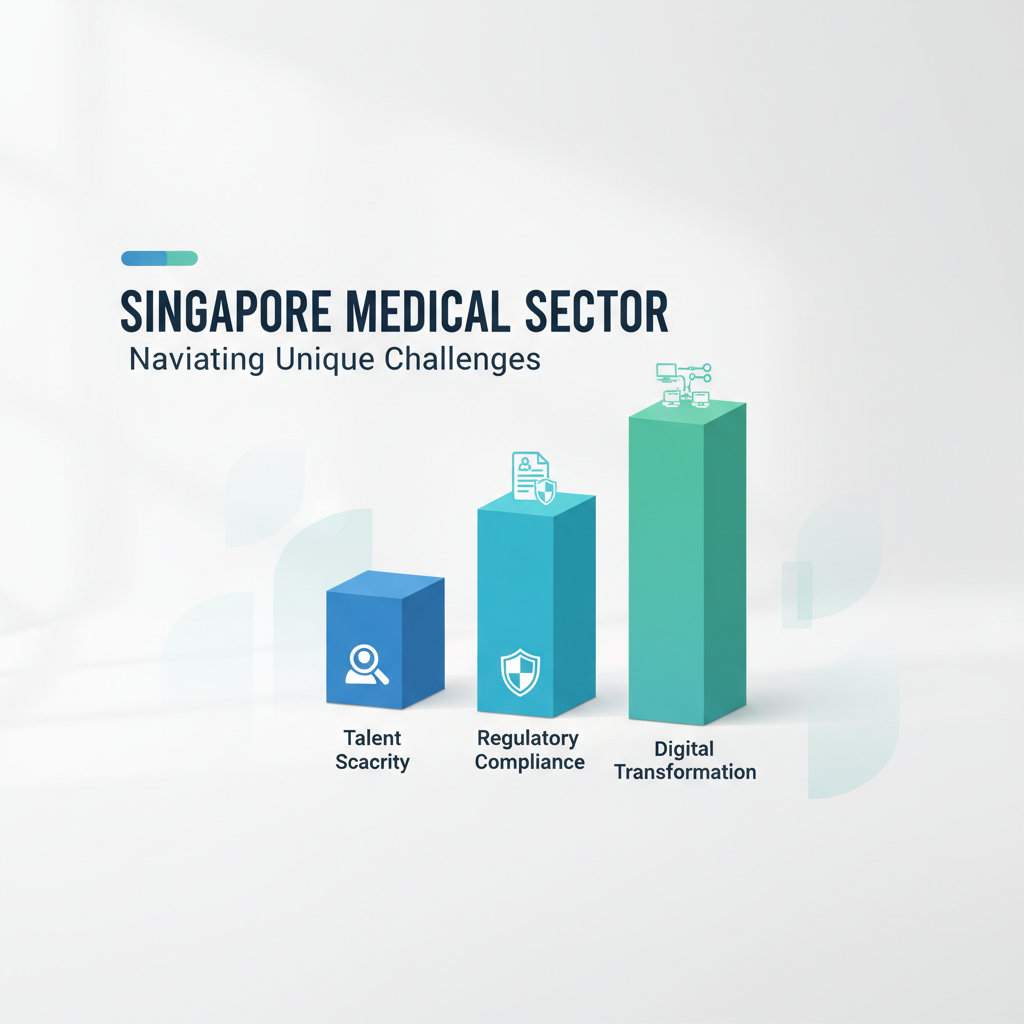
The differences between the SMEs’ HR Manager and the Corporates’ HR Director in the medicine field in Singapore are evident in compliance, talent acquisition, and digital transformation, where resources and operational scales diverge.
1. Navigating MOH Regulations & Healthcare Licensing
Singapore’s Ministry of Health (MOH) imposes strict regulations. HR ensures all medical staff possess necessary licenses, certifications, and comply with continuous professional development – a core healthcare HR challenge in Singapore.
For an SMEs’ HR Manager, managing MOH regulations is arduous. With lean teams, licensing and compliance checks are often manual. A single lapse means fines or operational suspension. Keeping abreast of updated guidelines without dedicated legal support is a constant struggle.
Conversely, a Corporates’ HR Director benefits from dedicated legal and compliance departments. Robust HRIS track licenses, and specialists monitor regulatory changes. Despite greater staff volume, resources ensure a structured, efficient approach, maintaining consistency across departments.
2. Staffing Shortages & Skill Gaps in Medical Roles
The global healthcare professional shortage is keenly felt in Singapore, exacerbated by an ageing population. HR professionals battle to attract and retain skilled medical talent. This persistent medical staffing solution in Singapore requires innovative strategies.
For an SMEs’ HR Manager, staffing shortages are crippling. They compete against larger institutions with better benefits and career progression. SMEs struggle to offer competitive compensation or sponsor foreign talent. Retention is challenging; professionals may view SMEs as stepping stones. Creative recruitment and leveraging networks are crucial.
A Corporates’ HR Director faces the challenge of scale. With larger budgets, they manage high-volume recruitment for diverse specialisations. Corporates invest in talent pipelines and extensive employer branding. Focus shifts to strategic forecasting, succession planning, and comprehensive wellness programs. The Singapore Ministry of Health provides regular updates and policy directions concerning healthcare manpower.
3. Technology Adoption & Digital HR in Healthcare
Digital transformation significantly impacts healthcare HR. From ATS and HRIS to telemedicine, technology integration is paramount. HR must adapt, managing technical roles and utilising digital tools.
For an SMEs’ HR Manager, adopting advanced digital HR solutions is a significant hurdle. Budgetary constraints often mean relying on basic software or manual processes. Implementation is costly and time-consuming, a burden a small team struggles to accommodate. Sophisticated digital transformation is often a luxury, leading to potential inefficiencies.
In contrast, a Corporates’ HR Director oversees advanced HR technology stacks. They have the budget and IT support for integrated HRIS, e-learning for CME, and predictive analytics for workforce planning. The challenge is ensuring seamless integration, managing data security in line with regulations, and continuous system upgrades. They also champion digital literacy.
In conclusion, both SMEs and large corporates face fundamental challenges in Singapore’s medical sector. However, the differences between the SMEs’ HR Manager and the Corporates’ HR Director in the medicine field in Singapore are starkly defined by resource availability and operational scale. SMEs require immense agility and multifaceted expertise, while corporates leverage specialised teams and substantial resources. Recognizing these distinct landscapes is vital for tailored HR strategies.
Essential Skill Sets and Career Trajectories
Navigating Singapore’s healthcare HR landscape demands distinct competencies, varying significantly between an SME HR Manager’s hands-on responsibilities and a Corporate HR Director’s strategic oversight. Understanding the Differences between the SMEs’ HR Manager and the Corporates’ HR Director in medicine field in singapore is crucial for aspiring professionals. This section outlines critical competencies, potential career paths, and development opportunities within this vital sector, emphasizing each role’s unique demands.
-
Essential Skills: Generalist vs. Specialist Expertise
An SME HR Manager typically functions as a generalist. This role demands proficiency across the entire HR lifecycle: recruitment, compensation and benefits, employee relations, performance management, training, and strict compliance with local labor laws (MOM, CPF Board). Given leaner SME structures and limited resources, this individual needs adaptability, proactive problem-solving, and swift policy execution. Their direct impact on operational efficiency and employee support makes them indispensable.
Conversely, a Corporate HR Director in a larger healthcare enterprise focuses on specialist expertise and strategic acumen. While foundational HR understanding is expected, their role involves strategic design and oversight, not operational execution. Key competencies include strategic workforce planning, talent management, organizational development, change management, HR analytics, and acting as an HR business partner to senior leadership. They align HR strategies with business objectives, drive culture transformation, and manage complex initiatives, leveraging data for critical decisions.
-
Leadership & Management Expectations
Leadership expectations also differ. An SME HR Manager often leads a small team or acts as a standalone practitioner, influencing stakeholders through direct communication and tangible results. Their leadership is practical, focused on guiding employees through operational challenges, implementing effective HR policies, and managing immediate needs. They must be hands-on, capable of quick decisions, and fostering a supportive environment. Crisis management and swift problem-solving are regular aspects, demanding a pragmatic and resilient approach.
A Corporate HR Director, conversely, leads larger, multi-disciplinary HR teams, potentially across various business units. Their leadership is more strategic and visionary, focusing on cultivating high-performance culture, driving strategic talent acquisition, and orchestrating comprehensive workforce planning. They advise the C-suite on human capital issues, manage significant HR budgets, and ensure HR strategies support long-term organizational growth. This role demands strong governance, consensus-building among diverse leadership, and a forward-looking perspective. For foundational knowledge, refer to the Ministry of Manpower Singapore’s Employment Act.
-
Future Career Trajectories & Development Paths
Career trajectories offer distinct yet interconnected paths. An SME HR Manager with a strong generalist background might progress to a Senior HR Manager in a larger SME or transition to a specialized HR Business Partner role in a corporate environment, leveraging operational expertise. Development opportunities include specialized certifications (e.g., HR analytics, compensation and benefits) or advanced HR diplomas. Continuous learning and staying abreast of evolving HR technologies are essential for upward mobility.
For a Corporate HR Director, the path typically leads to more expansive roles like Regional HR Director, Head of HR for a major division, or Chief Human Resources Officer (CHRO). Development entails executive education focusing on strategic leadership, change management, and global HR strategies. Global assignments, industry forums, and mentorship are invaluable for broadening strategic perspective. A deep understanding of business operations, financial acumen, and innovation drive are critical for aspiring CHROs. Both paths underscore the growing demand for skilled HR professionals in Singapore’s healthcare organizations.
Impact on Business Agility and Employee Experience
In the dynamic landscape of Singapore’s medical field, the organizational structure of human resources plays a pivotal role in shaping an entity’s ability to adapt to change and cultivate a thriving employee experience. The differences between the SMEs’ HR Manager and the Corporates’ HR Director in medicine field in Singapore are profound, extending beyond mere job titles to impact the very fabric of how organizations function and how their employees perceive their workplace. This distinction is critical for understanding business agility and fostering a positive employee experience medical sector-wide.

1. Speed of Decision-Making & Implementation
One of the most striking distinctions lies in the pace at which HR-related decisions are made and implemented. In small to medium-sized enterprises (SMEs) within the medical field, the HR Manager often operates with a leaner structure and direct access to top leadership. This proximity facilitates rapid decision-making, especially when addressing urgent staffing needs, policy adjustments, or immediate employee concerns. For instance, an SME HR Manager might quickly approve a new flexible working arrangement in response to staff feedback or rapidly onboard critical medical personnel to meet sudden patient demand. This streamlined process contributes significantly to business agility in healthcare, enabling the organization to pivot swiftly.
Conversely, in large medical corporates, the HR Director typically navigates a more complex hierarchical structure. Decisions often require multiple layers of approval, involving various departments, legal teams, and senior executives. While this ensures thorough vetting and compliance, it inherently slows down the process. The focus shifts to strategic alignment and scalability across numerous departments or facilities. For example, implementing a new benefits package might take months of planning, negotiation, and communication across a large workforce. While less agile in immediate response, this structured approach ensures robust, well-considered policies that serve a diverse and extensive employee base.
2. Employee Engagement & Well-being Initiatives
The approach to employee engagement and well-being also varies significantly. In SMEs, the HR Manager often cultivates a highly personal relationship with employees due to the smaller team size. Initiatives tend to be bespoke, tailored to individual or small group needs, and communicated directly. This personal touch can foster a strong sense of community and belonging, crucial in the high-stress medical environment. The HR Manager might personally check in with staff, organize informal team-building events, or quickly address individual well-being concerns, enhancing the overall employee experience medical sector-wide by making staff feel genuinely heard and valued. Such direct engagement is a hallmark of strong HR agility in healthcare Singapore.
In contrast, HR Directors in large corporates are responsible for designing and implementing standardized programs that cater to a vast and diverse workforce. While these programs – ranging from comprehensive wellness platforms to extensive professional development courses – offer a wider range of resources, they can sometimes feel less personal. The challenge for a corporate HR Director is to create scalable initiatives that resonate with thousands of employees while maintaining a sense of individual recognition. This often involves leveraging technology for communication, surveys, and program delivery, aiming for broad impact rather than individualized solutions, a necessity given the sheer scale of operations.
3. Adapting to Industry Changes & Market Dynamics
The medical field is constantly evolving, driven by technological advancements, regulatory shifts, and changing patient demographics. How HR structures facilitate adaptation to these changes is paramount. SMEs, with their agile HR Manager at the helm, can often pivot quickly. A sudden change in government healthcare policy or the emergence of a new medical technology might see an SME HR Manager rapidly coordinating retraining programs or adjusting staffing models with minimal bureaucratic hurdles. Their ability to react swiftly to external pressures is a key competitive advantage in maintaining HR agility in healthcare Singapore, ensuring the organization remains relevant and effective.
For large corporates, the HR Director’s role in adaptation is more strategic and long-term. They are tasked with developing robust workforce planning strategies, talent acquisition pipelines, and large-scale training initiatives that anticipate future industry trends. While the implementation of such large-scale changes can be slower, the corporate structure often provides greater resources for research, development, and comprehensive change management. For instance, an HR Director might lead a multi-year project to integrate AI-driven diagnostics into daily operations, requiring extensive upskilling across numerous departments. The challenge lies in managing the inertia of a large organization while ensuring its readiness for future disruptions. Both models offer unique strengths, ultimately influencing an organization’s resilience and its capacity to thrive amidst constant transformation in Singapore’s vibrant medical landscape.
Partner with Shelby Global
You are looking for reliable HR Sevice Suppliers? Contact Shelby Global Now! To connect with verified talents and upgrade your orginization.
—————————————
References
– MOH Singapore: Stronger Support for Healthcare Manpower: https://www.moh.gov.sg/news-highlights/details/stronger-support-for-healthcare-professionals-and-manpower-to-be-provided-in-the-coming-years
– Employment Act – Ministry of Manpower Singapore: https://www.mom.gov.sg/employment-practices/employment-act
– Singapore Ministry of Health: https://www.moh.gov.sg/
– Ministry of Manpower Singapore’s Employment Act: https://www.mom.gov.sg/employment-practices/employment-act
– :