
Fundamental Organizational Structure & HR Team Size
The core setup of Human Resources (HR) departments in Malaysia’s fast-moving consumer goods (FMCG) sector varies significantly, primarily dictated by the inherent scale, operational complexity, and resource availability distinguishing Small and Medium-sized Enterprises (SMEs) from large corporations. Understanding these fundamental Differences between the SMEs’ HR Structure and the Corporates’ HR Structure in FMCG companies in malaysia is crucial for grasping their respective strategic capabilities and day-to-day HR operations. While both strive for efficient talent management, their approaches diverge profoundly due to their structural foundations.

1. Lean vs. Specialized HR Teams
In Malaysian FMCG SMEs, HR teams are typically characterized by their lean structure. Often, this might mean a single HR manager or a small generalist team responsible for the entire spectrum of human resource functions. Resource constraints and a smaller employee base necessitate a pragmatic, multi-functional approach where team members wear many hats, covering everything from recruitment and onboarding to payroll, employee relations, and policy implementation. The focus is on agility and direct support to business operations, often without the luxury of dedicated specialists for each HR domain.
Conversely, large FMCG corporations boast highly specialized HR teams, reflecting their extensive workforce, complex organizational charts, and strategic imperative for best-in-class HR practices. These teams are typically compartmentalized into distinct functions such as Talent Acquisition, Compensation & Benefits, Learning & Development, HR Business Partnering, Employee Relations, and HR Operations. Each sub-department is staffed by experts dedicated to their specific area, enabling deeper insights, more sophisticated strategies, and greater efficiency in large-scale HR delivery. This specialization allows for the development of robust frameworks and long-term talent pipelines critical for sustaining growth in competitive markets.
2. Generalist vs. Specialist Roles and Capabilities
The nature of HR roles within SMEs naturally gravitates towards generalists. HR professionals in these environments are expected to possess a broad skillset, capable of navigating diverse HR challenges across the employee lifecycle. Their strength lies in their versatility, problem-solving capabilities, and close proximity to the business’s day-to-day needs. They often act as the primary point of contact for all HR-related queries, fostering strong relationships within the smaller organizational fabric. Their capabilities are broad but might lack the deep, niche expertise found in larger entities.
In large corporations, the HR landscape is dominated by specialist roles. Talent Acquisition specialists focus solely on attracting and recruiting candidates, employing advanced sourcing techniques and employer branding strategies. Compensation and Benefits specialists design complex reward structures, ensuring market competitiveness and compliance. Learning & Development specialists craft comprehensive training programs aligned with career progression and organizational needs. This deep specialization enables the application of advanced methodologies, data analytics, and strategic foresight, driving more impactful HR outcomes and directly contributing to the company’s long-term strategic objectives, as highlighted by reports on global human capital trends that emphasize the evolving role of specialized HR functions.
3. Reporting Structures and Autonomy Levels
The reporting structures in SME HR departments are generally flat and direct. The HR manager or head of HR often reports directly to the CEO, Managing Director, or a senior general manager, reflecting HR’s operational importance and integral role in day-to-day management. This direct line of reporting can afford a degree of operational autonomy and faster decision-making, allowing HR to respond quickly to immediate needs and implement changes with less bureaucratic oversight. However, strategic influence might be limited by the overall business strategy and resources allocated.
Large corporations, on the other hand, typically feature complex, multi-layered HR reporting structures. HR Business Partners (HRBPs) might report to both a central HR function (e.g., Chief Human Resources Officer) and have dotted line reporting to the business unit leaders they support. This matrix structure ensures alignment with both overarching HR strategy and specific business objectives. Centralized functions like payroll and HR IT often report up through shared services centers. While this structure promotes governance, consistency, and strategic alignment, it can also lead to slower decision-making processes due to multiple approval layers and a greater emphasis on adhering to extensive corporate policies and procedures. The autonomy of individual HR professionals is typically guided by strict policy frameworks and corporate directives, ensuring consistency across diverse and often global operations.
Talent Acquisition and Retention Strategies
The Malaysian fast-moving consumer goods (FMCG) sector, characterized by its rapid pace and intense competition, presents a unique battleground for talent. Attracting, hiring, and retaining critical talent in this dynamic environment is a paramount challenge for both small and medium-sized enterprises (SMEs) and large corporates. While both aim to secure top-tier professionals, their approaches are starkly contrasting, primarily due to inherent differences between the SMEs’ HR structure and the Corporates’ HR structure in FMCG companies in Malaysia. These disparities are evident in their employer branding efforts, resource allocation, and overall strategic execution of human capital management, shaping their ability to thrive in the competitive Malaysian FMCG job market.
1. Recruitment Channels, Branding Power & Candidate Experience
In the race for top FMCG talent in Malaysia, recruitment channels and employer branding form the frontline. Corporates, with their substantial financial backing and established global footprints, leverage a multi-channel approach. They invest heavily in sophisticated Applicant Tracking Systems (ATS), premium job board subscriptions, professional recruitment agencies, and often boast dedicated in-house talent acquisition teams. Their employer branding is typically polished, disseminated through comprehensive career websites, active social media campaigns, and high-profile industry events, effectively communicating their stability, growth opportunities, and diverse culture. This strong brand presence allows them to attract a vast pool of qualified candidates, often resulting in a more streamlined and professional candidate experience, from initial application to interview stages.
Conversely, SMEs in the Malaysian FMCG landscape face significant differences between the SMEs’ HR structure and the Corporates’ HR structure in FMCG companies in Malaysia. Their resource limitations restrict their ability to compete on the same scale. SMEs often rely on more cost-effective channels such as local job portals, word-of-mouth referrals, personal networks, and occasionally, smaller, specialized recruitment firms. Their employer branding, if present, is usually organic, built on reputation within specific industry niches or through direct interaction. While this can offer a more personal touch, it often means a smaller candidate pool and a less formalized recruitment process. The candidate experience might be less structured but can be highly engaging due to direct access to senior management or even owners, offering a unique insight into the company culture. According to a Hays Malaysia Talent Trends Report, a significant number of Malaysian companies are focusing on enhancing their candidate experience, a critical area where corporates often have an edge over SMEs.
2. Onboarding Processes & Culture Integration Challenges
Effective onboarding is crucial for talent retention, especially within the fast-paced Malaysian FMCG sector. Corporates typically implement comprehensive, multi-stage onboarding programs designed to integrate new hires seamlessly into their organizational structure and culture. These programs often include formal orientation sessions, mentorship programs, structured training modules, and clear performance expectations, spanning several weeks or even months. The aim is to ensure new employees understand their roles, the company’s vision, and how they contribute to larger objectives, thereby fostering a strong sense of belonging and reducing early attrition. Their sheer size and established protocols facilitate a structured approach to culture integration.
For SMEs, the onboarding process is generally less formalized and often more ad-hoc. New hires might be thrown directly into tasks with minimal formal orientation, relying on immediate colleagues or direct managers for guidance. While this can offer a quick immersion into the role and a hands-on learning experience, it can also lead to feelings of being overwhelmed or unsupported, particularly if the company culture is not clearly articulated. The challenge for SMEs in Malaysia FMCG lies in effectively integrating new talent without the extensive resources of their corporate counterparts. Culture integration often happens through informal social interactions and direct leadership involvement, making the personality and leadership style of founders or senior managers highly influential in shaping the new employee’s initial experience and long-term commitment. This highlights a key aspect of the differences between the SMEs’ HR structure and the Corporates’ HR structure in FMCG companies in Malaysia, where flexibility and personal touch replace rigid frameworks.
3. Employee Value Proposition (EVP) & Retention Initiatives
The Employee Value Proposition (EVP) serves as the core of any retention strategy. Corporates in Malaysian FMCG offer robust EVPs, characterized by competitive salaries, comprehensive benefits packages (health, dental, insurance), structured career development paths, extensive training programs (including international exposure), and often, attractive share option schemes or performance bonuses. They use data-driven insights to tailor their retention initiatives, focusing on employee engagement surveys, leadership development programs, diversity and inclusion initiatives, and flexible work arrangements. Their ability to provide clear pathways for promotion and skill enhancement is a significant draw, ensuring long-term loyalty and reducing turnover in a market where talent mobility is high.
SMEs, while often unable to match the financial packages or extensive training budgets of corporates, distinguish their EVP through different means. They often emphasize a more agile work environment, opportunities for broader role responsibilities, direct impact on business outcomes, closer team dynamics, and a strong sense of community. Their retention strategies often lean towards personalized recognition, direct mentorship from senior leaders, and a culture that values individual contributions and flexibility. For some candidates, the allure of being a “big fish in a small pond,” with greater autonomy and a faster path to influence, outweighs the benefits offered by larger organizations. Understanding these differences between the SMEs’ HR structure and the Corporates’ HR structure in FMCG companies in Malaysia is crucial for talent in FMCG. While corporates may offer security and structured growth, SMEs provide unique opportunities for rapid development and direct contribution, making both viable options for different career aspirations within Malaysia’s competitive FMCG talent landscape.
Compensation, Benefits, and Performance Management
In the dynamic landscape of Malaysia’s Fast-Moving Consumer Goods (FMCG) sector, the operational disparities between Small and Medium-sized Enterprises (SMEs) and large corporations are particularly evident in their approach to human resources, specifically in compensation, benefits, and performance management. These differences are not merely superficial but are deeply rooted in budgetary capabilities and overarching strategic objectives, significantly impacting employee attraction, retention, and overall productivity. Understanding these differences between the SMEs’ HR structure and the Corporates’ HR structure in FMCG companies in Malaysia is crucial for both employers and job seekers navigating this competitive industry.
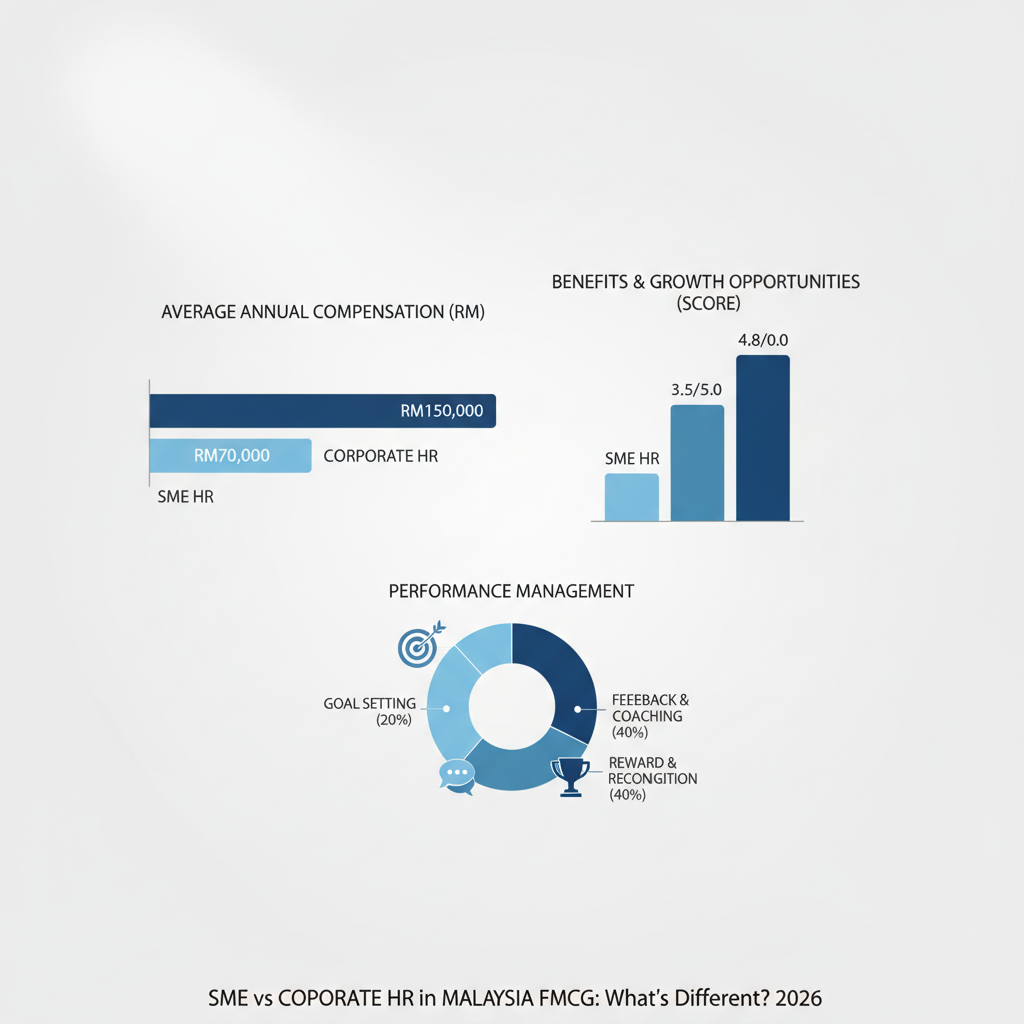
1. Salary Scales, Bonus Structures & Benefit Offerings
The fundamental divergence in reward systems begins with salary scales. Large FMCG corporations typically operate with well-defined, multi-tiered salary bands, often benchmarked against regional and international market rates. This structured approach allows for clear career progression and ensures competitive positioning in talent acquisition. Their bonus structures are usually sophisticated, incorporating a mix of individual, team, and company-wide performance metrics, sometimes extending to long-term incentive plans like stock options for senior leadership. Employee benefits packages in these corporations are extensive, covering not just statutory requirements (EPF, SOCSO, EIS) but also comprehensive medical and dental insurance, life and personal accident insurance, generous leave policies, retirement savings plans, wellness programs, employee assistance programs (EAP), and sometimes even transport or housing allowances. These robust offerings reflect their strategic objective to attract and retain top talent by providing a holistic total rewards package.
Conversely, SMEs in the Malaysian FMCG sector often adopt more flexible, albeit less structured, salary scales. Wages are frequently determined by direct market demand, individual negotiation, and immediate budget availability rather than rigid banding. Bonus structures tend to be more discretionary, often linked to company profitability or specific project success, and are typically short-term. While SMEs adhere to statutory benefits, their additional offerings are usually more basic. A common practice is a basic medical card, limited outpatient benefits, and standard annual leave entitlements. The provision of comprehensive wellness programs or EAP services is rare due to cost implications. Their strategic objective, driven by budgetary constraints, often prioritizes direct compensation over a broad suite of indirect benefits, aiming to be competitive enough to fill roles but less focused on elaborate retention strategies through extensive perks.
2. Performance Appraisal Systems, KPIs & Feedback Mechanisms
Performance management methodologies also reveal significant contrasts. Corporate FMCG giants employ formal, standardized performance appraisal systems, often utilizing sophisticated tools like 360-degree feedback, Management by Objectives (MBO), or Objectives and Key Results (OKRs). Key Performance Indicators (KPIs) are meticulously defined, cascaded from organizational strategic goals down to individual contributors, ensuring alignment and clear expectations. Feedback mechanisms are structured and regular, encompassing annual reviews, mid-year check-ins, and ongoing coaching. These systems are integral to talent development, succession planning, and linking performance directly to rewards, reflecting a strategic objective of continuous improvement and organizational growth through structured talent management. The importance of benchmarking compensation and performance metrics is often highlighted in these larger organisations.
In contrast, SMEs often feature less formal performance appraisal systems. Feedback is frequently direct, ad-hoc, and primarily manager-driven, sometimes lacking the structured documentation common in larger entities. KPIs, while present, might be less formalized, more focused on immediate operational tasks rather than strategic alignment. Development plans might be informal discussions rather than structured programs. The limited resources and smaller organizational size mean that performance management often relies on direct observation and immediate problem-solving. While effective for immediate operational needs, this approach can sometimes lack the consistency and long-term developmental focus seen in corporates. Their strategic objective here is often agility and responsiveness, with performance management supporting immediate business goals rather than extensive talent pipeline development.
3. Budgetary Constraints vs. Extensive Total Rewards Strategies
The overarching factor influencing these disparities is undoubtedly the budget and its interplay with strategic objectives. Large corporations possess the financial muscle to implement extensive total rewards strategies that encompass not only competitive compensation and comprehensive benefits but also sophisticated recognition programs, robust learning and development opportunities, and initiatives promoting work-life balance and employee well-being. Their strategic objective is to be an employer of choice, building a strong employer brand that attracts and retains high-calibre talent globally. They can invest in state-of-the-art HR Information Systems (HRIS) and advanced analytics to optimize their HR strategies.
For SMEs, budgetary constraints dictate a more focused approach. While they strive for competitive compensation, their total rewards strategy often leans towards creativity in non-monetary recognition, fostering a strong company culture, providing opportunities for diverse work experiences, and offering flexibility where possible. Training and development, while valued, might be delivered through more cost-effective methods such as on-the-job learning or external short courses rather than extensive internal academies. Their strategic objective is often centered on survival, growth, and efficiency, meaning every HR investment must demonstrate a clear and immediate return. This leads to a pragmatic approach to compensation, benefits, and performance management, prioritizing essential provisions and agile implementation over comprehensive, costly programs. The impact of these differences between the SMEs’ HR structure and the Corporates’ HR structure in FMCG companies in Malaysia is profound, shaping career paths and employee expectations within the sector.
HR Technology Adoption & Data Analytics
The landscape of HR technology adoption in Malaysian FMCG companies presents a stark contrast when comparing Small and Medium-sized Enterprises (SMEs) with their larger corporate counterparts. While both aim for efficient human resource management, the journey towards digital transformation, from basic administrative tools to advanced Human Resources Information Systems (HRIS) and data-driven insights, varies significantly. Understanding the Differences between the SMEs’ HR Structure and the Corporates’ HR Structure in FMCG companies in malaysia is crucial for appreciating the varying levels of technology integration. SMEs often grapple with resource constraints, leading to slower HR technology adoption Malaysia, whereas corporates leverage substantial investments to drive sophisticated HR automation and strategic data utilization. These differing approaches impact operational efficiency, talent management, and overall strategic HR capabilities within Malaysia’s competitive FMCG sector, highlighting the critical role of HR tech in overcoming common FMCG HR challenges.
1. Manual Processes vs. Integrated HRIS & Cloud Solutions
Many Malaysian FMCG SMEs characterize their HR functions by manual processes, spreadsheets, and fragmented systems. Tasks like payroll, attendance, and leave management frequently rely on Excel or basic, standalone software. This approach, while initially seemingly cost-effective, leads to inefficiencies, data inaccuracies, and compliance risks. The lack of an integrated system hinders real-time reporting and strategic oversight, making a holistic workforce view difficult. For these SMEs, investing in cloud HR for SMEs offers scalable and affordable solutions that integrate core HR functions without heavy upfront infrastructure costs.
In contrast, corporate HR best practices in large FMCG companies involve comprehensive, integrated HRIS implementation in FMCG. Systems like SAP SuccessFactors or Workday provide a unified platform for human capital management, encompassing recruitment, onboarding, performance, compensation, and learning. These sophisticated systems automate routine administrative tasks, standardize processes, and ensure regulatory compliance on a much larger scale. The shift to integrated cloud solutions also enables global accessibility and facilitates seamless data exchange, crucial for multinational FMCG corporations. This robust infrastructure supports proactive HR data management and streamlines operations, offering significant HR efficiency tools.
2. Data-Driven Decisions vs. Intuitive Approaches in HR
The dichotomy extends profoundly into decision-making. In smaller FMCG companies, HR decisions often spring from intuitive approaches, relying heavily on the experience of HR managers or business owners. While valuable for contextual understanding, this method lacks empirical backing to consistently drive optimal outcomes or predict future trends. Strategic HR initiatives, such as workforce planning Malaysia or talent management strategies, may be more reactive due to limited access to comprehensive HR data and analytics. The focus tends to be on immediate operational needs rather than long-term, predictive insights.
Conversely, large FMCG corporates increasingly embrace HR analytics FMCG to inform every aspect of their human resource strategy. They deploy advanced HR analytics tools and dashboards to process vast employee data, identifying trends, predicting attrition, and optimizing recruitment. This data-driven HR strategies approach enables informed decisions regarding talent acquisition, employee retention, and succession planning. For instance, analyzing employee engagement data through employee experience technology can pinpoint specific improvements, directly impacting productivity. This analytical prowess allows for strategic workforce planning Malaysia, ensuring the right talent is in the right place, transforming HR into a strategic business partner. Deloitte’s Global Human Capital Trends reports consistently highlight leveraging data for competitive advantage in talent management.
3. Investment in Digital Transformation & HR Automation
The disparity in financial capacity directly translates into varying levels of investment in HR digital transformation Malaysia and HR automation benefits. For most SMEs, capital expenditure for extensive HR tech solutions is often constrained. Their digital journey typically involves adopting piecemeal solutions, focusing on immediate pain points like payroll automation Malaysia or basic recruitment software FMCG, rather than a holistic overhaul. While these incremental improvements offer some relief, they rarely achieve the full integration and strategic value seen in larger organizations. Budget-conscious decisions often mean a slower pace in embracing comprehensive HR automation solutions, limiting the scope for advanced human capital management.
Large FMCG corporates, on the other hand, commit substantial budgets to continuous HR digital transformation Malaysia. This includes significant investments in cutting-edge HRIS, talent management systems, AI-powered recruitment tools, and sophisticated HR automation benefits across all functions. They understand that advanced HR technology is a strategic asset that enhances competitive advantage, improves employee experience, and optimizes operational costs in the long run. Their digital transformation initiatives re-imagine HR processes, foster innovation, and create a future-ready workforce, enabling them to attract and retain top talent, manage global workforces effectively, and adapt swiftly to market changes.
Legal Compliance, Employee Relations, and Development
In Malaysia’s dynamic Fast-Moving Consumer Goods (FMCG) sector, human resources management, particularly in legal compliance, employee relations, and talent development, showcases significant differences between the SMEs’ HR structure and the Corporates’ HR structure in FMCG companies in Malaysia. Both entity types strive for operational excellence and sustainable growth, yet their scale, resources, and strategic depth dictate varying methodologies for navigating employment law, fostering a positive workplace, and nurturing their workforce for future challenges.
1. Navigating Malaysian Labor Laws & Regulatory Compliance
For any Malaysian business, thorough understanding and strict adherence to labor laws are paramount, including the Employment Act 1955 (amended 2022), Industrial Relations Act 1967, and other regulations. The differences between the SMEs’ HR structure and the Corporates’ HR structure in FMCG companies in Malaysia become particularly evident here.
SMEs, with leaner teams and limited budgets, often rely on a single HR generalist or non-HR personnel for compliance. This poses challenges in staying abreast of legislative updates like minimum wage or flexible working arrangements. Their HR structure might involve outsourced legal advice, often leading to reactive rather than preventative risk management.
In contrast, large FMCG corporates typically possess sophisticated internal HR departments, often with dedicated legal counsel or specialized compliance teams. They invest heavily in continuous HR training and implement robust compliance frameworks. This proactive approach ensures higher adherence to Malaysian labor laws and regulations, mitigating legal risks and safeguarding their reputation. Resource allocation to regulatory compliance is a key differentiator.
2. Conflict Resolution, Grievance Procedures & Employee Engagement
Effective conflict resolution and robust grievance procedures are crucial for a harmonious and productive workplace. In Malaysian FMCG SMEs, dispute resolution often leans towards informal processes, relying on direct owner or manager involvement. While fostering a familial atmosphere, this can lack formal documentation, consistency, and impartiality. Employee engagement might be driven by direct interactions, effective but less structured.
Corporates, with larger workforces and complex hierarchies, necessitate well-defined, transparent, and legally compliant grievance mechanisms. Their HR structures feature structured pathways for employees to raise concerns, involving multiple management levels, HR business partners, and, if necessary, external mediation. These formal procedures ensure fairness, protect rights, and comply with the Industrial Relations Act 1967. Employee engagement strategies are typically multi-faceted, involving surveys, recognition, and internal communications. This formalization highlights the differences between the SMEs’ HR structure and the Corporates’ HR structure in FMCG companies in Malaysia.
3. Training, Upskilling, Career Pathing & Succession Planning
Investing in learning and development (L&D) is vital for nurturing talent and ensuring long-term organizational growth. Here too, the differences between the SMEs’ HR structure and the Corporates’ HR structure in FMCG companies in Malaysia are pronounced.
FMCG SMEs often prioritize on-the-job training, mentorship, and skill-specific workshops. Career pathing might be less formalized, with growth opportunities emerging organically. Succession planning, if present, tends to be informal, focusing on key individuals rather than a systematic program. While agile and cost-effective, this may limit exposure to diverse training methodologies.
Conversely, large FMCG corporates dedicate substantial budgets and resources to comprehensive L&D programs. Their HR structures include dedicated L&D departments that design structured training modules, leadership development, professional certifications, and robust career pathing frameworks. They often utilize advanced learning management systems (LMS) and offer international exposure. Succession planning is a highly strategic initiative, identifying high-potential employees, preparing them for future leadership through structured development, and ensuring continuity. This systematic investment builds a deep talent pool and sustains future growth.
In conclusion, while both SMEs and Corporates in Malaysian FMCG navigate similar HR imperatives, their scale and resources lead to distinct approaches in legal compliance, employee relations, and talent development. Understanding these structural differences is key to appreciating the unique challenges and strengths each type of organization brings to the dynamic Malaysian business environment.
Partner with Shelby Global
You are looking for reliable HR Sevice Suppliers? Contact Shelby Global Now! To connect with verified talents and upgrade your orginization.
—————————————
References
– Deloitte Global Human Capital Trends: https://www2.deloitte.com/us/en/pages/human-capital/articles/human-capital-trends.html
– :
– Malaysia Salary Budget Planning Report – Willis Towers Watson: https://www.wtwco.com/en-MY/insights/2023/10/malaysia-salary-budget-planning-report
– Deloitte Global Human Capital Trends reports: https://www2.deloitte.com/us/en/pages/human-capital/articles/human-capital-trends.html
– Malaysian Ministry of Human Resources Labour Policy and Legislation: https://www.mohr.gov.my/index.php/en/labour-policy-and-legislation/



































































































