Understanding Education Management Hiring in SG
Singapore’s education landscape is a complex, high-stakes ecosystem defined by rigorous standards and a constant pursuit of excellence. For organizations aiming to thrive in this environment, hiring the right leadership is not just a human resources task; it is a strategic imperative. The need for a robust Test structure to assess Manager Level CVs in education companies in singapore has never been more critical to ensure that candidates possess the pedagogical vision and operational agility required to succeed.

-
Current Market Trends in Education
The Singaporean education sector is currently undergoing a digital and pedagogical transformation. As outlined in the Ministry of Education (MOE) guidelines, there is an increasing emphasis on holistic development, ed-tech integration, and personalized learning pathways. Managers are now expected to be “dual-threat” leaders who understand both the nuances of student development and the business complexities of private training providers, international schools, or ed-tech firms. Consequently, the recruitment process must move beyond traditional credentials to identify those capable of navigating these rapid shifts.
-
Why Standard CV Reviews Often Fail
Traditional screening methods often prioritize years of experience or institutional pedigree, which are insufficient proxies for success in Singapore’s dynamic market. A standard CV review frequently fails to uncover a candidate’s ability to manage cross-functional teams, navigate regulatory compliance, or drive innovation under pressure. When hiring for manager-level roles, relying on surface-level metrics often leads to “resume-smart” but “execution-poor” hires. To mitigate this risk, firms must implement a structured evaluation framework that maps professional history against specific, measurable management scenarios.
-
Defining Essential Managerial Competencies
To build an effective hiring pipeline, firms must define the core pillars of a successful education manager. First, Stakeholder Engagement is paramount; managers must be able to communicate effectively with parents, regulators, and internal faculty. Second, Operational Resilience is required, as the Singapore market demands adherence to strict KPIs while managing limited resources. Finally, Adaptability—the ability to pivot strategy in response to technological disruptions—is a non-negotiable trait. By creating a standardized test structure to evaluate these competencies through CV analysis and subsequent behavioral interviews, hiring teams can filter out high-risk applicants and focus their resources on individuals who align with the organization’s long-term mission and Singapore’s high-performance culture.
Core Components of a Reliable Test Structure
In the competitive landscape of the Singaporean education sector, identifying leadership talent requires more than a traditional interview. A robust test structure to assess Manager Level CVs in education companies in singapore is essential to ensure that candidates possess the pedagogical vision and operational rigor needed to lead diverse teams. By implementing a systematic evaluation framework, organizations can mitigate hiring risks and align new leaders with their institutional goals.
-
Establishing Initial Screening Criteria
-
Integrating Cognitive and Behavioral Testing
-
Utilizing Role-Specific Scenario Assessments
The foundation of any effective assessment begins with a standardized screening process. Before moving into complex testing, HR teams must filter applications based on non-negotiable benchmarks such as relevant local certification, years of experience in regional education administration, and demonstrated ability to navigate the Ministry of Education (MOE) guidelines. By establishing these objective criteria early, recruiters can focus their resources on high-potential candidates who possess the foundational compliance and leadership experience required for the role.
Once the initial screening is complete, the focus must shift to identifying the psychological and intellectual traits that define a successful manager. Managerial roles in education demand high-level decision-making, emotional intelligence, and long-term strategic planning. Integrating standardized cognitive assessments allows companies to gauge a candidate’s analytical problem-solving skills, while behavioral assessments—often modeled after the STAR method—reveal how a candidate has previously navigated personnel conflicts or curriculum changes. This phase of the test structure to assess Manager Level CVs in education companies in singapore ensures that the candidate’s cognitive capacity is matched by the soft skills necessary to thrive in an academic environment.
The final component of a reliable test structure involves simulated real-world scenarios. For education managers, this might include drafting a response to a parent’s grievance, designing a faculty training workshop, or managing a budgetary shortfall. These simulations provide a high-fidelity look at how a candidate performs under pressure. By moving beyond self-reported experience, organizations gain empirical evidence of how a candidate approaches the specific operational, pedagogical, and administrative challenges inherent in the Singaporean private education sector. When combined with the previous stages, these scenario-based evaluations ensure that the final candidate is not only qualified on paper but is also capable of driving immediate value within the organization.
Evaluating Leadership Resumes for Critical Red Flags
In the competitive landscape of the Singaporean education sector, hiring managers must go beyond surface-level qualifications. When screening candidates for leadership roles, a rigorous evaluation framework is essential to ensure that talent matches the strategic needs of your organization. To streamline your hiring pipeline, implementing a robust Test structure to assess Manager Level CVs in education companies in singapore is vital for maintaining high academic and operational standards.

-
Identifying Unexplained Employment Gaps
While career breaks are increasingly common, unexplained gaps in a manager-level CV can indicate potential performance issues or lack of professional commitment. As noted by the Ministry of Manpower Singapore, transparent documentation of professional history is key to verification. Look for candidates who proactively address these gaps with clear explanations—whether for further study, family commitments, or sabbaticals—rather than leaving them as blank spaces that raise doubts about their accountability.
-
Verifying Institutional Credentials
Education companies thrive on reputation. A candidate’s credentials must be beyond reproach. Red flags include ambiguous degree titles, unaccredited certification bodies, or dates of attendance that do not align with industry norms. For manager-level roles, verify not just the existence of the degree, but the reputation of the granting institution. Cross-referencing background checks with official transcripts is a non-negotiable step to protect your institution from misrepresentation risks.
-
Analyzing Realistic Career Progression
Leadership requires a proven track record of increasing responsibility. A major red flag is the “title jumper,” where a candidate holds several high-level titles (e.g., Director or Principal) in a very short span of time without clear, measurable achievements. Authentic leadership growth should show a trajectory of managing larger budgets, bigger teams, or more complex operational challenges. If a CV lists high-impact titles but lacks data-driven evidence of outcomes—such as enrollment growth rates, staff retention metrics, or curriculum innovation success—it is likely an exaggerated claim that warrants further scrutiny during the interview process.
By focusing on these three pillars, hiring committees can mitigate risk and identify candidates who possess the genuine experience required to lead effectively in Singapore’s dynamic education market.
Aligning Candidate Benchmarks with Institutional Goals
In the competitive landscape of Singaporean education, identifying the right leadership talent requires more than scanning for keywords. A robust Test structure to assess Manager Level CVs in education companies in singapore is essential to ensure that a candidate’s professional narrative is not just impressive on paper, but strategically aligned with the institution’s long-term vision. This process mitigates hiring risks and ensures that new managers can hit the ground running, fostering growth from day one.
-
Mapping Hard Skills to Company Vision
The first step in evaluating a manager-level CV is ensuring that their technical expertise directly maps to the company’s strategic imperatives. For an education provider, this means looking past general management experience and focusing on evidence of successful curriculum implementation, digital transformation in learning, or scalable operational growth. According to SkillsFuture Singapore, the current education landscape demands leaders who can bridge the gap between pedagogy and digital competency. When reviewing CVs, look for tangible data—such as improved enrollment metrics, specific accreditation achievements, or the successful integration of ed-tech tools—that prove the candidate’s hard skills are tailored to meet the unique challenges of Singapore’s education sector.
-
Assessing Cultural and Academic Fit
In Singapore, where education is highly valued and institutions often carry a strong, distinctive brand identity, cultural alignment is paramount. An excellent candidate for one school may struggle in another due to divergent academic philosophies or operational styles. To assess this, examine the CV for consistent narrative threads: has the candidate moved between institutions with similar academic rigor, or have they successfully navigated diverse environments? Look for evidence of collaborative leadership, mentorship, and a genuine commitment to the institution’s educational mission. During the evaluation process, utilize structured behavioral questions that require candidates to provide examples of how they have fostered community, handled stakeholder concerns, or supported teaching staff in past roles.
-
Spotting Long-Term Retention Indicators
High turnover at the management level can be incredibly disruptive to both student outcomes and operational stability. A well-designed evaluation framework must identify candidates with the resilience and motivation to commit to long-term goals. While assessing the CV, analyze the timeline of their career progression. Are there frequent jumps between roles without clear professional development outcomes, or is there a history of seeing long-term projects through to completion? Indicators of longevity include evidence of sustained team development, institutional initiatives launched and managed over several years, and a documented history of navigating organizational change. Candidates who have demonstrated the ability to adapt, grow, and remain committed through different phases of an institution’s life cycle are the most likely to contribute to long-term success.
Implementing Your 2026 CV Assessment Framework
As the education sector in Singapore undergoes rapid digital transformation, recruitment strategies must evolve to keep pace. Establishing a rigorous test structure to assess Manager Level CVs in education companies in singapore is no longer optional; it is a necessity for maintaining academic excellence and operational efficiency. Transitioning to this new framework requires a disciplined approach, moving away from subjective hiring toward data-driven talent acquisition.
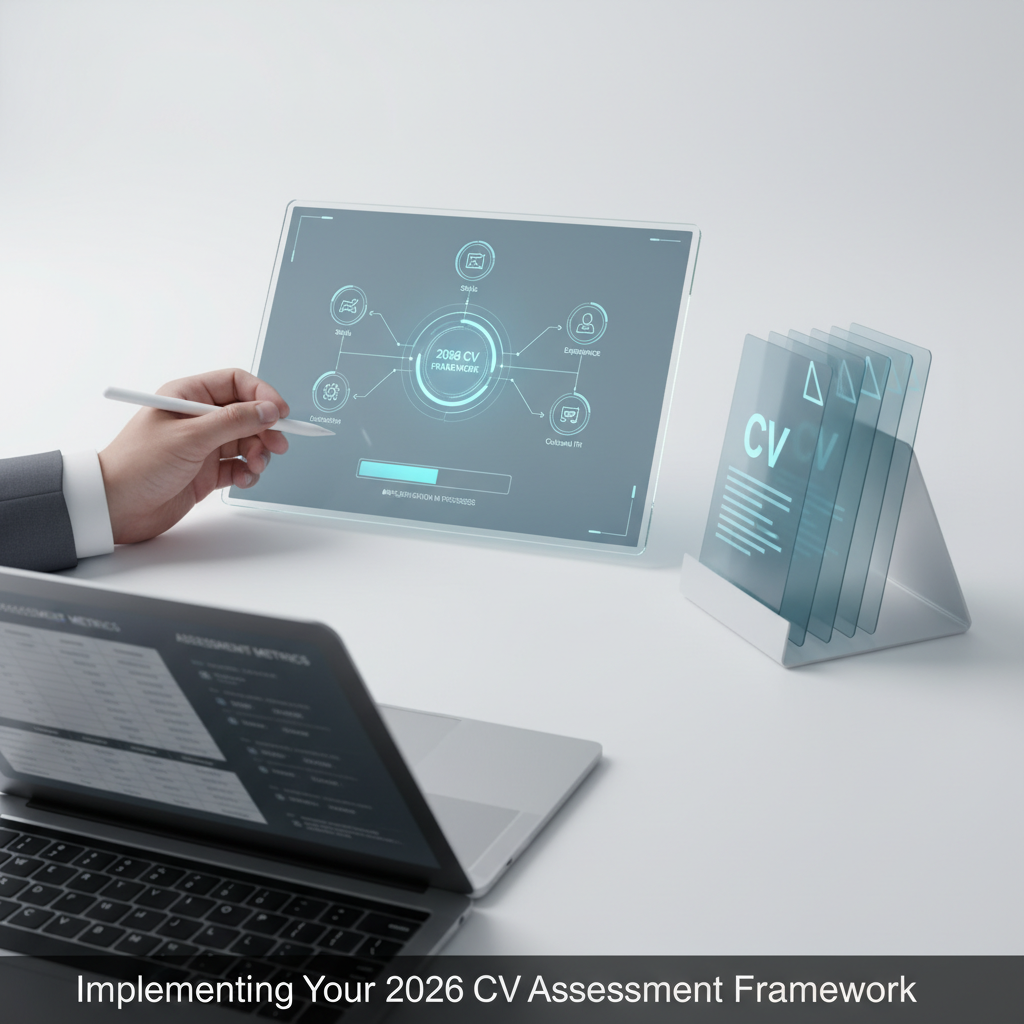
To successfully deploy these changes, HR departments must view this transition as a strategic pivot rather than a simple policy update.
-
Training Your HR Team on the New Protocol
The most sophisticated framework is ineffective if your internal team lacks the expertise to apply it consistently. Conduct mandatory workshops focused on the nuances of competency-based interviewing and standardized CV scoring. HR recruiters must understand how to distinguish between a candidate with generic administrative experience and one who possesses the specialized pedagogical leadership required for high-level management. Role-playing sessions based on anonymized profiles can help team members align their scoring methodologies, ensuring that every recruiter assesses leadership potential using the exact same metrics.
-
Leveraging Modern ATS and AI Screening Tools
To scale your hiring process effectively, integrate Applicant Tracking Systems (ATS) that support custom scoring modules. Modern tools now allow for the automated mapping of candidate profiles against your proprietary 2026 rubrics. According to SHRM, leveraging AI for the preliminary screening of manager-level applications can reduce time-to-hire by up to 40% while mitigating unconscious bias. By automating the extraction of key milestones—such as curriculum development success, staff retention rates, and regional expansion achievements—you ensure that only the most qualified candidates advance to the human review stage, allowing your HR team to focus on cultural fit and long-term vision.
-
Continuous Refinement of the Testing Rubric
The education landscape in Singapore is volatile, influenced by shifting government regulations and evolving student expectations. Your CV assessment framework must remain dynamic. Schedule quarterly reviews of the testing rubric to analyze the performance of recently hired managers against their initial assessment scores. If a high-scoring candidate underperforms, investigate whether the assessment structure failed to capture key behavioral traits or leadership gaps. By treating your recruitment process as an iterative product development cycle, you can fine-tune your criteria to ensure your management bench remains robust and highly capable of navigating the complexities of modern educational institutions.
Partner with Shelby Global
You are looking for reliable HR Sevice Suppliers? Contact Shelby Global Now! To connect with verified talents and upgrade your orginization.
—————————————
References
– Ministry of Education (MOE) Singapore: https://www.moe.gov.sg/
– Ministry of Education Singapore: https://www.moe.gov.sg/
– Ministry of Manpower Singapore: https://www.mom.gov.sg/
– SkillsFuture Singapore: https://www.ssg-wsg.gov.sg/
– Society for Human Resource Management: https://www.shrm.org