Scope of Responsibilities
Understanding the differences between the SMEs’ HR Manager and the Corporates’ HR Director in marketing agency in Singapore is crucial for aspiring HR professionals and business leaders alike. While both roles are fundamental to an organisation’s success, their day-to-day tasks, strategic involvement, and overall areas of accountability vary significantly depending on the company’s size and structure. In Singapore’s dynamic marketing agency landscape, HR professionals navigate unique challenges, from rapid growth and talent acquisition to fostering vibrant creative cultures. This section delves into these nuanced distinctions, highlighting how HR functions adapt across different scales.

1. Operational vs. Strategic Focus
The most striking distinction lies in the operational versus strategic focus of the roles. An HR Manager in an SME marketing agency often wears multiple hats, deeply immersed in the daily operational grind. Their responsibilities typically encompass everything from payroll processing and benefits administration to recruitment coordination and employee onboarding. This hands-on approach means they are directly involved in immediate problem-solving, such as managing employee grievances or handling leave requests. Their strategic input, while valued, is often reactive and focused on short-term needs, like fulfilling urgent hiring demands or implementing basic HR policies to ensure compliance. The emphasis is on keeping the HR machinery running smoothly with limited resources.
Conversely, a Corporate HR Director in a larger marketing agency operates at a much higher strategic altitude. While they oversee operational excellence, their primary mandate is to align HR initiatives with the organisation’s overarching business goals. This involves developing long-term talent acquisition strategies, crafting robust compensation and benefits frameworks, and leading organizational development efforts to foster a high-performance culture. They engage in workforce planning, succession planning, and collaborate with executive leadership on major business transformations. Their role is less about the day-to-day execution and more about foresight, policy formulation, and shaping the human capital strategy that drives competitive advantage and market leadership. They delegate operational tasks to a team of HR specialists, allowing them to concentrate on strategic HR planning and global HR trends.
2. Breadth of Functions Covered
The breadth of functions covered also presents a significant divergence. In an SME, the HR Manager is typically a generalist. They are responsible for the entire employee lifecycle, from initial talent acquisition strategies to employee offboarding. This includes managing recruitment campaigns, conducting interviews, overseeing performance management systems, handling employee relations management, and ensuring basic compliance. They might also be the sole point of contact for HR-related inquiries, requiring a broad understanding across all HR domains. This generalist approach is essential for lean operations where specialized HR departments are not feasible.
In a large corporate marketing agency, the HR function is often compartmentalized into specialized departments. An HR Director, while having an overarching view, typically leads a team comprising specialists in areas like talent acquisition, compensation and benefits, learning and development, and HR technology implementation. For instance, dedicated recruiters manage the talent pipeline, while specialists design intricate benefits packages. The HR Director’s role here is to integrate these specialized functions, ensure consistency across policies, and provide strategic direction for each area. They focus on overall organizational development and ensuring a holistic HR service delivery, often overseeing multiple countries or regions, each with its own compliance and legal oversight requirements.
3. Resource Management and Budgeting
Resource management and budgeting are areas where the differences between the SMEs’ HR Manager and the Corporates’ HR Director in marketing agency in Singapore are particularly pronounced. An HR Manager in an SME typically operates with a constrained budget and limited resources. Decisions regarding HR software, training programs, or external recruitment support often require direct approval from senior management or even the business owner. Their challenge is to maximize impact with minimal expenditure, often leveraging free tools, internal training, or cost-effective recruitment channels. They must be adept at demonstrating ROI for every HR initiative, directly tying it to immediate business outcomes.
Conversely, a Corporate HR Director manages a substantial budget, often allocated for sophisticated HR technology, comprehensive training and development programs, and external consulting services. They have greater autonomy in allocating resources across various HR functions, investing in cutting-edge HR platforms, robust employee wellness programs, and extensive leadership development initiatives. Their budgeting process is strategic, involving detailed forecasting, long-term investment planning, and demonstrating value at an organizational level. For instance, ensuring compliance with Singapore employment laws might involve investing in advanced HRIS systems and legal counsel to mitigate risks across a large workforce. This allows for more proactive and comprehensive approaches to managing human capital, reinforcing the company’s position as a top employer in the competitive marketing landscape.
Strategic Impact & Influence
In the dynamic landscape of marketing agencies in Singapore, the role of Human Resources has transcended traditional administrative functions to become a pivotal driver of strategic impact and influence. As businesses navigate rapid market changes and intense competition, the contribution of HR professionals, whether an HR Manager in a nimble SME or an HR Director in a sprawling corporate entity, is increasingly critical. This section delves into how these diverse HR roles contribute to the overall business strategy, decision-making processes, and organizational development, highlighting the profound differences between the SMEs’ HR Manager and the Corporates’ HR Director in marketing agency in Singapore and their unique contributions to an agency’s success. Effective HR strategy alignment is no longer a luxury but a necessity for sustainable business growth and fostering a positive employee experience.
1. Direct Business Partnership
The transition of HR from a purely supportive role to a strategic one marks a significant evolution, transforming HR professionals into direct business partners. For SMEs in Singapore’s marketing sector, the HR Manager often embodies a highly hands-on approach. They are intimately involved in daily operations, sitting at the table to contribute directly to strategic discussions, understanding immediate staffing needs, and quickly adapting HR initiatives to align with urgent business objectives. Their influence is often felt immediately through direct employee interaction and agile problem-solving, acting as a crucial link between management and the workforce to support overall business growth.
In contrast, a Corporate HR Director in a larger marketing agency typically operates at a more macro level. Their focus is on developing overarching HR strategy alignment that supports long-term organizational goals, often advising the C-suite on workforce implications of major strategic decisions like mergers, acquisitions, or market expansions. They are instrumental in shaping high-level policies and frameworks that drive performance across multiple departments or even regional offices. This strategic input ensures that human capital considerations are integrated into every significant business decision. The shift towards a strategic HR business partner model underscores how HR leaders are no longer just administrators but essential architects of organizational success, directly impacting revenue generation and competitive advantage by ensuring human capital strategies are seamlessly woven into the business fabric.
2. Talent Management & Succession Planning
Attracting, developing, and retaining top talent is paramount for any marketing agency, and HR plays the central role in this. In an SME marketing agency, the HR Manager often takes a highly personalized approach to talent management. They might be responsible for end-to-end recruitment, designing localized training programs, and conducting performance reviews themselves. Their intimate knowledge of each employee allows for tailored development plans and a strong focus on individual employee experience. While succession planning might be less formalized, it often relies on direct observation and nurturing key individuals for future leadership roles within the smaller structure.
For a Corporate HR Director, the scope of talent management is far broader and more systematic. They are tasked with developing sophisticated workforce planning strategies, identifying future skill gaps across the entire organization, and implementing robust performance management systems that include objective setting, regular feedback cycles, and comprehensive appraisal processes. Succession planning becomes a formalized, organization-wide initiative, involving pipeline development for critical roles, identifying high-potential employees, and creating structured leadership development programs. This strategic oversight ensures a continuous flow of skilled professionals, mitigating risks associated with key personnel departures and positioning the agency for sustained growth and innovation in the highly competitive Singaporean market.
3. Organizational Design & Culture Shaping
Beyond individual talent, HR’s strategic influence extends to shaping the very structure and soul of the agency. An SME HR Manager in a marketing agency often has a direct hand in informal organizational development, influencing culture through daily interactions, team-building activities, and embodying the company’s values. They are instrumental in fostering a close-knit environment, facilitating open communication, and ensuring that the organizational structure supports agile decision-making characteristic of smaller entities. Their direct involvement means they can quickly identify cultural nuances and implement immediate, tangible changes to enhance the employee experience and productivity.
Conversely, a Corporate HR Director leads comprehensive organizational development initiatives designed to optimize efficiency, define clear career paths, and adapt the agency’s structure to evolving business needs and market demands. This includes significant projects like departmental restructuring, M&A integration, or implementing new technological platforms, all requiring expert change management strategies. They are the architects of the agency’s overarching culture, designing programs and policies that reinforce desired values, promote diversity and inclusion, and ensure a consistent brand experience for employees across all levels and locations. Their work ensures that the agency’s internal environment not only supports current strategic objectives but is also resilient and adaptable enough to navigate future challenges, solidifying the vital role of HR in sculpting a thriving, future-ready marketing agency in Singapore.
Team Structure & Resources
The operational landscape for Human Resources professionals varies dramatically between a lean Small to Medium-sized Enterprise (SME) and a sprawling corporate entity, particularly within the dynamic marketing agency sector in Singapore. The fundamental Differences between the SMEs’ HR Manager and the Corporates’ HR Director in marketing agency in singapore are not merely titular; they manifest in team composition, the array of available tools, and the very support systems underpinning their roles. This section delves into these distinctions, offering a comprehensive look at how resource availability shapes strategic influence and day-to-day responsibilities.
1. Solo Practitioner vs. Department Head
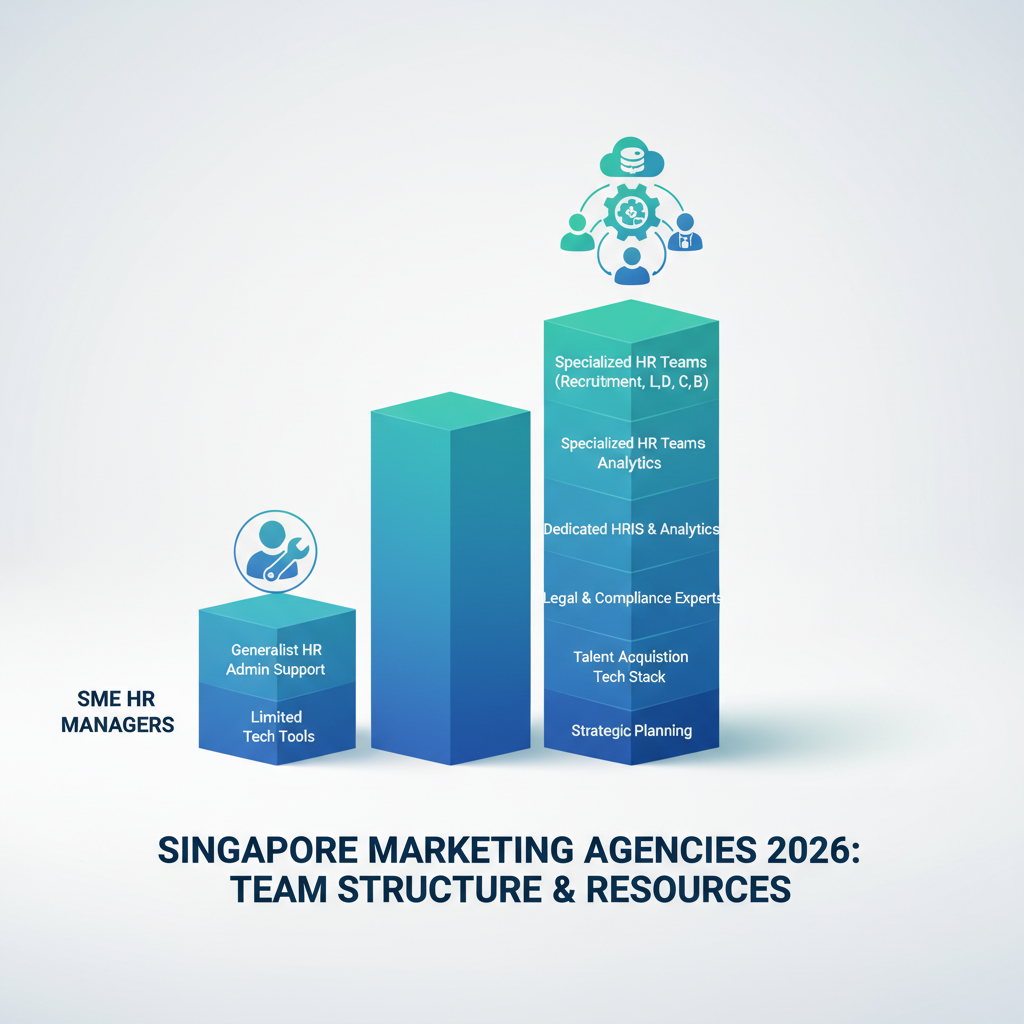
For the HR Manager in an SME marketing agency in Singapore, the role often embodies that of a solo practitioner. This individual is typically a generalist, single-handedly managing the full spectrum of HR functions: talent acquisition, payroll, benefits, employee relations, performance management, and compliance. Their focus is inherently operational, driven by immediate needs and often reactive problem-solving. They might also foster company culture with limited budget, facing HR challenges for small businesses due to resource constraints and the need for broad expertise. Decisions are often made autonomously, requiring deep understanding across all HR domains.
In contrast, the HR Director in a larger corporate marketing agency operates as a department head, leading a specialized team. This team is typically segmented into distinct functions like talent acquisition, compensation & benefits, HR business partnering, and learning & development. The corporate HR Director’s role transcends daily operational tasks, shifting towards strategic HR planning, organizational development, and aligning HR initiatives with broader business objectives. They design comprehensive HR strategies, foster long-term talent management, and develop robust policies for a larger, more complex workforce. Managing a substantial HR budget and overseeing team development are integral components, empowering significant organizational change and strategic growth.
2. HR Technology & Systems Utilisation
The disparity in HR technology and systems utilisation forms another significant dividing line. SME HR Managers often rely on a more rudimentary tech stack, from basic spreadsheets for employee data and leave, to entry-level cloud-based HR Information Systems (HRIS) for core functions like payroll. Budget limitations often dictate the adoption of advanced HR tech solutions, leading to more manual processes for tasks like performance reviews. The emphasis is on functionality and cost-effectiveness, rather than extensive integration or sophisticated data insights. While these tools fulfill essential needs, they typically lack the depth for strategic workforce planning.
Conversely, corporate HR Directors command access to and oversee highly sophisticated and integrated Human Capital Management (HCM) platforms. Systems like Workday, SAP SuccessFactors, or Oracle HCM Cloud provide end-to-end solutions for talent management, global payroll, advanced analytics, performance management, and learning management. These platforms enable data-driven decision-making, automate complex HR workflows, and provide comprehensive workforce insights. The significant investment reflects a corporate commitment to operational efficiency, enhanced employee experience, and strategic HR initiatives. Robust HR technology empowers the corporate HR Director to focus on strategic insights, rather than administrative burdens.
3. Access to Specialist Support
Access to specialist support further highlights the distinct operational environments. The HR Manager in an SME marketing agency frequently operates without immediate internal specialist support. When confronting complex legal matters, intricate compensation challenges, or highly specialized recruitment for niche creative roles, they typically outsource. This involves engaging external legal counsel for employment law, partnering with specialized recruitment agencies, or consulting with benefits experts on an ad-hoc basis. The HR Manager must possess broad knowledge to identify when external expertise is required and manage those relationships, embodying a ‘jack-of-all-trades’ approach.
In contrast, the corporate HR Director benefits from an extensive internal network of specialist support. This often includes dedicated in-house legal teams, compensation and benefits specialists, industrial relations experts, and learning and development departments. For global marketing agencies, regional HR leads or global mobility specialists may also be present. This internal ecosystem of expertise allows the HR Director to delegate specialized tasks and draw upon profound institutional knowledge, freeing them to focus on overarching strategic HR objectives and organizational development. While external consultants may still be engaged for highly specialized projects, leveraging internal capabilities is often the default, showcasing a deeper pool of HR resources.
In conclusion, the journey from an SME HR Manager to a Corporate HR Director in a marketing agency in Singapore reflects a profound evolution in scope, resources, and strategic influence. While the SME role demands versatility and operational agility, the corporate position emphasizes strategic leadership and specialized expertise, underscoring the dynamic nature of HR across different organizational scales.
Key Challenges & Problem-Solving
The dynamic landscape of a marketing agency in Singapore presents a unique set of challenges for HR professionals, whether they operate within the lean structure of an SME or the expansive framework of a multinational corporation. The fundamental differences between the SMEs’ HR Manager and the Corporates’ HR Director lie not just in their titles or team sizes, but profoundly in their approaches to problem-solving, influenced by resource availability, organizational scale, and strategic imperatives. While both aim to foster a productive and compliant work environment, the obstacles they face and the methods they employ to overcome them diverge significantly.
1. Budget Constraints & Scalability Issues
For an HR Manager in a small-to-medium-sized marketing agency in Singapore, budget constraints are often the primary hurdle. Resourcefulness becomes a core competency. They might rely on free or low-cost HR tools, negotiate fiercely with vendors, or leverage professional networks for affordable training solutions. Their approach to scalability is typically reactive; a sudden surge in projects might mean manual onboarding processes are stretched thin, or rapid team growth requires creative, often ad-hoc, solutions for talent management. Problem-solving here is hands-on, requiring a deep understanding of every HR function and the ability to wear multiple hats.
Conversely, a Corporate HR Director in a larger marketing agency in Singapore operates with a more substantial budget, allowing for strategic investments in advanced HR Information Systems (HRIS), Applicant Tracking Systems (ATS), and comprehensive learning & development platforms. Their focus on scalability is proactive, involving robust workforce planning, establishing standardized global processes, and leveraging technology to manage growth or contraction efficiently. Problem-solving for the Corporate HR Director involves strategic financial planning, securing C-suite buy-in for HR initiatives, and ensuring a measurable return on investment for HR technology and programs.
2. Compliance & Risk Management Demands
Compliance and risk management present distinct challenges. An SME HR Manager in a marketing agency in Singapore is often the sole custodian of HR compliance, necessitating meticulous self-education on local labor laws, such as the Employment Act, PDPA, and various MOM guidelines. The personal liability can feel significant, and problem-solving typically involves diligent research, seeking advice from industry peers, or engaging external consultants only for critical, high-risk situations. Preventative measures might be less formal, relying on personal oversight rather than elaborate systems.
In contrast, a Corporate HR Director benefits from dedicated legal teams, compliance specialists, and a larger HR department with specific roles for risk mitigation. They implement sophisticated internal policies, conduct regular audits, and roll out mandatory compliance training programs across the organization. Their approach to problem-solving is systemic and proactive, focusing on developing robust frameworks, integrating compliance into HR tech, and collaborating closely with legal counsel to pre-empt potential issues and manage complex regulatory changes on a global or national scale. The Differences between the SMEs’ HR Manager and the Corporates’ HR Director in marketing agency in Singapore are stark in this domain, with corporates having the luxury of specialized resources.
3. Attracting & Retaining Talent (Niche vs. Volume)
The challenge of attracting and retaining top talent in Singapore’s competitive marketing sector also differs. For an SME HR Manager, attracting talent often hinges on building a compelling company culture, highlighting unique growth opportunities, and leveraging employee referrals and direct networking. They often target niche skill sets but struggle to compete with larger corporations on compensation or brand recognition. Retention strategies are highly personalized, focusing on direct engagement, flexible work arrangements, and fostering a strong sense of community. Their problem-solving involves creative employer branding on a limited budget and cultivating a deep understanding of individual employee needs.
The Corporate HR Director, on the other hand, leverages a powerful employer brand, extensive recruitment budgets, and sophisticated Applicant Tracking Systems (ATS) to attract both volume hires and specialized talent. Their strategies include comprehensive compensation and benefits packages, structured career development paths, and global mobility opportunities. Retention involves data-driven talent analytics, strategic workforce planning, and developing robust learning & development programs. The HR Director’s problem-solving focuses on optimizing recruitment funnels, refining compensation structures, and developing scalable programs to engage and retain a diverse, large workforce, highlighting further differences between the SMEs’ HR Manager and the Corporates’ HR Director in marketing agency in Singapore in talent strategy.
Career Trajectories & Skill Sets
In Singapore’s dynamic business landscape, the roles of HR Manager in Small and Medium-sized Enterprises (SMEs) and HR Director in corporate marketing agencies represent distinct yet crucial facets of human resource management. While both aim to nurture talent and foster productive workplaces, the differences between the SMEs’ HR Manager and the Corporates’ HR Director in marketing agency in Singapore are profound, shaped by organisational scale, strategic mandates, and resource availability. This section delves into the unique career paths, required competencies, and growth opportunities for these pivotal HR roles, providing insights into HR roles Singapore, SME HR challenges, corporate HR strategy, and marketing agency HR.
1. Required Skill Sets & Competencies
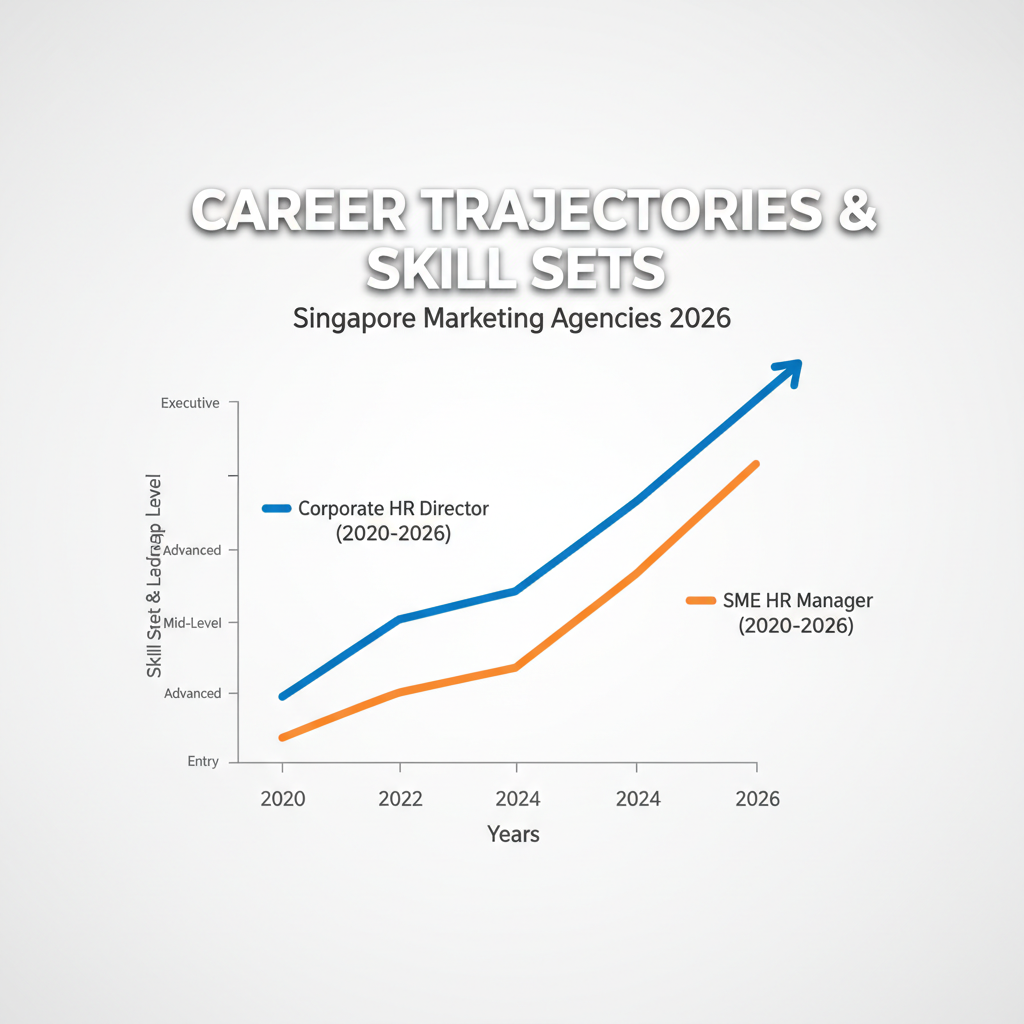
The competencies demanded by each role reflect their operational scope. An HR Manager in an SME typically operates as a generalist, handling a broad spectrum of HR functions. Their skill set must encompass HR skill development across talent acquisition, onboarding, payroll processing, employee relations, performance management, and compliance with local labour laws. Resourcefulness, adaptability, and strong problem-solving skills are paramount, as they often work with limited budgets and resources, acting as a one-person HR department or part of a very lean team. They need to be hands-on, managing day-to-day HR operations efficiently while also providing basic strategic input to the business owner.
Conversely, an HR Director in a corporate marketing agency in Singapore requires a highly strategic and specialised skill set. This role involves overseeing larger HR teams, often segmented into talent acquisition, learning & development, compensation & benefits, and HR operations. Key competencies include strategic HR leadership, business acumen, change management, organisational design, and advanced data analytics. They must align HR strategies with the agency’s overarching business goals, navigate complex global or regional structures, and possess a deep understanding of the fast-paced, creative, and often demanding nature of the marketing industry. Stakeholder management, particularly with executive leadership and diverse employee groups, is critical for driving initiatives that enhance talent management in marketing and overall organisational performance.
2. Professional Development Opportunities
Professional development pathways also diverge significantly. For an HR Manager in an SME, growth often means deepening their generalist expertise, gaining certifications in specific HR domains (e.g., payroll, industrial relations), or moving into a more senior HR generalist role within a larger SME. Learning is typically hands-on, driven by immediate operational needs, and supplemented by online courses or local HR workshops. Networking within the SME community is invaluable for sharing best practices and overcoming common SME HR challenges. Their career progression might lead them to manage a small HR team or transition into a specialist role in a larger organisation after gaining broad experience.
An HR Director in a corporate marketing agency, however, has access to and requires more sophisticated development opportunities. This includes executive leadership programs, advanced certifications in areas like HR analytics, organisational development, or strategic workforce planning, and participation in industry-specific conferences. Mentorship from senior business leaders and involvement in high-level strategic projects are common. Their HR career growth Singapore trajectory can lead to regional HR leadership, Global HR Director roles, or even a Chief People Officer position. They are expected to contribute to the strategic direction of the entire business, making continuous learning in areas like digital transformation, AI in HR, and global talent trends essential.
3. Future Outlook & Industry Trends
Both roles are being shaped by overarching industry trends, including digital transformation, data analytics, and the evolving employee experience. For SME HR Managers, the future demands greater proficiency in leveraging HR technology to streamline administrative tasks, allowing more focus on employee engagement and well-being with limited resources. They will need to be agile in adopting new tools and processes to stay competitive and manage hybrid work models effectively.
For Corporate HR Directors in marketing agencies, the future points towards an even more strategic and data-driven approach. They will be at the forefront of implementing advanced HR analytics to predict talent needs, optimise workforce planning, and measure the ROI of HR initiatives. Their role will involve shaping an adaptable, innovative culture that attracts and retains top creative talent in a highly competitive market. Understanding and integrating concepts from the Deloitte Global Human Capital Trends will be crucial for navigating global shifts in workforce dynamics. Embracing AI-driven HR solutions, fostering diversity and inclusion, and building resilient organisations will define strategic HR leadership and success in the coming years. Both roles, despite their differences, are indispensable in driving business success through effective people management in Singapore’s vibrant economy.
Partner with Shelby Global
You are looking for reliable HR Sevice Suppliers? Contact Shelby Global Now! To connect with verified talents and upgrade your orginization.
—————————————
References
– Singapore Employment Act: https://www.mom.gov.sg/employment-practices/employment-act
– Strategic HR Business Partner Model: https://www.shrm.org/topics-tools/news/hr-magazine/what-is-the-hr-business-partner-model
– HR challenges for small businesses: https://www.shrm.org/resources-and-tools/hr-topics/small-business-hr/pages/hr-challenges-small-businesses.aspx
– Ministry of Manpower Singapore – Employment Practices: https://www.mom.gov.sg/employment-practices
– Deloitte Global Human Capital Trends: https://www2.deloitte.com/us/en/pages/human-capital/articles/human-capital-trends.html