The Rise of AI Agents in Vietnam’s Marketing Scene
The digital transformation journey in Southeast Asia has reached a pivotal juncture, with Vietnam standing at the forefront of this evolution. As businesses seek to optimize operational efficiency, the integration of autonomous systems has become a priority. Understanding how AI agent effect to marketing agency in vietnam is essential for stakeholders looking to maintain a competitive edge in an increasingly automated landscape.

1. Current Tech Landscape in Vietnam
Vietnam’s digital economy is expanding at an unprecedented pace. According to the e-Conomy SEA 2023 report, the region’s digital sector continues to mature, driven by a young, tech-savvy population and robust government support for technological infrastructure. For creative firms, this means access to high-speed connectivity and a growing talent pool skilled in data analytics. However, the true disruption comes from the transition from basic automation to sophisticated AI agents—systems capable of autonomous decision-making, content generation, and real-time consumer interaction that go far beyond traditional software tools.
2. Why Agencies Are Adopting AI Now
The urgency to modernize is fueled by the need to scale services without ballooning overhead costs. Many local firms are exploring how AI agent effect to marketing agency in vietnam to streamline complex workflows. AI agents excel at repetitive tasks, such as programmatic ad bidding, sentiment analysis of localized social media comments, and hyper-personalized email marketing at scale. By delegating these labor-intensive responsibilities to intelligent agents, human strategists are free to focus on high-level creativity and client relationship management. Furthermore, as the Vietnamese market demands faster turnarounds, agencies that adopt these technologies early are finding it easier to meet aggressive performance KPIs.
3. Early Local AI Success Stories
Several pioneering agencies in Ho Chi Minh City and Hanoi have already begun piloting AI agents to manage cross-platform campaigns. One notable trend involves the deployment of localized AI chatbots that understand the nuances of Vietnamese dialects and cultural idioms, providing a level of customer support that standard global models cannot match. These agents are being used to nurture leads through the sales funnel, resulting in higher conversion rates and reduced response times. As these tools become more accessible, the barrier to entry is lowering, forcing traditional agencies to rethink their service models to survive in a landscape defined by intelligent automation. The move toward agency-wide AI integration is no longer a luxury but a fundamental requirement for growth in the current Vietnamese marketing ecosystem.
Transforming Daily Operations and Workflow Automation
In the rapidly evolving digital landscape of Southeast Asia, marketing agencies are facing unprecedented pressure to deliver faster results with greater precision. For businesses operating in this space, understanding how AI agent effect to marketing agency in vietnam is no longer just an academic exercise; it is a fundamental shift in operational strategy. By integrating intelligent agents into daily workflows, agencies can eliminate the bottleneck of manual labor, allowing human talent to pivot from execution to high-level strategic planning.
1. Automating Complex Data Analysis
Data is the lifeblood of modern marketing, yet the sheer volume of information from platforms like Google Analytics, Meta Ads, and CRM systems can overwhelm even the most capable teams. AI-driven agents function as tireless analysts, continuously processing vast datasets to identify actionable insights. Instead of spending hours aggregating spreadsheets, teams can now deploy agents that detect anomalies, spot trending keywords, and optimize bidding strategies in real-time. According to McKinsey’s research on the state of AI, the ability to automate complex data synthesis is one of the primary drivers of competitive advantage in the professional services sector. This automation ensures that every decision made is backed by data, rather than intuition, significantly increasing the ROI for clients.
2. Streamlining Bulk Content Creation
The demand for high-quality, localized content is relentless. For a Vietnam-based agency, maintaining a consistent brand voice across multiple social channels while ensuring cultural relevance in the local language can be exhausting. AI agents have revolutionized this process by generating bulk content—from blog outlines and social media captions to ad copy variations—at scale. These tools do not replace human creativity; rather, they serve as a force multiplier. By offloading the initial drafting and formatting to AI, creative teams can dedicate their energy to refining brand narratives and crafting unique strategies that resonate with specific demographics. This streamlined workflow significantly reduces time-to-market for campaigns, allowing agencies to handle larger client portfolios without sacrificing quality.
3. Enhancing Real-Time Client Reporting
Transparency and communication are the pillars of client retention. Traditionally, reporting has been a recurring, labor-intensive chore that occupies the end of every week or month. AI-powered automation shifts this paradigm by enabling real-time, dynamic reporting dashboards. AI agents can monitor campaign KPIs around the clock and automatically compile updates that flag significant wins or issues immediately. By automating the extraction and visualization of metrics, agencies provide their clients with instant access to their performance data. This level of responsiveness builds deeper trust and allows account managers to move away from administrative reporting tasks toward more valuable consultations, such as discussing long-term growth objectives and future-proofing the client’s marketing roadmap.
Enhancing Customer Personalization at Scale
In the rapidly evolving digital landscape of Vietnam, agencies are shifting away from mass-marketing tactics toward hyper-personalized experiences. As businesses seek to capture the attention of a highly connected population, understanding how AI agent effect to marketing agency in vietnam has become a strategic priority. By integrating artificial intelligence, agencies can process vast datasets to deliver messages that resonate with the unique cultural nuances and preferences of the Vietnamese consumer.

AI agents allow brands to move beyond demographic segmentation, enabling them to engage users as individuals in real-time. This precision is essential for maintaining brand loyalty in a market that values high-quality service and convenience.
1. Predicting Consumer Behavior
Predictive analytics driven by AI serves as the backbone for modern agency strategies. By analyzing historical purchase data, social media interactions, and browsing habits, agencies can anticipate the needs of Vietnamese shoppers before they even express them. This capability is instrumental in transforming consumer insights into actionable marketing strategies that minimize wasted spend and increase conversion rates. With machine learning models tailored for local trends, agencies can forecast shifts in demand for retail, e-commerce, and fintech sectors.
2. Dynamic Ad Targeting Strategies
Dynamic ad targeting has fundamentally changed how campaigns are executed. Rather than serving static banners to generic audiences, AI-driven systems automatically adjust creative elements—such as imagery, messaging, and language—based on individual user data. In Vietnam, where mobile usage is dominant, agencies utilize these tools to ensure content looks native and culturally relevant. To learn more about the integration of these technologies in local operations, read our latest insights on how AI agent effect to marketing agency in vietnam. This allows for A/B testing at a scale previously impossible, ensuring high engagement levels across diverse demographics.
3. Localized Chatbot and Support Experiences
Customer service is a pillar of the Vietnamese market experience. AI-powered chatbots have evolved from simple scripted bots into sophisticated agents capable of understanding context, sentiment, and local dialects. By leveraging Natural Language Processing (NLP), these agents provide 24/7 support that mirrors human empathy and cultural etiquette. This level of localization ensures that customers feel heard and valued, fostering long-term relationships between brands and their audiences. As these AI agents learn from every interaction, they become increasingly adept at resolving queries, reducing the burden on human staff while significantly improving the overall customer journey.
Overcoming AI Adoption Challenges in the Local Market
The digital landscape in Vietnam is evolving at an unprecedented pace. As agencies look to scale their services, understanding how AI agent effect to marketing agency in vietnam has become a strategic priority. However, shifting from traditional workflows to automated systems is not without its hurdles. To remain competitive, local agencies must navigate specific operational bottlenecks, from resource limitations to technical proficiency gaps.
1. Budget Constraints for Local SMEs
For many marketing agencies in Vietnam, the primary barrier to entry is the perceived high cost of implementation. While large multinational firms can absorb the expense of enterprise-grade AI software, local SMEs often operate with tighter margins. The challenge lies in justifying the ROI of AI integration when immediate capital expenditure is required for software licenses, API costs, and cloud computing infrastructure. To overcome this, agencies should adopt a modular approach—implementing cost-effective, task-specific AI tools before scaling into complex agentic workflows. By focusing on high-impact, low-cost automation first, agencies can generate the operational savings needed to fund more advanced systems over time.
2. Bridging the Technical Skills Gap
Technology is only as effective as the human talent managing it. In the Vietnamese market, there is a palpable shortage of professionals who possess both creative marketing acumen and the technical ability to orchestrate AI agents. Bridging this gap requires a proactive approach to professional development. Agencies should prioritize upskilling their existing workforce by promoting a culture of experimentation. By treating AI as a collaborative partner rather than a replacement, teams can learn to refine prompts, troubleshoot AI outputs, and manage automated pipelines effectively. Partnering with specialized training institutions can also accelerate the internal knowledge transfer required to maintain a competitive edge.
3. Navigating Regional Data Privacy Laws
Compliance is a critical concern when integrating AI, especially with the tightening of regulatory frameworks regarding digital information. With the ongoing updates to the Decree on Personal Data Protection in Vietnam, agencies must be diligent about how they handle client and customer data within AI systems. Sending sensitive campaign performance data or proprietary customer lists through third-party AI models can create significant legal vulnerabilities. To mitigate these risks, agencies must implement strict data governance policies, opting for private cloud instances or enterprise versions of AI models that guarantee data non-retention. Ensuring that AI workflows are compliant with local laws is not just a defensive measure; it is a competitive advantage that builds long-term trust with high-profile clients.
By systematically addressing these barriers, Vietnamese marketing agencies can effectively harness the power of AI to drive efficiency and innovation, ensuring they stay ahead in an increasingly automated global market.
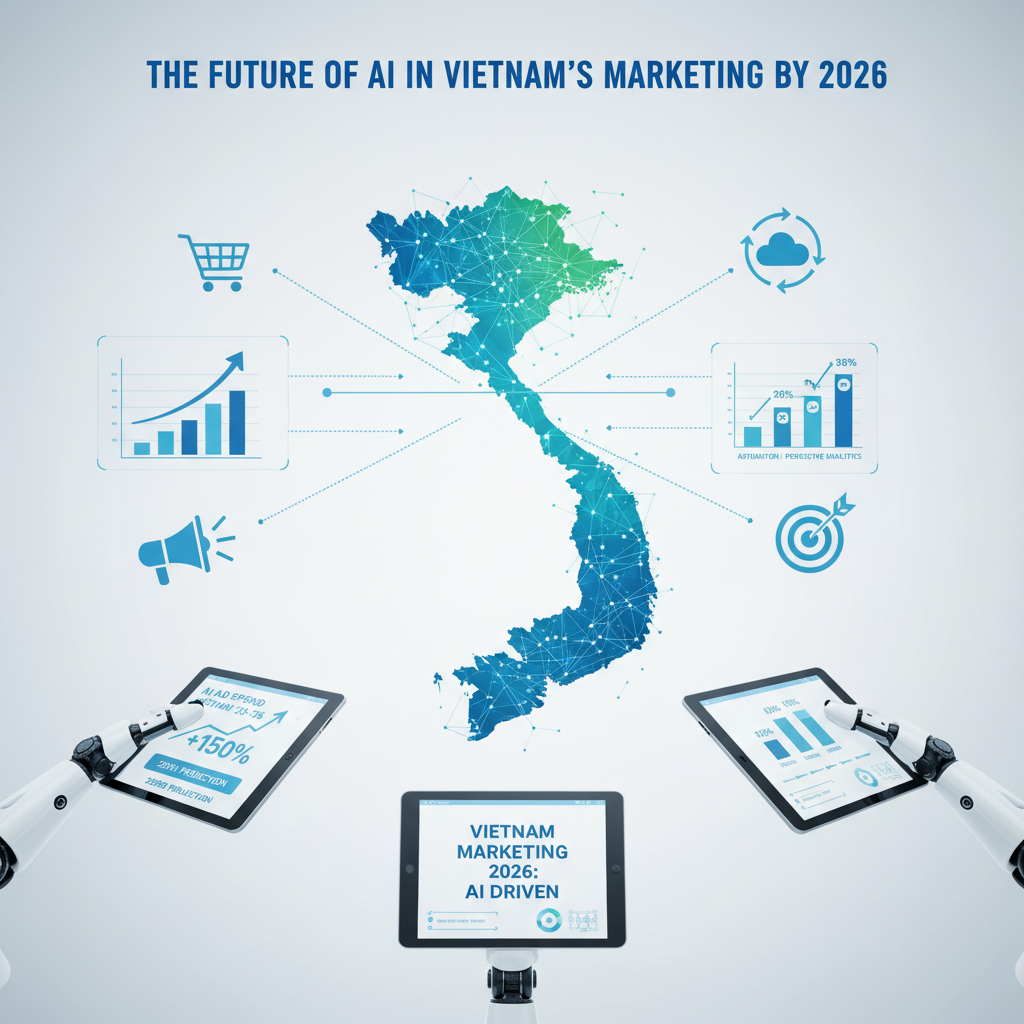
The Future of AI in Vietnam’s Marketing by 2026
By 2026, the digital landscape in Vietnam will undergo a fundamental transformation as AI agents move from experimental tools to the backbone of agency operations. As businesses strive to navigate this high-tech evolution, understanding how AI agent effect to marketing agency in vietnam becomes essential for survival. This shift is not merely about speed; it is about a total structural overhaul of the traditional agency model.
1. The Shift from Execution to Strategy
The commoditization of creative production—writing copy, generating graphics, and scheduling social posts—has reached a saturation point. In Vietnam, where agencies previously thrived on high-volume labor, the value proposition is migrating toward high-level consultancy. AI agents are now capable of managing end-to-end execution, forcing agencies to move from being “doers” to being “architects of intent.” Strategic planning now relies on predictive analytics, where AI-driven insights define the audience’s path to purchase before the first ad is even drafted.
2. The Rise of AI-First Micro Agencies
The traditional agency hierarchy is being dismantled by lean, AI-first micro agencies. These smaller, highly agile firms leverage autonomous agents to replicate the output of a 50-person agency with a team of five. As reported by McKinsey, the surge in generative AI adoption is forcing a rapid reassessment of cost structures. In the Vietnamese market, clients are increasingly demanding performance-based pricing models, moving away from monthly retainers toward value-based fees fueled by AI efficiency. This democratization of high-end tools allows smaller players to compete with multinational giants, permanently altering the competitive landscape.
3. Evolving Roles for Human Marketers
The role of the human marketer in Vietnam is pivoting toward AI orchestration, ethics, and emotional intelligence. In a world saturated with AI-generated content, the “human touch” is becoming a premium luxury. Marketers are no longer tasked with writing content; they are tasked with curating, auditing, and fine-tuning AI agents to ensure brand consistency and cultural resonance. Success in 2026 will be defined by the ability to manage the intersection of human creativity and machine learning, ensuring that AI-driven campaigns maintain the authentic connection required to engage the unique nuances of the Vietnamese consumer.
Partner with Shelby Global
You are looking for reliable HR Sevice Suppliers? Contact Shelby Global Now! To connect with verified talents and upgrade your orginization.
—————————————
References
– e-Conomy SEA 2023 report: https://economy.google/reports/e-conomy-sea-2023/
– McKinsey’s research on the state of AI: https://www.mckinsey.com/capabilities/quantumblack/our-insights/the-state-of-ai-in-2023-generative-ais-breakout-year
– how-ai-is-reshaping-marketing: https://hbr.org/2024/02/how-ai-is-reshaping-marketing
– Vietnam Issues New Decree on Personal Data Protection: https://www.dlapiper.com/en/insights/publications/2023/04/vietnam-issues-new-decree-on-personal-data-protection
– McKinsey Digital: The state of AI in 2024: https://www.mckinsey.com/capabilities/mckinsey-digital/our-insights/the-state-of-ai-in-2024-gen-ai-adoption-surges-and-starts-to-generate-value