- Understanding AI Agents in Malaysia’s Production Context
- 1. What are AI Agents? (Definition and Types)
- 2. Evolution of AI in Malaysian Manufacturing (From Automation to Autonomy)
- 3. Key Technologies Powering AI Agents (ML, Robotics, IoT)
- Current Impact on Malaysian Production Fields
- 1. Increased Efficiency and Automation Adoption
- 2. Optimized Resource Management and Supply Chains
- 3. Shifting Workforce Dynamics and Skill Requirements
- Benefits and Opportunities for Malaysian Industries
- Boosting Global Competitiveness and Market Share
- Enhancing Product Quality, Customization, and Speed-to-Market
- Fostering Innovation and Domestic R&D Capabilities
- Challenges and Considerations for AI Agent Adoption in Malaysia
- 1. Infrastructure and Digital Connectivity Requirements
- 2. Addressing the Skills Gap and Workforce Retraining Needs
- 3. Investment Costs, ROI Justification, and SME Adoption
- The Future Landscape: AI Agents in Malaysia by 2026
- 1. Predictive Maintenance and Emergence of Smart Factories
- 2. Human-Robot Collaboration (Cobots) and Augmented Workforce
- 3. Government Policies and Regulatory Frameworks to Support AI Growth
- Partner with Shelby Global
- References
Understanding AI Agents in Malaysia’s Production Context
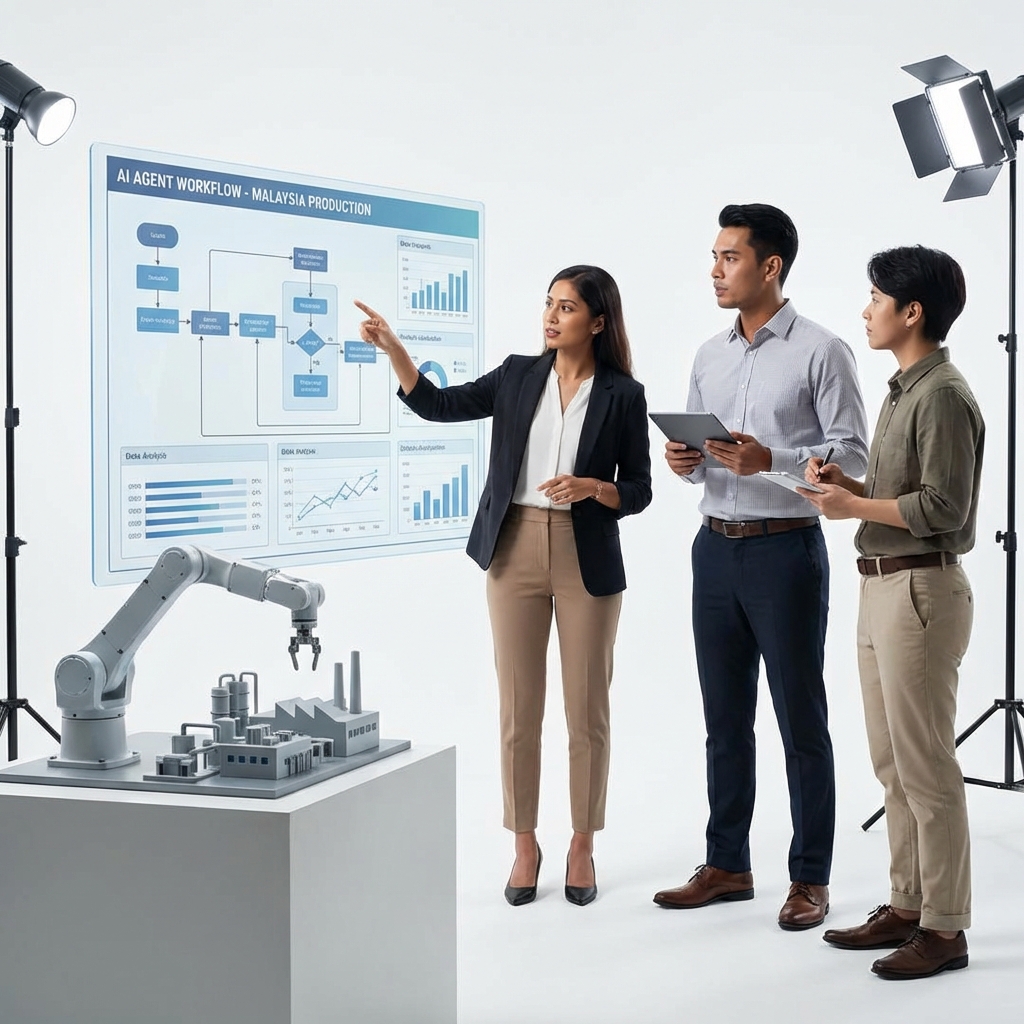
Malaysia’s manufacturing sector, a cornerstone of its economy, is rapidly embracing innovation to enhance productivity, efficiency, and competitiveness. The advent of Artificial Intelligence (AI) agents marks a pivotal shift, moving beyond traditional automation to redefine industrial processes. Understanding how AI agents effect to production field in Malaysia is crucial for businesses aiming to thrive in the era of Industry 4.0. These intelligent entities are not merely advanced algorithms; they represent a fundamental change in how operations are conceived, managed, and executed, promising a future of unprecedented agility and optimization.
1. What are AI Agents? (Definition and Types)
AI agents are autonomous entities—software programs or physical robots—designed to perceive their environment, process information, make decisions based on objectives and learned patterns, and then take actions to achieve specific goals. This distinguishes them sharply from traditional automation, which typically follows rigid, pre-programmed rules without the capacity for independent learning or adaptation. For instance, a conventional robotic arm might weld the same spot repeatedly, while an AI agent could dynamically adjust its welding path based on real-time material analysis.
Agents vary from reactive types, responding directly to current perceptions, to more advanced deliberative or utility-based agents that plan future actions and maximize outcomes like efficiency or profit. In Malaysia’s industrial landscape, this translates into practical applications such as quality control agents that learn to identify defects, predictive maintenance agents that forecast equipment failures, or supply chain optimization agents that adapt to market fluctuations. Their ability to learn and evolve makes them invaluable assets in complex, dynamic production environments.
2. Evolution of AI in Malaysian Manufacturing (From Automation to Autonomy)
Malaysia’s manufacturing sector has historically relied on efficient, large-scale production driven by traditional automation like programmable logic controllers (PLCs) and industrial robots performing fixed tasks. While this significantly boosted productivity, it remained rule-bound and lacked adaptive intelligence. The current phase, however, signals a significant evolution: a transition from mere automation to true autonomy. This shift is not just about faster machines, but smarter operations where systems can make independent decisions, adapt to unforeseen circumstances, and learn from experiences.
This journey towards autonomy is critical for Malaysian industries to remain globally competitive. It involves enabling systems to self-optimize production lines, manage complex logistics with minimal human intervention, and perform intricate quality inspections using computer vision and machine learning. A report by Accenture on the readiness of Malaysian manufacturers for Industry 4.0 highlights AI adoption as pivotal for enhancing operational efficiency and fostering innovation. This evolution empowers Malaysian manufacturers to address challenges like labor shortages, rising operational costs, and the demand for greater product customization, transforming factories into intelligent, self-regulating ecosystems.
3. Key Technologies Powering AI Agents (ML, Robotics, IoT)
The intelligence and effectiveness of AI agents in industrial settings are fundamentally underpinned by the convergence of several transformative technologies: Machine Learning (ML), Advanced Robotics, and the Internet of Things (IoT). These technologies form a powerful synergy that enables AI agents to perceive, process, decide, and act autonomously.
- Machine Learning (ML): As the “brains,” ML algorithms allow agents to learn from vast datasets, recognize patterns, make predictions, and continuously improve performance. In production, ML powers predictive analytics for maintenance, optimizes resource allocation, and enhances quality control through real-time anomaly detection.
- Advanced Robotics: Integrated with AI, advanced robotics—especially collaborative robots (cobots) and autonomous mobile robots (AMRs)—can perform complex tasks, navigate dynamic environments, interact safely with human workers, and adapt movements based on real-time sensory input. This means more flexible assembly lines and optimized material handling in Malaysia.
- Internet of Things (IoT): IoT devices provide the “senses” for AI agents. A vast network of sensors embedded in machinery, production lines, and environmental systems collects real-time data. This continuous stream feeds into AI agents, giving them an accurate, up-to-the-minute understanding of their operational environment for informed decision-making and proactive interventions.
Together, these technologies create a sophisticated framework where AI agents can monitor production lines, predict potential failures, optimize energy consumption, and manage inventory with unprecedented precision. This integrated approach fundamentally reshapes how AI agents effect to production field in Malaysia, driving it towards higher levels of efficiency, sustainability, and innovation.
Current Impact on Malaysian Production Fields
AI agents are rapidly reshaping industries worldwide, and Malaysia’s production fields are no exception. The pervasive integration of artificial intelligence is fundamentally altering how AI agent effect to production field in malaysia, driving significant shifts in productivity, operational efficiency, and the very fabric of the workforce. This section delves into the existing influence of AI agents across Malaysia’s manufacturing and production sectors, examining their transformative power and the challenges and opportunities they present. From automating routine tasks to optimizing complex supply chains, AI is becoming an indispensable tool for Malaysian businesses seeking to remain competitive in a globalized economy.
1. Increased Efficiency and Automation Adoption
The most immediate and tangible impact of AI agents in Malaysian production fields is the remarkable surge in efficiency and the accelerated adoption of advanced automation. AI-powered systems are revolutionizing processes by enabling predictive maintenance, where algorithms analyze sensor data from machinery to forecast potential failures before they occur. This proactive approach drastically reduces unplanned downtime, extends equipment lifespan, and maintains continuous production flow. Furthermore, AI-driven quality control systems, utilizing computer vision and machine learning, can detect defects with unparalleled accuracy and speed, far surpassing human capabilities. This not only ensures higher product quality but also minimizes waste and rework. Robots, often integrated with AI agents, are now performing repetitive and dangerous tasks with greater precision and speed, freeing human workers to focus on more complex, value-added activities. This heightened level of automation, fueled by intelligent algorithms and supported by the national push for Industry 4.0 adoption, directly translates into increased output, reduced operational costs, and a more streamlined manufacturing environment across Malaysian factories.
2. Optimized Resource Management and Supply Chains
Beyond individual production lines, AI agents are proving instrumental in optimizing resource management and fortifying the resilience of supply chains within Malaysia’s production landscape. Intelligent algorithms can process vast amounts of data to provide highly accurate forecasts for demand, raw material requirements, and energy consumption. This capability allows manufacturers to optimize inventory levels, reducing holding costs and minimizing obsolescence, while also ensuring that resources are allocated precisely where and when they are needed. Energy management systems, powered by AI, monitor and adjust consumption patterns in real-time, leading to substantial energy savings and a reduced carbon footprint. For supply chains, AI agents offer unprecedented visibility and predictive capabilities. They can identify potential disruptions – from weather events to geopolitical shifts – and suggest alternative routes or suppliers, ensuring continuity of operations. By analyzing logistics data, AI optimizes transportation routes, warehouse operations, and overall delivery networks, making Malaysian supply chains more agile, cost-effective, and robust against unforeseen challenges.
3. Shifting Workforce Dynamics and Skill Requirements
The integration of AI agents undeniably brings about a significant transformation in workforce dynamics and skill requirements within Malaysian production fields. While concerns about job displacement are valid, the reality is more nuanced. AI’s role is often one of augmentation, taking over mundane, repetitive, or hazardous tasks, thereby allowing human workers to focus on higher-level problem-solving, creativity, and strategic decision-making. This shift necessitates a significant re-evaluation of existing job roles and a proactive approach to skill development. New positions are emerging, such as AI trainers, data scientists, robotics maintenance technicians, and human-AI collaboration specialists, requiring expertise in areas like machine learning, data analytics, programming, and system integration. The Malaysian government and educational institutions are increasingly recognizing this need, emphasizing upskilling and reskilling initiatives to equip the current workforce with the competencies required for the AI-driven industrial era. Embracing lifelong learning and adaptability will be crucial for Malaysian workers to thrive in this evolving landscape, fostering a collaborative environment where humans and AI agents work in synergy to drive productivity and innovation. For a deeper dive into the broader implications, you can explore resources discussing how AI agent effect to production field in malaysia.
Benefits and Opportunities for Malaysian Industries
The advent of Artificial Intelligence (AI) agents marks a transformative era for Malaysian industries, presenting a unique confluence of distinct advantages and unparalleled growth prospects. Integrating these intelligent systems into various sectors promises to redefine operational paradigms, significantly enhance competitiveness, drive innovation, and foster robust economic diversification. For Malaysian enterprises looking to thrive in the global landscape, understanding how AI agents effect to production field in Malaysia is not just an advantage, but a critical imperative for sustained success and resilience.

-
Boosting Global Competitiveness and Market Share
AI agents are poised to be a powerful catalyst for elevating Malaysian industries onto the global stage. By automating routine tasks, optimizing complex processes, and providing real-time data analytics, these intelligent systems significantly enhance operational efficiency and reduce production costs. This translates directly into more competitive pricing and improved product quality, making Malaysian goods and services more attractive in international markets. For instance, in manufacturing, AI-driven predictive maintenance minimizes downtime, while AI-powered quality control systems ensure defect rates are slashed, leading to higher output and consistent product standards. The implementation of smart manufacturing Malaysia initiatives, powered by AI agents, allows local companies to scale operations efficiently, respond rapidly to market shifts, and gain a larger footprint in key export markets. According to the World Economic Forum, countries embracing AI early on stand to gain significant advantages in global economic competitiveness, a trajectory Malaysia is keen to follow by harnessing advanced AI-driven efficiency.
-
Enhancing Product Quality, Customization, and Speed-to-Market
One of the most profound impacts of AI agents lies in their ability to revolutionize product development and delivery. These systems can meticulously monitor and analyze production lines, identifying anomalies and potential defects with unparalleled precision, thus ensuring superior product quality. Furthermore, AI agents facilitate hyper-personalization, allowing Malaysian companies to offer customized products and services tailored to individual customer preferences at scale. From apparel to automotive parts, AI can analyze customer data, design specifications, and even automate the production of bespoke items, fulfilling niche market demands with greater agility. This capability drastically improves customer satisfaction and opens new revenue streams. Moreover, AI-driven simulations and rapid prototyping capabilities significantly reduce the time taken from conception to market launch. Malaysian businesses can leverage AI-driven efficiency to accelerate innovation cycles, adapt quickly to evolving consumer trends, and maintain a leading edge in fast-paced industries.
-
Fostering Innovation and Domestic R&D Capabilities
The integration of AI agents is not merely about optimizing existing processes; it’s about igniting a culture of innovation and strengthening Malaysia’s domestic research and development (R&D) capabilities. AI systems can process vast amounts of scientific data, identify complex patterns, and even propose novel solutions or materials that human researchers might overlook. This accelerates scientific discovery and technological breakthroughs across various sectors, from advanced materials to biotechnology. By investing in AI agent development and deployment, Malaysian industries can reduce their reliance on foreign technologies, cultivate a highly skilled local workforce, and build proprietary intellectual property. Furthermore, AI agents can optimize complex systems like supply chain optimization in Malaysia, suggesting innovative ways to improve logistics, reduce waste, and enhance overall resilience. To delve deeper into how AI agent effect to production field in Malaysia, particularly in fostering local innovation, it’s clear that these technologies empower Malaysian enterprises to become creators rather than just consumers of technology, driving sustainable long-term economic growth and creating high-value jobs within the nation.
Challenges and Considerations for AI Agent Adoption in Malaysia
Malaysia stands at the precipice of a significant digital transformation, with the potential of AI agents to revolutionize various sectors, particularly the production field. However, the full integration and widespread adoption of these sophisticated systems face a unique set of challenges within the Malaysian context. While the promise of enhanced efficiency, precision, and productivity is clear, realizing these benefits requires a concerted effort to overcome existing hurdles. Understanding how AI agent effect to production field in Malaysia depends heavily on addressing fundamental limitations, ranging from foundational infrastructure to human capital development and financial viability. These obstacles not only dictate the pace of AI adoption but also determine its equitable distribution and long-term sustainability across the nation’s diverse economic landscape, impacting everything from large manufacturers to small and medium-sized enterprises (SMEs). Ethical considerations surrounding data privacy, job displacement, and algorithmic bias also loom large, demanding robust frameworks and thoughtful implementation strategies as Malaysia navigates its digital future.
1. Infrastructure and Digital Connectivity Requirements
The bedrock of successful AI agent deployment is a robust and pervasive digital infrastructure. In Malaysia, while significant strides have been made in urban areas, disparities in digital connectivity remain a critical challenge. High-speed broadband penetration, especially in rural and semi-urban regions, is not yet universally consistent enough to support the real-time data processing and communication demands of advanced AI agents. Many production facilities, particularly older ones, may lack the necessary network infrastructure, edge computing capabilities, and cloud integration required for seamless AI operations. The rollout of 5G technology is progressing, promising the low latency and high bandwidth essential for industrial AI applications, but its comprehensive coverage and affordability are still works in progress. Furthermore, the capacity of existing data centers and the reliability of power supply need to be enhanced to prevent disruptions to AI-driven processes. Without a resilient and widespread digital backbone, the potential for AI agent adoption in Malaysia, particularly in remote manufacturing or agricultural settings, will remain significantly hampered, limiting the nation’s overall digital transformation progress.
2. Addressing the Skills Gap and Workforce Retraining Needs
Perhaps one of the most pressing challenges for AI agent adoption in Malaysia is the existing skills gap. The current workforce, while adaptable, often lacks the specialized expertise required to develop, deploy, manage, and interact effectively with AI systems. This encompasses not only highly technical roles like AI engineers, data scientists, and machine learning specialists but also roles that require an understanding of AI ethics, human-AI collaboration, and data governance. Many existing workers in traditional production fields may lack the digital literacy and analytical skills necessary to work alongside AI agents, necessitating substantial workforce upskilling Malaysia-wide. Fear of job displacement due to automation can also create resistance to adoption, highlighting the need for transparent communication and comprehensive retraining programs. Government initiatives, academic institutions, and industry players must collaborate to design and implement targeted educational programs, vocational training, and continuous learning platforms. These efforts should focus on equipping both new entrants to the workforce and existing employees with the competencies needed to thrive in an AI-driven economy, ensuring that the benefits of technological advancement are inclusive and socially responsible.
3. Investment Costs, ROI Justification, and SME Adoption
The initial investment required for AI agent adoption can be substantial, encompassing costs for hardware, software licenses, system integration, data infrastructure upgrades, and specialist talent. For many Malaysian businesses, especially Small and Medium-sized Enterprises (SMEs) which form the backbone of the economy, these upfront costs can be prohibitive. Demonstrating a clear and compelling Return on Investment (ROI) is crucial, yet often difficult to quantify in the early stages of AI implementation, making it a challenging proposition for cautious investors. SMEs often operate with tighter budgets, limited technical resources, and less risk tolerance, making them less likely to invest in unproven or high-cost technologies. To encourage broader SME AI integration Malaysia, government incentives, grants, and subsidies are vital. Furthermore, the promotion of AI-as-a-Service (AIaaS) models, which offer AI capabilities on a subscription basis, can lower the barrier to entry by reducing upfront capital expenditure. Pilot programs, success stories, and case studies tailored to local industries can also help demystify AI and illustrate tangible benefits, providing the confidence needed for more widespread investment across the diverse Malaysian business landscape. The ability to navigate these financial hurdles will significantly influence the pace and depth of AI agent integration.
The Future Landscape: AI Agents in Malaysia by 2026
The manufacturing sector in Malaysia is on the cusp of a transformative era, driven by the rapid evolution and integration of AI agents. By 2026, these intelligent entities are poised to redefine operational paradigms, enhance efficiency, and foster innovation across various production fields. This section projects the anticipated trends, potential advancements, and strategic roadmap for AI agent integration, highlighting how AI agent effect to production field in malaysia. The shift will not merely be incremental but foundational, pushing Malaysian industries towards a more automated, intelligent, and interconnected future. Understanding this trajectory is crucial for businesses aiming to remain competitive and for the nation to solidify its position in the global digital economy.
1. Predictive Maintenance and Emergence of Smart Factories
One of the most immediate and impactful changes brought by AI agents in Malaysian production fields will be the widespread adoption of predictive maintenance. Traditional reactive or preventative maintenance schedules will be replaced by AI-driven systems capable of analyzing vast datasets from sensors and operational history to forecast equipment failures before they occur. This predictive capability significantly reduces unscheduled downtime, optimizes maintenance schedules, and extends the lifespan of machinery, leading to substantial cost savings and increased productivity. Furthermore, AI agents are central to the emergence of “smart factories” across Malaysia. These factories leverage interconnected AI systems to monitor, analyze, and optimize every aspect of the production process, from supply chain management to quality control. Through real-time data analysis and autonomous decision-making, AI agents can dynamically adjust production parameters, manage inventory more efficiently, and ensure consistent product quality, moving towards highly automated and responsive manufacturing ecosystems. This will not only streamline operations but also foster greater agility in responding to market demands.

2. Human-Robot Collaboration (Cobots) and Augmented Workforce
The vision of AI agents in Malaysian factories by 2026 also encompasses a burgeoning era of human-robot collaboration, often referred to as cobots. These intelligent robots, powered by advanced AI, are designed to work alongside human employees, augmenting their capabilities rather than replacing them. In production fields, cobots can handle repetitive, dangerous, or highly precise tasks, freeing human workers to focus on more complex problem-solving, creative tasks, and quality oversight. This collaborative model leads to increased efficiency, improved safety standards, and enhanced ergonomic conditions for workers. AI agents will also empower an augmented workforce by providing intelligent assistants for decision support, process optimization, and real-time training. For instance, AI-powered systems can guide workers through complex assembly processes, flag potential errors, or even simulate production scenarios for better planning. This symbiotic relationship between humans and AI agents will necessitate a significant investment in upskilling and reskilling the Malaysian workforce, equipping them with the digital literacy and specialized knowledge required to interact with and manage these advanced tools effectively.
3. Government Policies and Regulatory Frameworks to Support AI Growth
Crucial to the successful integration of AI agents in Malaysian production fields will be the proactive role of the government in establishing supportive policies and robust regulatory frameworks. By 2026, it is anticipated that Malaysia will have clearer guidelines and incentives aimed at accelerating AI adoption across industries. This includes potential tax incentives for companies investing in AI technologies, grants for research and development, and funding for workforce training initiatives. Furthermore, the government will need to address critical aspects such as data governance, intellectual property rights, and the ethical deployment of AI. Developing a comprehensive national AI strategy that promotes innovation while ensuring responsible use will be paramount. For instance, frameworks addressing AI bias, transparency, and accountability will build trust and facilitate wider acceptance. Collaborations between government bodies, industry leaders, and academic institutions will be vital in creating a conducive ecosystem that not only attracts foreign investment in AI but also nurtures local talent and homegrown AI solutions. This concerted effort will solidify Malaysia’s position as a regional leader in embracing the opportunities of the Fourth Industrial Revolution. The World Economic Forum highlights the transformative potential of AI in manufacturing, a vision Malaysia is rapidly embracing.
Partner with Shelby Global
You are looking for reliable HR Sevice Suppliers? Contact Shelby Global Now! To connect with verified talents and upgrade your orginization.
—————————————
References
– Industry 4.0 in Malaysia: https://www.accenture.com/my-en/insights/industry-x-0/industry-4-0-malaysia
– Malaysia’s Industry 4.0 Push: Experts See Opportunities: https://www.malaysiakini.com/news/647902
– Malaysia’s economy and global growth, trade and AI: https://www.weforum.org/agenda/2023/11/malaysia-economy-global-growth-trade-ai/
– MyDIGITAL blueprint to drive Malaysia’s digital economy growth – The Star: https://www.thestar.com.my/news/nation/2021/02/19/mydigital-blueprint-to-drive-malaysias-digital-economy-growth
– The World Economic Forum highlights the transformative potential of AI in manufacturing: https://www.weforum.org/agenda/2023/12/ai-manufacturing-industrial-revolution-factory-of-the-future/