Introduction: Understanding Singapore’s Fashion Salary Landscape
Singapore, a dynamic hub of innovation and style, boasts a vibrant fashion industry. From global luxury brands and international retailers to burgeoning local designers and tech-fashion startups, the sector offers diverse career opportunities. However, navigating the compensation landscape within this competitive market can be challenging for both aspiring professionals and seasoned industry veterans. Without clear, up-to-date information, job seekers may undervalue their skills, while employers struggle to offer competitive packages that attract and retain top talent. This is precisely why a comprehensive salary range report of jobs in Fashion field in Singapore is not just beneficial, but crucial.
In an industry driven by trends, creativity, and rapid change, compensation benchmarks must reflect current economic realities and market demands. The fashion industry in Singapore is particularly susceptible to global economic shifts, consumer spending patterns, and technological advancements. Understanding the nuances of what different roles command in terms of salary, benefits, and overall compensation empowers individuals to make informed career decisions and enables businesses to craft strategic hiring and retention policies. This report aims to demystify the financial aspects of fashion careers in the Lion City, providing transparency and actionable insights.
Our 2026 report delves into the intricate details of compensation across various segments of Singapore’s fashion ecosystem. We recognize that a simple average rarely tells the whole story. Factors such as specific job functions, years of experience, educational background, and even the type of company (e.g., multinational luxury conglomerate vs. local startup) significantly impact earning potential. By offering a granular analysis, this report serves as an invaluable resource for anyone looking to understand or benchmark salaries in this exciting industry.
-
Why a Fashion Salary Report for Singapore is Crucial
The fashion industry in Singapore is characterized by its fast pace and increasing global integration. For job seekers, a detailed salary range report of jobs in Fashion field in Singapore provides clarity and confidence during salary negotiations. It allows them to benchmark their skills and experience against market standards, ensuring fair compensation. In a city with a high cost of living, understanding typical salary expectations is paramount for financial planning and career progression, guiding professional development.
From an employer’s perspective, this report is equally vital. Attracting and retaining skilled professionals is a continuous challenge in a talent-driven market. Offering competitive salaries is key to winning the war for talent. Employers can leverage this report to fine-tune compensation structures, ensuring they are competitive and sustainable. It aids in budgeting, talent acquisition strategies, and internal equity assessments, fostering a fair workplace culture. For new entrants or international brands, understanding local compensation norms is essential for successful market penetration. Reliable salary data, like that offered by leading labor market authorities, provides a crucial foundation for strategic planning. For example, understanding Singapore’s overall labor market trends from sources like the Ministry of Manpower Singapore can provide broader economic context for fashion industry salaries.
-
Key Factors Influencing Fashion Salaries in SG
Salaries within Singapore’s fashion industry are shaped by a multifaceted interplay of various factors. Foremost among these is experience level. Entry-level positions command lower salaries compared to mid-career professionals (3-7 years) or senior executives (10+ years) with a proven track record. Role specialization also plays a significant role; a Visual Merchandiser’s salary will differ from that of a Fashion Designer, Marketing Manager, or Supply Chain Specialist. Highly specialized skills, particularly those incorporating digital aspects like e-commerce management, digital marketing, or data analytics in fashion, often attract premium compensation.
The type and size of the company are another critical determinant. Multinational luxury fashion houses or large retail conglomerates typically offer more structured packages, including robust benefits and higher base salaries, compared to smaller local boutiques or startups. Educational background and relevant certifications can also influence initial offers and career trajectory. Lastly, broader economic conditions and the overall health of the retail sector in Singapore directly impact salary adjustments and bonus payouts. A thriving economy generally leads to higher consumer spending and better prospects for fashion industry professionals. To explore more specific salary benchmarks and current openings, a comprehensive salary range report of jobs in Fashion field in Singapore offers granular insights into these varying influences.
-
Methodology: How We Compiled This 2026 Report
The accuracy and reliability of this 2026 salary range report of jobs in Fashion field in Singapore are paramount. Our methodology involved a multi-pronged approach to gather and analyze comprehensive data. Primarily, we leveraged a combination of quantitative and qualitative data sources. Quantitative data was collected through an extensive survey disseminated to fashion professionals across various roles and experience levels in Singapore, ensuring broad industry representation. This was supplemented by an in-depth analysis of thousands of recent job postings on leading recruitment platforms and company career pages, providing real-time market data on advertised salary ranges.
Qualitative insights were gathered through anonymous interviews with HR professionals, recruitment specialists, and senior executives within Singapore’s fashion companies. These interviews provided valuable context, identifying emerging trends, specific in-demand skills, and strategic considerations influencing compensation. All data was meticulously cross-referenced and analyzed using statistical tools to identify median, average, and percentile salary ranges for key positions. We focused on standardizing job titles and responsibilities to ensure accurate comparisons. While this report aims for the highest degree of accuracy, specific individual salaries can always vary based on negotiation skills, unique skill sets, and company-specific policies. This rigorous approach ensures that our report offers a dependable and forward-looking snapshot of the fashion salary landscape in Singapore for 2026.
Salary Ranges for Creative & Design Roles in Fashion SG
Singapore’s fashion industry offers a dynamic environment for creative professionals. Understanding compensation is vital for career growth. This section presents a detailed salary range report of jobs in Fashion field in singapore, offering insights into earning potential for various creative roles fashion Singapore. By exploring typical fashion industry salaries Singapore, professionals can better strategize their career path in this vibrant sector.
1. Fashion Designer Salary Singapore: Entry to Senior Level
Fashion designers are central to a brand’s identity, translating concepts into garments. The fashion designer salary Singapore varies based on experience, brand type (luxury, fast fashion), and scope.
- Entry-Level (0-2 years): Junior Designers or Design Assistants support senior teams. Salaries typically range from S$2,500 to S$3,500 per month. A strong portfolio helps secure the higher end.
- Mid-Level (3-6 years): Designers manage specific collections, contributing to concept development and liaising with production. Compensation usually falls between S$3,500 and S$6,000 per month, reflecting increased autonomy.
- Senior/Lead & Creative Director (7+ years): These roles demand exceptional design talent, leadership, and strategic vision, overseeing design teams and creative direction. Salaries can range from S$6,000 to S$10,000+ per month, with Creative Directors at large luxury houses earning significantly more, often with performance incentives.
2. Stylist & Visual Merchandiser Compensation Trends
Stylists and Visual Merchandisers present fashion appealingly, directly impacting brand perception and sales.
- Fashion Stylist: Compensation depends on portfolio, client base, and employment (freelance vs. in-house).
- Junior/Assistant Stylist: Assisting on shoots or styling, full-time roles might offer S$2,000 to S$3,000 monthly, or project fees of S$150 to S$500 per day.
- Experienced/Senior Stylist: With a robust portfolio, senior stylists (editorial, commercial, personal) can earn S$3,500 to S$7,000+ monthly for full-time, or S$500 to S$1,500+ per day for high-profile freelance projects.
- Visual Merchandiser: These professionals design captivating store displays and window presentations.
- Junior Visual Merchandiser: Executing display plans and maintaining visual standards, salaries typically range from S$2,400 to S$3,500 per month.
- Senior Visual Merchandiser/VM Manager: Developing visual strategies and leading teams across multiple locations. Compensation ranges from S$3,800 to S$7,000+ per month, with managers at international luxury brands potentially earning higher.
3. Textile & Product Development Roles: Earning Potential
These roles are foundational to garment creation, focusing on material selection, quality, and production feasibility.
- Textile Designer: Specialists creating original patterns, prints, and textures for fabrics. Salaries range from S$3,000 to S$5,500 per month, influenced by experience and niche skills (e.g., sustainable textiles).
- Pattern Maker/Garment Technologist: Highly skilled professionals translating designs into precise patterns and ensuring fit, construction, and quality. Due to technical expertise, salaries start around S$3,200 for junior roles and can reach S$6,500+ per month for senior roles, especially in luxury fashion or complex garment construction.
- Product Developer: Bridging design, production, and sourcing, product developers manage the product lifecycle from concept to delivery. Salaries range from S$3,500 to S$7,500+ per month, varying with product complexity and experience.
These figures are general ranges, influenced by company prestige, individual skills, negotiation, and benefits. Continuous professional development and a strong portfolio are key to maximizing earning potential in Singapore’s competitive fashion landscape.
Remuneration in Fashion Marketing & Communication in Singapore
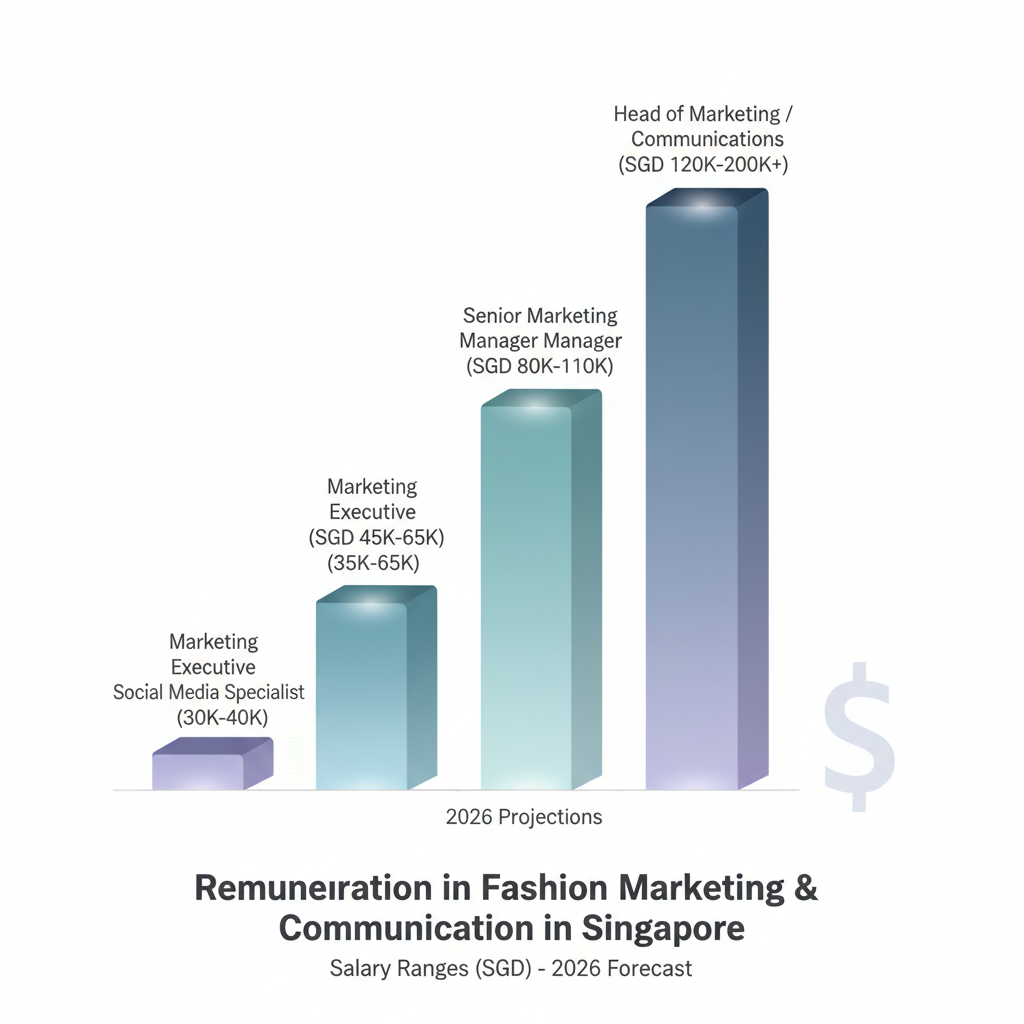
Singapore’s dynamic fashion landscape, fueled by a discerning consumer base and a burgeoning e-commerce sector, presents a vibrant career path for professionals in marketing and communication. As brands vie for attention in this competitive market, roles dedicated to promotion, branding, and digital engagement are indispensable. Understanding the remuneration landscape for these critical positions is key for both aspiring professionals and employers. This section delves into the salary range report of jobs in Fashion field in Singapore, offering a comprehensive look at what individuals can expect to earn in various marketing and communication roles within the Lion City’s fashion industry, from traditional marketing management to cutting-edge digital and e-commerce specialisms.
1. Fashion Marketing Manager Salary Singapore Insights
The Fashion Marketing Manager role is pivotal for strategic brand positioning and market penetration. Professionals in Singapore develop and execute comprehensive marketing strategies, oversee campaigns, manage budgets, and analyze market trends. Their remuneration is heavily influenced by experience, the fashion brand’s size and prestige, and a proven track record of driving sales and enhancing brand awareness.
Entry-level Marketing Executives or Coordinators might expect monthly salaries from S$3,000 to S$4,500. Experienced Fashion Marketing Managers typically earn between S$6,000 and S$10,000. Senior or Regional Marketing Directors, especially in high-end fashion or multi-national corporations, could command upwards of S$12,000 to S$18,000 per month, particularly with global perspective and strong digital acumen. Bonuses, commissions, and other benefits frequently form a significant part of the overall compensation.
2. Public Relations & Brand Communications Pay Scales
In fashion, public relations and brand communications professionals are strategic storytellers, safeguarding brand reputation and cultivating strong relationships with media, influencers, and the public. Roles such as PR Manager, Communications Specialist, and Brand Ambassador are crucial for shaping public perception, generating buzz, and managing brand initiatives. Their expertise in media outreach, event management, crisis communication, and stakeholder engagement directly impacts brand visibility and desirability.
For those entering the field, a PR Executive might expect a monthly salary between S$3,200 and S$4,800. Mid-level PR Managers in Singapore’s fashion sector typically earn S$5,500 to S$8,500. Senior Brand Communications Managers or Directors, with an established network and proven ability to manage complex, integrated campaigns, can see their monthly earnings rise significantly, often from S$9,000 to S$15,000. Factors such as a strong portfolio, proficiency in both traditional and digital PR, and a deep understanding of luxury market dynamics substantially elevate these pay scales. According to recent industry benchmarks from reputable recruitment firms like Hays, expertise in integrated communications strategies is increasingly valued, reflecting in higher compensation.
3. Digital & E-commerce Specialist Wages in Fashion
Digital transformation has profoundly reshaped the fashion industry, making digital marketing and e-commerce specialists indispensable. Roles here include Digital Marketing Specialist, E-commerce Manager, Social Media Strategist, SEO/SEM Specialist, and Content Creator. These professionals drive online sales, enhance brand presence across diverse digital channels, and leverage data analytics to optimize performance and customer engagement. Their specialized skills in areas like performance marketing, customer journey optimization, and platform management are highly sought after.
Given the high demand for digital expertise, entry-level Digital Marketing Executives in fashion can expect to earn between S$3,500 and S$5,000 per month. Mid-career E-commerce Managers or Senior Digital Marketing Specialists typically command salaries ranging from S$6,000 to S$10,000. For highly experienced E-commerce Directors or Head of Digital roles, particularly within established fashion houses or rapidly growing online brands, monthly remuneration can reach S$11,000 to S$18,000, often supplemented by performance-based incentives. As digital channels evolve, demand for specialists who can navigate complex analytics, leverage AI for personalized marketing, and drive conversion will only increase, influencing the overall salary range report of jobs in Fashion field in Singapore for these critical roles upwards.
Singapore’s fashion marketing and communication sector offers diverse and rewarding career opportunities, with competitive remuneration packages reflecting the strategic importance of these roles. While salary ranges vary based on experience, specific skills, company size, and brand positioning, a clear trend towards valuing digital and integrated communication expertise is evident. For professionals looking to thrive in this dynamic industry, continuous skill development, particularly in data analytics, e-commerce platforms, and sophisticated content creation, will be paramount. As the fashion landscape in Singapore continues to innovate, so too will the demand for highly skilled marketing and communication talent, promising a vibrant and well-compensated future for those who excel.
Retail & Operations: Fashion Salary Expectations in Singapore
Singapore’s vibrant fashion industry, characterized by a mix of luxury brands, international retailers, and burgeoning local designers, offers diverse career paths with competitive compensation. Understanding the typical salary ranges for pivotal operational and retail roles is essential for both aspiring professionals and employers. This section provides a focused salary range report of jobs in Fashion field in singapore, covering retail management, sales associates, fashion buyers, merchandisers, and supply chain professionals – roles crucial to the sector’s robust backbone.
Compensation in Singapore’s fashion landscape is primarily driven by factors such as company size, brand prestige (e.g., high-street vs. luxury), an individual’s experience level, and the specific skill sets required. Specialized expertise and proven leadership often command premium salaries, reflecting the high value placed on talent that can drive sales, efficiency, and market relevance in this dynamic environment.
1. Retail Store Manager & Sales Associate Salaries
Frontline roles are critical for customer engagement and revenue generation. For Sales Associates, entry-level positions typically offer a base salary of S$2,200 to S$2,800 per month, significantly augmented by sales commissions and performance incentives. Experienced associates, especially those with luxury brands or a strong sales record, can see total monthly earnings climb to S$3,500 – S$5,000+. The impact of individual sales performance and brand value is a key determinant for these Singapore fashion industry salaries.
Retail Store Managers, tasked with comprehensive store operations, team leadership, and achieving sales targets, command higher remuneration. An Assistant Store Manager typically earns between S$3,500 and S$5,500 monthly. Store Managers for mid-sized stores or key departments can expect S$5,000 to S$8,000 per month. For flagship stores or high-end luxury boutiques, Senior Store Managers or General Managers with extensive experience can earn S$8,000 – S$12,000+, often complemented by substantial performance-linked bonuses. This range underscores the premium placed on leadership, strategic execution, and the ability to significantly enhance profitability in Singapore’s competitive retail scene.
2. Fashion Buyer & Merchandising Role Compensation
Fashion buyers and merchandisers are the architects behind a brand’s product offerings and visual appeal, directly impacting market perception and financial success. A Junior Fashion Buyer or Assistant Merchandiser typically starts with a salary ranging from S$3,000 to S$4,500 per month. As experience grows and a strong understanding of market trends, supplier relations, and negotiation tactics develops, compensation increases significantly.
Experienced Fashion Buyers, responsible for product curation, vendor management, and category strategy, generally earn between S$5,000 and S$8,500 monthly. Senior Buyers or Category Managers with a proven ability to drive successful collections and manage substantial budgets can command S$8,500 to S$15,000+, often with performance bonuses linked to product margin and sales. Merchandising Managers, who oversee product planning, inventory optimization, and visual merchandising strategies, typically fall in the S$6,000 to S$10,000 range. Head of Merchandising roles for larger organizations can reach S$12,000 – S$18,000+, reflecting their strategic importance in shaping the brand’s commercial identity and ensuring robust apparel retail compensation Singapore.
3. Supply Chain & Logistics Salaries in Apparel Sector
The efficiency of the fashion industry’s rapid cycles hinges on seamless supply chain and logistics operations, ensuring timely product delivery from global manufacturers to consumers. For a Logistics Coordinator or Supply Chain Assistant, starting salaries generally range from S$2,800 to S$4,000 per month, depending on company size and scope of responsibilities.
Supply Chain Managers or Logistics Managers, overseeing inventory, procurement, warehousing, and distribution, are vital for operational excellence and cost control. Their salaries typically range from S$5,000 to S$9,000 monthly. Professionals with specialized expertise in areas like sustainable sourcing, supply chain technology, or international trade compliance are often compensated at the higher end. Senior Supply Chain Directors or Heads of Logistics for major fashion groups, especially those with complex international networks, can expect S$10,000 – S$18,000+ per month. The growing emphasis on agility, transparency, and ethical practices within the fashion supply chain ensures these roles remain critical and well-rewarded in any comprehensive salary range report of jobs in Fashion field in singapore.
In conclusion, Singapore’s fashion industry presents a multitude of rewarding career opportunities across its retail and operational spectrum. Understanding these typical salary benchmarks is invaluable for professionals aiming to strategically navigate their career progression and for businesses seeking to attract and retain top talent in this competitive market.
Future Outlook & Career Growth in Singapore Fashion 2026
Concluding with a forward-looking perspective, this section discusses emerging trends impacting salaries, potential growth areas, and strategic advice for professionals looking to advance their careers in Singapore’s fashion field.
The Singaporean fashion landscape is poised for dynamic growth and transformation in 2026 and beyond. As a regional hub for luxury, retail innovation, and sustainable practices, the city-state offers a fertile ground for fashion professionals to cultivate rewarding careers. This forward-looking section delves into the emerging trends shaping the industry, their projected impact on salary range report of jobs in Fashion field in singapore, and actionable strategies for career advancement, ensuring professionals are well-equipped to thrive in this evolving environment. The Singapore fashion industry growth trajectory is particularly influenced by technological adoption and a heightened consumer consciousness towards ethical consumption.
1. Emerging Trends & Their Impact on Future Salaries
The fashion industry in Singapore is experiencing a paradigm shift driven by several key trends that will undoubtedly redefine job roles and salary expectations. Firstly, sustainability and circular fashion are no longer niche concepts but mainstream imperatives. Consumers and regulations alike are pushing for transparent supply chains, ethical sourcing, and eco-friendly production methods. Professionals with expertise in sustainable materials, ethical manufacturing, and lifecycle assessment will see increased demand and, consequently, higher remuneration. This emphasis is not just a trend but a fundamental change impacting the entire supply chain, from design to retail.
Secondly, digitalization and e-commerce acceleration continue to reshape the retail landscape. The pandemic significantly amplified online shopping, making digital proficiency non-negotiable. Roles in e-commerce management, digital marketing, data analytics for consumer insights, and user experience (UX) design for online platforms are becoming critical. Technologies such as AI for personalized recommendations, augmented reality (AR) for virtual try-ons, and blockchain for supply chain transparency are also gaining traction. Expertise in these areas will command premium salaries, reflecting the strategic importance of digital innovation for Singapore fashion industry growth. A recent report on the global fashion industry highlights how digital transformation is central to market resilience and expansion.
Lastly, hyper-personalization and experiential retail are setting new benchmarks for customer engagement. Brands are investing in bespoke experiences, custom designs, and immersive in-store technologies to differentiate themselves. Professionals capable of crafting unique customer journeys, leveraging data for personalized offerings, or designing interactive retail spaces will find themselves in high demand. These roles, often at the intersection of creativity, technology, and business strategy, will attract competitive salaries, further diversifying the fashion career prospects Singapore offers.
2. Skills & Certifications for Higher Earning Potential
To capitalize on these evolving trends and secure a higher earning potential within Singapore’s fashion sector, professionals must strategically upskill and reskill. Core competencies now extend beyond traditional design or merchandising. Data analytics skills are paramount, allowing professionals to interpret consumer behavior, sales trends, and market performance, informing strategic decisions. Digital marketing expertise, encompassing SEO, SEM, social media strategy, and content creation, is essential for driving online visibility and sales.
Furthermore, a deep understanding of sustainable practices and supply chain management is crucial. This includes knowledge of eco-friendly materials, ethical labor practices, waste reduction strategies, and circular economy principles. Certifications in sustainable fashion or supply chain logistics can significantly boost one’s marketability and earning potential. 3D design and virtual prototyping skills are also gaining traction, streamlining design processes and reducing material waste, making these specialized skills highly valuable.
For those in leadership or entrepreneurial roles, business acumen, financial literacy, and intercultural communication remain vital. Singapore’s diverse market and regional connectivity demand professionals who can navigate complex business environments and foster international collaborations. Investing in professional development courses or certifications from recognized institutions can provide a competitive edge and open doors to more senior, higher-paying positions, enhancing overall fashion career prospects Singapore.
3. Navigating Career Advancement in Singapore’s Fashion Industry
Advancing one’s career in Singapore’s vibrant fashion industry requires a proactive and strategic approach. Continuous learning and adaptability are non-negotiable. Stay abreast of global fashion trends, technological advancements, and shifts in consumer preferences. Attending industry workshops, webinars, and conferences can provide invaluable insights and networking opportunities.
Networking and mentorship play a crucial role. Building relationships with peers, industry leaders, and potential mentors can open doors to new opportunities, collaborations, and knowledge sharing. Participating in industry associations or professional groups can also broaden your network and enhance your visibility.
Consider specialization within a high-growth area, such as sustainable fashion consulting, fashion tech development, or luxury brand management. Developing a niche expertise can position you as a go-to expert, commanding higher salaries and greater influence. For ambitious professionals, exploring entrepreneurial ventures in emerging niches, supported by Singapore’s robust startup ecosystem, can also be a pathway to significant career growth and financial reward.
Finally, regular review of market intelligence, including a comprehensive salary range report of jobs in Fashion field in singapore, is essential for understanding current remuneration benchmarks and negotiating effectively. This report, alongside broader industry analysis, provides critical data for making informed career decisions and positioning yourself for optimal growth in this dynamic and rewarding sector.
Partner with Shelby Global
You are looking for reliable HR Sevice Suppliers? Contact Shelby Global Now! To connect with verified talents and upgrade your orginization.
—————————————
References
– Ministry of Manpower Singapore Statistics: https://stats.mom.gov.sg/Pages/Home.aspx
– fashion industry salaries Singapore: https://www.hays.com.sg/salary-guide
– Hays Singapore Salary Guide: https://www.hays.com.sg/salary-guide
– Michael Page Singapore Salary Guide: https://www.michaelpage.com.sg/salary-guide
– recent report on the global fashion industry: https://www.mckinsey.com/industries/retail/our-insights/the-state-of-fashion