Navigating Vietnam’s Core Labor Laws for the IT Sector
Vietnam’s burgeoning IT sector, characterized by rapid growth and an influx of both local and foreign investment, operates within a dynamic legal framework. Understanding the legal HR terms & conditions for IT field in Vietnam is not merely a matter of compliance; it’s a strategic imperative for sustainable growth, talent attraction, and risk mitigation. This overview delves into the fundamental labor legislation in Vietnam, highlighting its specific implications for technology companies and the professionals they employ, from startup innovators to multinational tech giants. Navigating these complexities ensures that businesses maintain robust HR compliance IT Vietnam and offer attractive, legally sound employment conditions. The distinct nature of IT work, often involving remote teams, flexible hours, and intellectual property concerns, demands a nuanced approach to standard labor practices, requiring close attention to IT sector labor regulations.

-
Key Labor Codes and Guiding Decrees (e.g., Labor Code 2019)
At the heart of Vietnam’s labor legal system is the Labor Code 2019, which came into effect on January 1, 2021. This comprehensive legislation is the primary source governing employment contracts Vietnam IT, working conditions, social insurance, and dispute resolution. It superseded the Labor Code 2012, introducing significant changes aimed at aligning Vietnam’s labor practices with international standards and promoting flexibility while safeguarding workers’ rights. Key areas addressed include expanded protections against discrimination, changes to working hour regulations, and updated provisions on termination of employment.
Beyond the main Code, numerous guiding decrees and circulars issued by the government and the Ministry of Labor, Invalids and Social Affairs (MOLISA) provide detailed implementation instructions. For instance, Decree No. 145/2020/ND-CP elaborates on working conditions and labor relations, while Decree No. 152/2020/ND-CP specifies conditions for foreign workers in Vietnam, including requirements for foreign worker permits Vietnam. For IT companies, understanding these layers of legislation is crucial for establishing proper legal HR terms & conditions for IT field in vietnam. Staying updated with these legal instruments, often found on official government portals or specialized legal news sites, ensures robust adherence to Vietnamese labor law. A great resource for understanding the general framework of labor laws in Vietnam can be found through reputable legal firms or government bodies. For example, a thorough overview of the Labor Code 2019 and its implications is often provided by organizations like the International Labour Organization (ILO) or leading legal firms operating in Vietnam.
-
Distinguishing IT Sector-Specific Legal Considerations
While the Labor Code provides a general framework, the IT sector presents unique challenges and considerations. The global nature of tech work often involves intellectual property (IP) creation, data handling, and non-traditional working arrangements. Therefore, specific clauses in employment contracts Vietnam IT must address intellectual property rights IT jobs, clearly defining ownership of code, designs, and innovations developed by employees. Furthermore, with the rise of remote work and the gig economy, companies must carefully navigate regulations concerning remote work regulations Vietnam and ensure compliance regarding working hours IT Vietnam and overtime pay Vietnam tech. The standard eight-hour workday might not always fit the agile and project-based nature of IT development, necessitating precise agreements on flexible hours and their compensation.
Additionally, the handling of sensitive client and company data makes data protection IT employees a critical concern, often requiring explicit non-disclosure agreements and adherence to relevant data privacy laws. Companies expanding or operating in Vietnam should also consult resources on comprehensive legal HR terms & conditions for IT field in vietnam to ensure all bases are covered, from recruitment to exit procedures.
-
Essential Compliance Framework for Local and Foreign IT Firms
Both local startups and foreign-invested enterprises (FIEs) in the IT sector must establish a robust HR compliance IT Vietnam framework. This includes, but is not limited to:
- Employment Contracts: Drafting comprehensive employment contracts Vietnam IT that are compliant with the Labor Code, specifying job roles, responsibilities, salaries, working hours IT Vietnam, overtime pay Vietnam tech, benefits, and termination procedures Vietnam. These contracts should also clearly delineate probationary periods and conditions for contract renewal.
- Social Insurance & PIT: Ensuring timely and accurate contributions to compulsory social insurance, health insurance, and unemployment insurance, alongside proper calculation and remittance of personal income tax IT Vietnam. These contributions are mandatory for both Vietnamese and, in many cases, foreign employees.
- Work Permits and Visas: For foreign IT professionals, securing appropriate work permits and temporary residence cards is paramount. Companies must understand the detailed application process and requirements set forth in recent decrees.
- Internal Labor Rules & Collective Bargaining Agreements: Developing internal labor rules registered with local labor authorities, and where applicable, engaging in collective bargaining agreements to foster good labor relations.
- Dispute Resolution: Establishing clear internal mechanisms for dispute resolution labor Vietnam and understanding the legal avenues for conciliation, mediation, or arbitration in case of labor disputes.
Ignoring these fundamental requirements can lead to significant penalties, including fines, operational disruptions, and reputational damage. Therefore, proactive engagement with legal experts specializing in Vietnamese labor law and continuous training for HR personnel on tech company legal obligations are indispensable for navigating the complexities of Vietnam’s labor landscape successfully. Adhering to these legal HR terms & conditions for IT field in vietnam protects both the employer and the employee, fostering a fair and productive working environment crucial for the thriving IT sector.
Employment Contracts and Onboarding for IT Professionals
Navigating the intricacies of employment law in Vietnam is crucial for businesses aiming to attract and retain top-tier IT talent. For IT professionals and the companies employing them, a clear understanding of legal HR terms & conditions for the IT field in Vietnam is not just about compliance, but also about fostering a stable and productive work environment. This section delves into the types of employment contracts, mandatory clauses, and the legal requirements for a compliant onboarding process, ensuring smooth integration and legal security for both parties in Vietnam’s dynamic tech landscape.
1. Types of IT Employment Contracts: Fixed-Term, Indefinite, and Project-Based
In Vietnam, the Labor Code outlines three primary types of employment contracts applicable to IT professionals, each with distinct legal implications:
- Indefinite-Term Contracts: These contracts have no specified end date, signifying a long-term commitment. They are the most secure for employees and are often preferred by seasoned IT professionals seeking stability. After a successful probationary period, an indefinite contract offers robust employee rights and benefits, aligning with best practices for retaining valuable IT talent acquisition Vietnam.
- Fixed-Term Contracts: These contracts specify a definite duration, typically ranging from 12 to 36 months. They are common for roles with a foreseeable end date or for new hires where both parties wish to assess long-term fit before committing indefinitely. Under Vietnamese labor law, a fixed-term contract can only be renewed once. Upon the second renewal, or if the employee continues to work after the second fixed-term contract expires, it automatically converts into an indefinite-term contract. This distinction is vital for HR compliance Vietnam within the IT sector.
- Seasonal or Project-Based Contracts: These contracts are for specific tasks or projects with a duration of less than 12 months. While less common for core IT development roles, they can be utilized for specialized, short-term IT projects or consulting engagements. Employers must ensure that these contracts genuinely align with the project’s nature to avoid reclassification by labor authorities, which could lead to unforeseen legal requirements IT Vietnam.
Choosing the appropriate contract type is a foundational step in establishing a legally sound employment relationship for IT professionals under Vietnam labor law.
2. Mandatory Contractual Clauses: Salary, Benefits, IP, and Confidentiality
Beyond the contract type, several clauses are mandatory and critical for any employment agreement with an IT professional in Vietnam:
- Salary and Benefits: The contract must clearly state the base salary, any allowances, and supplementary wages. It should also detail employee benefits Vietnam, including social insurance, health insurance, unemployment insurance contributions, and any additional company benefits such as performance bonuses, private health insurance, or training budgets. Clarity here prevents disputes and ensures salary clauses Vietnam are fully compliant.
- Job Description and Working Hours: A precise job description outlining responsibilities and working hours (including overtime provisions) is essential for IT roles, given their often dynamic nature.
- Intellectual Property (IP) Rights: This is paramount for IT professionals. Contracts must explicitly define the ownership of any intellectual property (code, designs, algorithms, data, etc.) created by the employee during their employment. Generally, works created by an employee in the scope of their employment, or using company resources, are owned by the employer. However, specific clauses ensure clear IP rights Vietnam IT assignment and protection.
- Confidentiality and Non-Disclosure Agreements (NDAs): Given the sensitive nature of information handled by IT professionals, robust confidentiality clauses Vietnam are indispensable. These clauses protect proprietary information, trade secrets, and client data, extending even after the employment relationship ends.
- Termination Conditions: The contract must outline the conditions and procedures for contract termination by either party, including notice periods, severance pay (if applicable), and reasons for immediate termination, all in accordance with the Labor Code Vietnam.
Thorough drafting of these clauses is a key aspect of legal HR terms & conditions for the IT field in Vietnam.
3. Legally Compliant Probationary Periods and Onboarding Procedures
The probationary period is a critical phase for both employers and IT professionals to assess compatibility and suitability. Vietnam’s labor law sets strict limits:
- Duration Limits: For positions requiring professional or technical qualifications (common for IT roles), the maximum probationary period is 60 days. For other roles, it can be 30 days or 6 days, depending on the job’s complexity. During this period, the probationary salary must be at least 85% of the official salary for that position.
- Termination During Probation: Either party can terminate the probationary contract without prior notice or compensation if the probation is deemed unsatisfactory. However, if the employee successfully completes probation, the employer must sign a formal employment contract.
- Onboarding Procedures: A legally compliant and effective IT onboarding Vietnam process goes beyond just signing papers. It includes:
- Documentation: Collecting necessary personal documents, social insurance books, and tax registration forms.
- Orientation: Introducing the company culture, policies, IT infrastructure, and team members.
- Training: Providing specific training required for the role, especially concerning proprietary software, security protocols, and compliance.
- Equipment Provision: Ensuring IT professionals have the necessary hardware and software from day one.
Adhering to these legal frameworks for probationary periods Vietnam and robust onboarding not only ensures compliance but also sets the stage for a productive and legally secure employment relationship, crucial for success in Vietnam’s competitive IT sector.
Compensation, Benefits, and Working Hours in Vietnamese IT
A comprehensive look at the legal stipulations surrounding salary structures, statutory benefits, and working time regulations specifically applicable to the IT industry.
Navigating the human resources landscape in Vietnam’s burgeoning IT sector requires a thorough understanding of the country’s unique legal framework. For businesses to attract and retain top talent, especially highly skilled Legal HR terms & conditions for IT field in vietnam, compliance with local labor laws concerning compensation, benefits, and working hours is paramount. This guide provides an in-depth look into the key legal HR terms & conditions for IT field in Vietnam, ensuring companies operate efficiently and ethically.
-
Minimum Wage, Salary Scales, and Performance-Based Pay Regulations
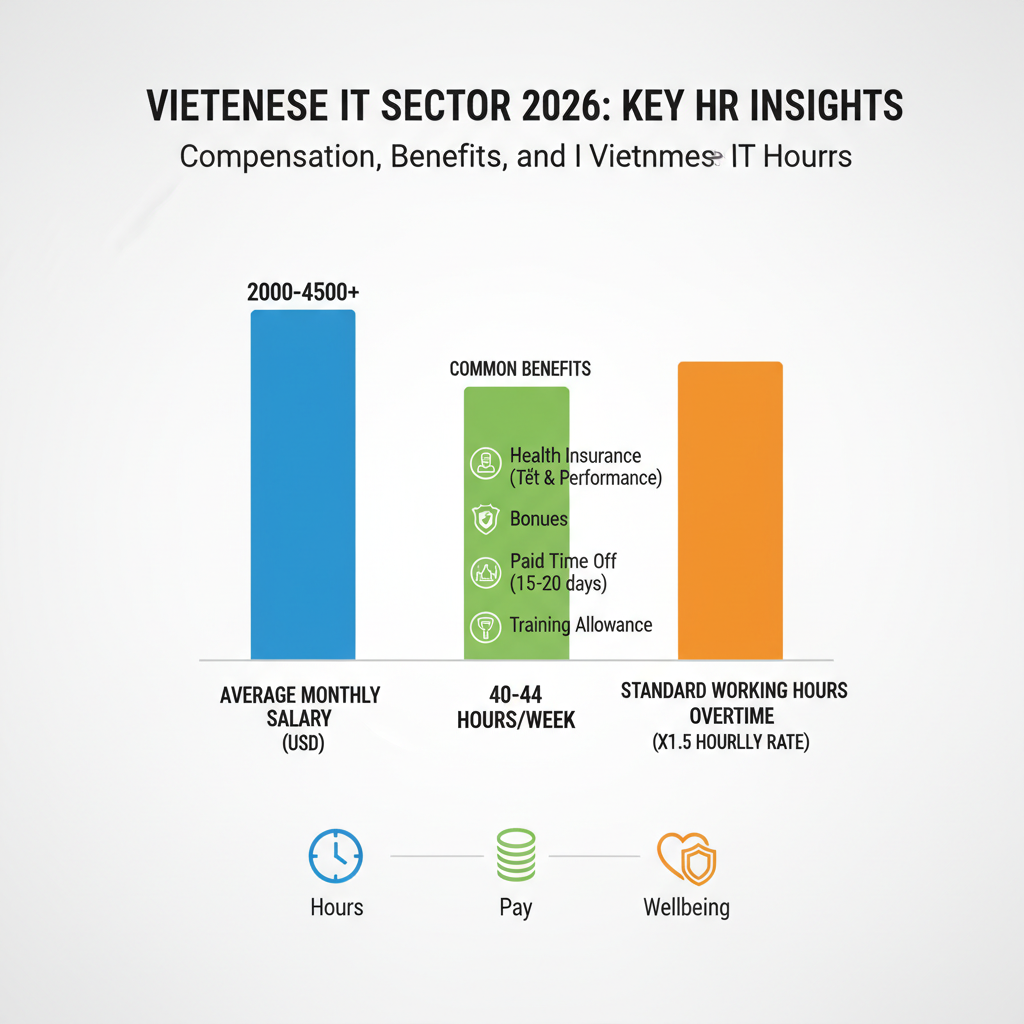
Vietnam’s labor law sets forth clear guidelines for employee compensation. While there isn’t a single national minimum wage, the government establishes regional minimum wage regulations based on four zones, which are periodically adjusted. IT companies must ensure that their base salaries, as stipulated in employment contracts, meet or exceed these regional minimums for all employees. Beyond the basic wage, the law mandates companies to develop and register internal salary scales and pay grades. These structures must be transparent and non-discriminatory, reflecting job complexity, required skills, and responsibilities. The dynamic nature of the IT sector specific rules often means that companies go beyond minimums, offering competitive base salaries to attract skilled IT professionals.
Furthermore, Vietnamese law supports the implementation of performance bonuses structure and other incentive-based pay, a common practice in the tech industry. These schemes, designed to reward employees for achieving specific targets or contributing to company success, must be clearly outlined in collective labor agreements or company regulations. While the specifics of performance metrics are left to the employer, the framework for calculating and disbursing such payments should comply with the Labor Code to avoid disputes. This flexibility allows IT firms to motivate their workforce through merit-based compensation, aligning employee performance with business objectives.
-
Mandatory Social, Health, and Unemployment Insurance Contributions
One of the most significant aspects of statutory employee benefits in Vietnam involves mandatory insurance contributions. All employees working under indefinite or definite-term employment contracts of three months or more are subject to compulsory participation in Social Insurance, Health Insurance, and Unemployment Insurance. The Vietnam Labor Code specifies the employer’s and employee’s respective contribution rates for social insurance contributions, health insurance premiums, and unemployment insurance benefits. These contributions form a vital safety net, providing employees with benefits during illness, maternity, work accidents, occupational diseases, retirement, and unemployment.
For IT companies, meticulous compliance with these regulations is not just a legal obligation but also a crucial factor in building employee trust and demonstrating responsible corporate citizenship. Failing to make accurate and timely contributions can lead to significant penalties and reputational damage. Beyond these mandatory contributions, many forward-thinking IT companies offer additional voluntary benefits, such as supplementary health insurance, life insurance, or retirement plans, to enhance their overall compensation package and further attract and retain top talent in a competitive market.
-
Overtime, Shift Schedules, and Flexible Working Arrangements for IT
The standard working hour limits in Vietnam are generally eight hours a day or 48 hours a week. However, the nature of the IT industry often necessitates flexibility. Employees may work shift schedules or have varying work patterns, especially for projects with international timelines or urgent deliverables. Vietnamese law permits overtime compensation, but it is strictly regulated. Employees can work a maximum of 300 overtime hours per year, and overtime pay rates vary: at least 150% of the normal wage on weekdays, 200% on weekends, and 300% on public holidays or paid leave days. Employers must obtain employee consent for overtime work and ensure accurate record-keeping.
The tech sector is a pioneer in implementing flexible work arrangements, including remote work and compressed workweeks, which are becoming increasingly popular. While the Labor Code Vietnam provides a framework, companies must ensure that such arrangements are clearly documented in employment contracts or internal policies, respecting core working hours, communication protocols, and monitoring mechanisms. Additionally, understanding entitlements to annual leave entitlements and public holidays observance is crucial for effective workforce planning and ensuring employee well-being. Proper management of these aspects is key to maintaining productivity and employee satisfaction within the dynamic Vietnamese IT environment.
Intellectual Property and Data Protection for IT Employees
The rapidly evolving technology landscape in Vietnam highlights the critical need for robust legal frameworks governing intellectual property (IP) and data protection, particularly for its burgeoning IT sector. For both IT businesses and their workforce, understanding these crucial legal aspects concerning intellectual property ownership, data privacy, and confidentiality agreements is not just compliance, but a strategic imperative. Navigating the complex world of Legal HR terms & conditions for IT field in vietnam requires a proactive approach to safeguard valuable assets and maintain trust.
1. IP Rights and Ownership of Employee-Created Software/Innovations
A significant area within legal HR terms & conditions for IT field in Vietnam concerns the ownership of intellectual property created by employees, such as employee-created software, algorithms, and other innovations. Under Vietnamese IP Law (Law on Intellectual Property No. 50/2005/QH11, as amended), the employer generally owns IP rights to inventions or solutions created by an employee during employment, especially if it’s within assigned tasks or using employer resources. Conversely, if an employee creates IP outside their assigned duties and without using company resources, they typically retain ownership. To prevent disputes and ensure clarity for IT businesses, meticulously drafted employment contracts and specific IP assignment agreements are crucial. These documents should explicitly define the scope of employment and clearly state that all intellectual property ownership arising from work performed, including employee-created software and innovations, belongs to the company. This proactive approach ensures the valuable output of the IT workforce directly benefits the business, fostering a secure environment for innovation.
2. Confidentiality and Non-Disclosure Agreements (NDAs) Best Practices
Protecting sensitive information is paramount for any IT business, making confidentiality agreements and Non-Disclosure Agreements (NDAs) indispensable tools. These agreements are a cornerstone of legal HR terms & conditions for IT field in Vietnam, designed to safeguard trade secrets, proprietary algorithms, client data, source code, and strategic business plans from unauthorized disclosure. Effective NDAs establish a clear legal obligation for employees and third parties to keep specified information confidential, both during and after their engagement.
Best practices for drafting and implementing NDAs include:
- Clear Definition of Confidential Information: Specify exactly what constitutes confidential information (e.g., client lists, software architecture).
- Duration of Confidentiality: Define the period during which the obligation remains active, often indefinitely for genuine trade secrets.
- Permitted Use: Outline the permissible uses of confidential information.
- Return/Destruction of Information: Mandate the return or destruction of all confidential materials upon termination.
- Remedies for Breach: Specify legal remedies available to the company.
While non-compete clauses exist, enforceability in Vietnam requires careful consideration. Focus should primarily be on robust confidentiality clauses to ensure intellectual assets and sensitive operational data of IT businesses in Vietnam remain secure, protecting their competitive edge and reputation.
3. Compliance with Data Privacy Regulations (e.g., Decree 13/2023/ND-CP)
In an era defined by data, compliance with data privacy regulations is a mandatory and complex aspect of legal HR terms & conditions for IT field in Vietnam. The most significant recent development is Decree 13/2023/ND-CP on Personal Data Protection, effective July 1, 2023. This landmark decree establishes a comprehensive legal framework for processing personal data, imposing stringent obligations on data controllers and data processors, which includes virtually all IT businesses operating in Vietnam.
Key requirements under Decree 13/2023/ND-CP include:
- Consent: Obtaining explicit consent from data subjects.
- Data Protection Impact Assessments (DPIAs): Conducting DPIAs for certain processing activities.
- Data Breach Notification: Mandatory notification to the Ministry of Public Security.
- Data Subject Rights: Granting rights such as access, correction, deletion.
- Cross-Border Data Transfers: Imposing conditions for transferring personal data out of Vietnam.
- Data Protection Officer (DPO): Requiring organizations processing large or sensitive data to appoint a DPO.
For the IT workforce, understanding and adhering to these regulations is critical. Companies must implement robust internal policies, provide regular training, and establish clear protocols for handling personal data to ensure compliance. Failure to comply can result in significant administrative fines and reputational damage. By prioritizing data protection compliance, IT businesses build trust with customers and partners. For detailed insights, refer to the official Vietnamese government decree: Decree 13/2023/ND-CP on Personal Data Protection.
Understanding and meticulously implementing these intellectual property and data protection measures are paramount for securing the future and fostering sustainable growth of IT businesses and their workforce in Vietnam.
Termination, Dispute Resolution, and Future HR Trends 2026
Navigating the complex landscape of employment in Vietnam’s rapidly evolving IT sector requires a deep understanding of legal HR terms & conditions for IT field in vietnam. As the digital economy accelerates, so do the intricacies of employment relationships, demanding proactive strategies for termination, dispute resolution, and adaptation to future regulatory shifts. This section delves into the critical aspects of ending employment relationships lawfully, resolving conflicts effectively, and anticipating the HR trends that will shape the IT industry by 2026.
1. Legally Sound Termination Procedures and Severance Entitlements
Ensuring legally sound termination procedures is paramount for IT companies operating in Vietnam to mitigate risks of litigation and reputational damage. The Vietnamese Labor Code sets forth strict guidelines for various types of termination, including mutual agreement, unilateral termination by either party, and termination during probation. For employer-initiated terminations, specific grounds such as serious disciplinary violations, business restructuring, or force majeure events must be clearly established and documented. Crucially, employers must adhere to mandated notice periods, which vary depending on the contract type and duration. Failure to follow these stipulations can lead to claims of unfair dismissal Vietnam, resulting in significant compensation and penalties.
When an employment contract is terminated, understanding severance pay Vietnam entitlements is essential. Employees are generally entitled to severance allowance if they have worked for 12 months or more, unless the termination is due to disciplinary dismissal, resignation, or the employee receiving unemployment insurance benefits. The calculation is typically half a month’s salary for each year of service. Companies must maintain meticulous records of employment contracts IT, performance reviews, and any disciplinary actions to support their decisions. Proactive compliance IT Vietnam with these regulations is not just about avoiding legal repercussions but also about fostering a fair and transparent work environment, crucial for retaining top IT workforce regulations and talent.
2. Resolving Labor Disputes: Mediation, Arbitration, and Litigation
Despite best efforts in drafting robust employment contracts IT and adhering to termination protocols, labor disputes can arise. Vietnam’s legal framework for labor dispute resolution generally follows a multi-tiered approach, prioritizing amicable settlements. The first mandatory step involves conciliation by a grassroots conciliator, which aims to resolve disputes quickly and informally. If conciliation fails or is not applicable, parties can then escalate the matter. Mediation Vietnam, though not always mandatory, is increasingly encouraged as an effective alternative dispute resolution (ADR) mechanism, offering flexibility and confidentiality that courtroom proceedings often lack. It allows both employers and employees to find mutually agreeable solutions without the adversarial nature of litigation.
For more complex or unresolved cases, the options typically move towards arbitration Vietnam or employment litigation through the labor courts. Labor arbitration councils, while less frequently utilized than conciliation or courts, offer a specialized avenue for resolution. However, the most common ultimate resort for unresolved disputes is the People’s Court. Navigating the courts requires expert legal counsel and a thorough understanding of Vietnamese labor law Vietnam. Companies should aim to resolve disputes at the earliest possible stage through conciliation or mediation to minimize costs, time, and potential damage to employee morale and company reputation. Implementing clear internal grievance procedures and fostering open communication can significantly reduce the likelihood of disputes escalating to formal legal proceedings.
3. Anticipated Regulatory Shifts and HR Best Practices for IT in 2026
Looking ahead to 2026, the HR landscape for IT companies in Vietnam is expected to undergo further transformation, driven by technological advancements and global shifts. Anticipated regulatory changes HR may focus on adapting to the future of work, particularly concerning remote work regulations and cybersecurity protocols. As more IT professionals work remotely or in hybrid models, Vietnam’s labor law Vietnam may introduce clearer guidelines on working hours, employee monitoring, and workplace safety for non-traditional work environments. Additionally, with increasing reliance on data, robust data privacy Vietnam laws, potentially mirroring international standards like GDPR, are likely to be a key focus, impacting how HR departments manage employee data and personal information.
Best practices for IT HR in 2026 will heavily involve digital HR transformation. This includes leveraging HR tech trends 2026 such as AI-powered recruitment, predictive analytics for talent management, and blockchain for secure record-keeping. Continuous skills development IT Vietnam will remain critical, as the pace of technological change demands constant upskilling and reskilling of the IT workforce regulations to stay competitive. Companies must proactively invest in learning and development programs to ensure their teams possess the advanced technical and soft skills required for emerging technologies. Furthermore, a strong emphasis on diversity, equity, and inclusion (DEI) initiatives will be crucial for attracting and retaining top talent, fostering an innovative and inclusive work culture that aligns with global best practices and strengthens compliance IT Vietnam.
Partner with Shelby Global
You are looking for reliable HR Sevice Suppliers? Contact Shelby Global Now! To connect with verified talents and upgrade your orginization.
—————————————
References
– Labor Code 2019 and its implications: https://www.vilaf.com/publications/vietnam-labor-code-2019-key-changes-and-impacts
– IP rights for employees in Vietnam: https://www.rouse.com/magazine/article/ip-rights-for-employees-in-vietnam-2/
– Labor Code of Vietnam (No. 45/2019/QH14): https://www.ilo.org/dyn/natlex/natlex4.detail?p_lang=en&p_isn=91742
– Decree 13/2023/ND-CP on Personal Data Protection: https://thuvienphapluat.vn/van-ban/Cong-nghe-thong-tin/Nghi-dinh-13-2023-ND-CP-bao-ve-du-lieu-ca-nhan-557348.aspx
– ILO – Vietnam Labor Code: https://www.ilo.org/dyn/natlex/natlex4.detail?p_lang=en&p_isn=109265